Gap-fill
A1 French gap-fill: a museum trip with one changed meeting point
Complete ten gaps in a French museum-outing plan. Track the changed meeting point, keep the museum as the destination and use the simple near future.
- A1
- 10 gaps
- Translation included
- Learn this in the A1 notebook →
In short
The message changes the meeting place while keeping the museum as the destination. Le rendez-vous is the meeting arrangement; here its place changes from the museum entrance to the kiosk. La destination is where the friends are going. They still visit the museum together.
Yellow the idea to rememberBlue French to learn
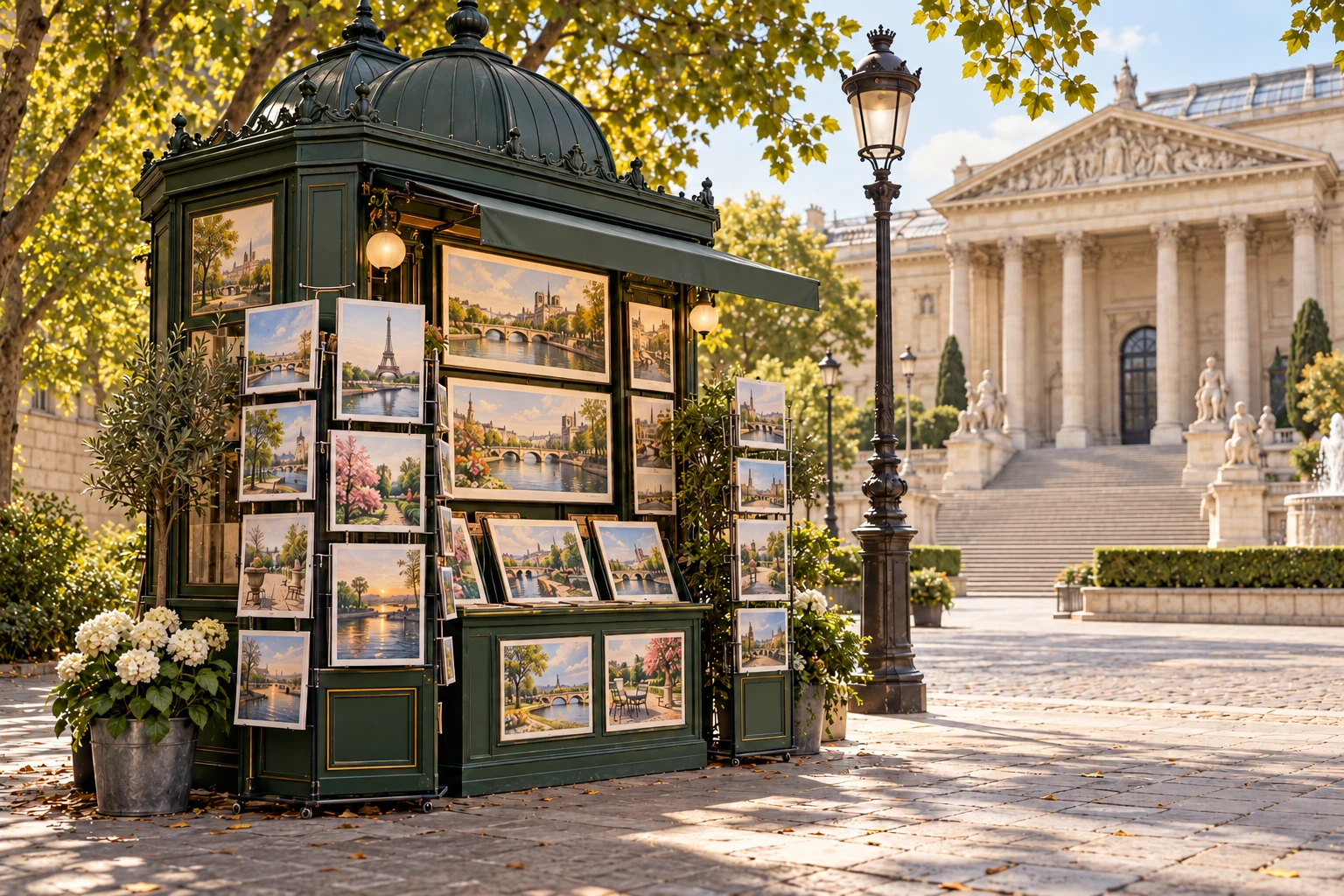
Complete the short message using each precise hint. The friends originally intended to meet at the museum entrance, but a new message names the kiosk on the square. Follow the final instruction rather than the earlier plan. Every gap has a specific word or verb form to retrieve.
Le nouveau point de rendez-vous
Salut Léa ! Demain, nous (aller, present tense with nous) visiter le musée. Le (the French noun for our meeting, including the hyphen) change, mais la (the French noun for where our outing is going) reste le musée.
On ne se retrouve plus devant l’entrée. Le nouveau rendez-vous est (in front of) le kiosque, sur la (the French noun for a town square). Je vais (to arrive, infinitive) à dix heures. Tu vas (to bring an object, infinitive) les deux billets.
(Then, the four-letter connector beginning with P), nous allons marcher ensemble jusqu’au musée. Nous allons entrer à dix heures et (the quarter in a quarter past ten). Après la visite, nous allons (to return home, infinitive) ensemble. À demain !
Read it in English
Hi Léa! Tomorrow, we are going to visit the museum. The meeting point changes, but the destination remains the museum.
We are no longer meeting in front of the entrance. The new meeting is in front of the kiosk, on the square. I’m going to arrive at ten. You’re going to bring the two tickets.
Then we are going to walk together to the museum. We are going to enter at a quarter past ten. After the visit, we are going to go home together. See you tomorrow!
Plus marks what no longer applies
On ne se retrouve plus devant l’entrée means the entrance is no longer the meeting point. It does not mean the museum is closed. The following sentence gives the new location explicitly. Reading the negative sentence together with the replacement prevents you from keeping the old instruction.
Le rendez-vous change, mais la destination reste le musée.
The meeting point changes, but the destination remains the museum.
Conjugate aller and keep the next verb unchanged
Nous allons visiter uses allons for nous and visiter as an infinitive. Je vais arriver uses vais for je and arriver as an infinitive. The person changes the aller form; the planned-action verb stays in its infinitive form.
| Detail | Final plan |
|---|---|
| Meet | Devant le kiosque, sur la place |
| Meeting time | Dix heures |
| Visit | Le musée, à dix heures et quart |
After completing the message, summarise it aloud with the final meeting place and time first. Then name the destination. That order gives your companion the information they need to find you before describing the visit itself.