Timeline
French departure preparations: put six tasks in a stated order
Follow six French departure tasks in an explicitly stated order. Read d’abord, ensuite, puis, après and enfin, then test which action comes before another.
- A1
- 6 moments
- Put-in-order game
- Learn this in the A1 notebook →
In short
Use d’abord for the first step, puis / ensuite for following steps and enfin for the last. Avant de sortir locates an action before going out. The note below supplies a complete six-step order; follow its words rather than inventing a different packing routine.
Yellow the idea to rememberBlue French to learn
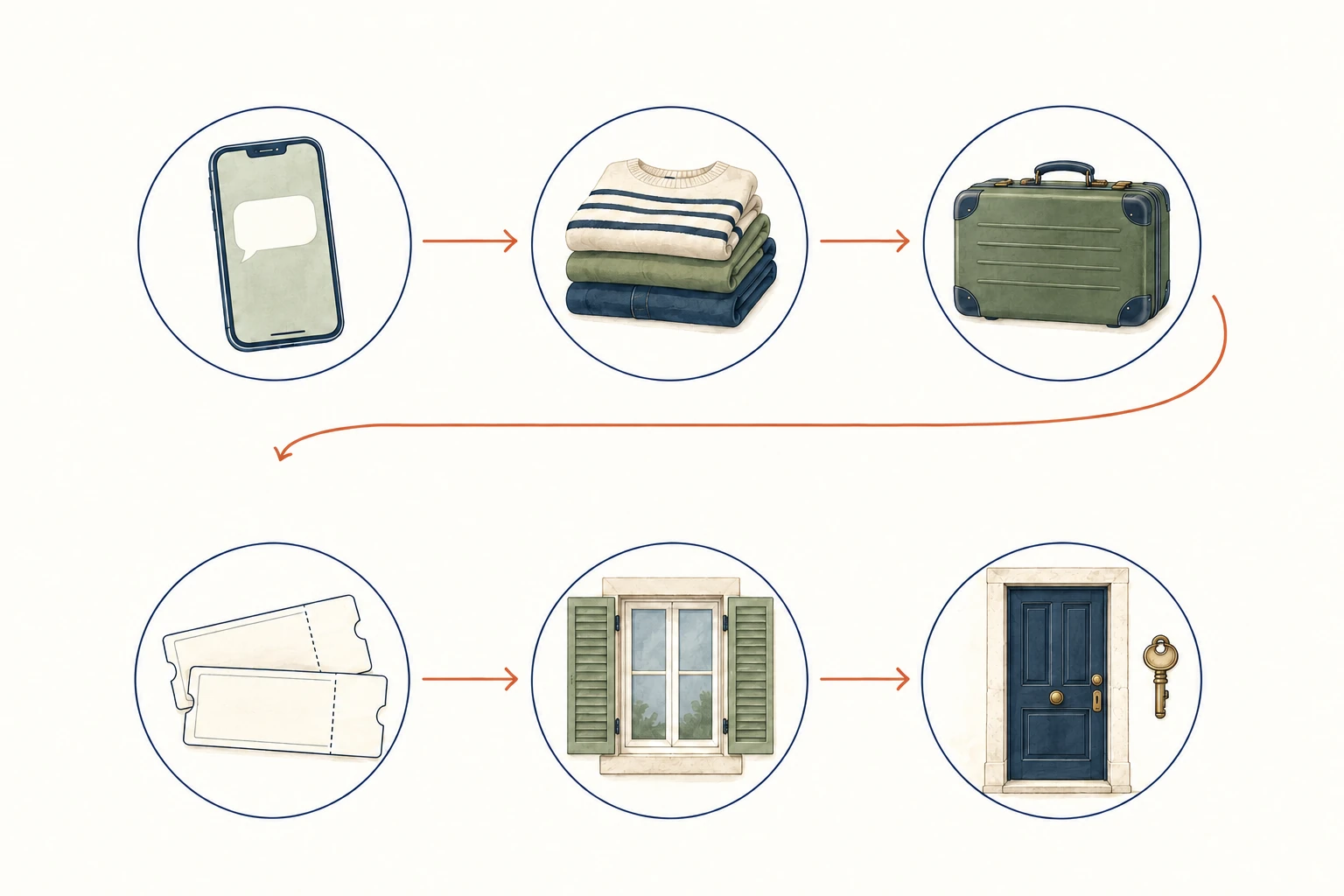
Lina writes a short preparation note before visiting Julie. The note is about the order Lina chooses for this particular departure. It does not claim that every traveller must use that order. Read the whole sequence once before answering the before-and-after questions.
Mon ordre avant le départ
D’abord, j’envoie mon heure d’arrivée à Julie. Ensuite, je prépare mes vêtements. Puis, je ferme la valise. Après, je prends mes deux billets sur la table. Avant de sortir, je ferme la fenêtre. Enfin, je sors et je ferme la porte à clé.
- 1 · D’abordJ’envoie mon heure d’arrivée à Julie.First, I send Julie my arrival time.
- 2 · EnsuiteJe prépare mes vêtements.Next, I prepare my clothes.
- 3 · PuisJe ferme la valise.Then I close the suitcase.
- 4 · AprèsJe prends mes deux billets sur la table.After that, I take my two tickets from the table.
- 5 · Avant de sortirJe ferme la fenêtre.Before going out, I close the window.
- 6 · EnfinJe sors et je ferme la porte à clé.Finally, I go out and lock the door.
Avant de is followed by an infinitive
Avant de sortir, je ferme la fenêtre.
Before going out, I close the window.
Sortir remains an infinitive after avant de. Je ferme is the main action in the sentence. The wording tells you that closing the window happens before leaving. It does not introduce a clock time; you know the relative position of the actions without knowing the minute.
Several connectors can mark the next step
Ensuite, puis and après all move the note forward here. Their position in the written sequence determines which follows which. Enfin clearly introduces the ending. Taking the two tickets occurs after the suitcase is closed and before the window is closed.
Retell the same sequence with je vais for planned actions: D’abord, je vais envoyer mon heure d’arrivée. Ensuite, je vais préparer mes vêtements. Keep the original order while changing the verbs into a future plan. That practises timing in the sentence without adding a new schedule.