Graded story

A1 French reading: the portrait has one surprising detail

Read a short French story about an unexpected detail in a painted portrait. Compare today’s shirt with an older party photo and follow the artist’s agreed change.

In short

The yellow bow tie comes from the party photograph, not Marc’s clothes today. Léa agrees to paint it out of the portrait. Marc chooses to keep the blue jacket and grey hair. Follow today’s appearance, the older photograph and the painting to understand the change.

Yellow the idea to rememberBlue French to learn

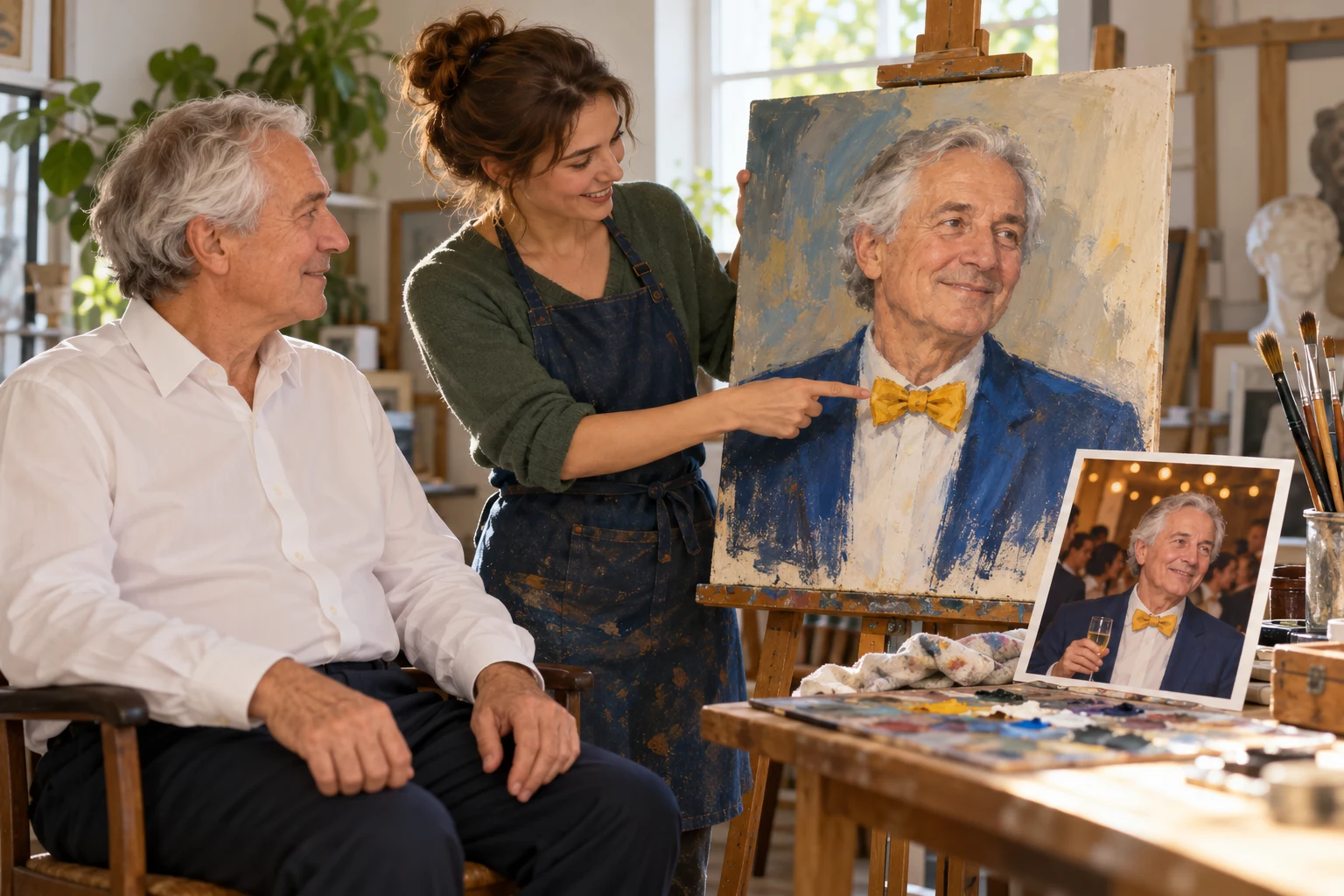
An artist points to a yellow bow tie in a painted portrait of a grey-haired man in a blue jacket. A party photo shows the same outfit; the man seated beside her wears only a white shirt.
The older photo supplies the jacket and bow tie. In the story, Marc asks to keep the jacket and remove only the bow tie from the painting. Illustration: Atelier

Read the story once for the unexpected detail. Then find the source of that detail and Marc’s choice at the end. The present tense describes the scene; va enlever and vont rester express what Léa plans to change or keep.

A1 · Appearance and an agreed change

Un petit détail en jaune

Ce samedi, Marc arrive chez Léa pour regarder son portrait1. Léa montre le tableau sur son chevalet. Marc reconnaît son visage, ses cheveux gris et sa veste bleue. « C’est bien moi ! », dit-il. Puis il regarde un petit détail sous son menton2.

Sur le tableau, il porte un nœud papillon3 jaune. Aujourd’hui, Marc porte une chemise blanche, sans veste et sans cet accessoire. « Pourquoi ce nœud papillon ? », demande-t-il. Léa montre une photo4 près de ses pinceaux. Sur cette photo de la fête du quartier, Marc porte sa veste bleue et le nœud papillon jaune.

« Je pense à cette fête quand je peins ton portrait », explique Léa. Marc sourit. Il aime la veste bleue, mais il ne veut pas le nœud papillon. Léa prend un pinceau5. Elle va enlever6 le détail jaune avec de la peinture blanche. La veste et les cheveux gris vont rester.

Marc attend à côté de la fenêtre. Léa change le petit détail, puis elle montre le portrait une nouvelle fois. « Maintenant, le tableau me plaît ! » Marc regarde aussi la photo de la fête. Il va mettre les deux images sur son bureau7, chacune dans un cadre8.

Read it in English

This Saturday, Marc comes to Léa’s home to look at his portrait. Léa shows him the painting on her easel. Marc recognises his face, his grey hair and his blue jacket. “That’s me!” he says. Then he looks at a small detail under his chin.

In the painting, he is wearing a yellow bow tie. Today, Marc is wearing a white shirt, without a jacket or that accessory. “Why this bow tie?” he asks. Léa points to a photo near her paintbrushes. In that photo of the neighbourhood party, Marc is wearing his blue jacket and the yellow bow tie.

“I think of that party when I paint your portrait,” Léa explains. Marc smiles. He likes the blue jacket, but he does not want the bow tie. Léa picks up a paintbrush. She is going to remove the yellow detail with white paint. The jacket and grey hair are going to stay.

Marc waits beside the window. Léa changes the small detail, then shows him the portrait again. “Now I like the painting!” Marc also looks at the photo of the party. He is going to put both images on his desk, each in a frame.

Which image are you reading about?

Aujourd’hui identifies Marc’s current appearance. Sur cette photo introduces the older party photograph. Sur le tableau refers to the portrait Léa is painting. Marc does not ask for every item of today’s clothing: he explicitly keeps the pictured blue jacket and asks to remove the bow tie.

Question 1No account needed
Where does the yellow bow tie in the portrait come from?

Choose one answer.

Answer and explanation

A photograph of the neighbourhood party. Léa points to the party photo, where Marc wears the yellow bow tie.

Question 2No account needed
What does Léa agree to remove?

Choose one answer.

Answer and explanation

The yellow bow tie. Elle va enlever le détail jaune states the agreed change. Marc explicitly keeps the blue jacket and grey hair.

Question 3No account needed
What will Marc put on his desk?

Choose one answer.

Answer and explanation

The portrait and the party photo. Les deux images refers to the portrait and the photo, each in a frame.

For a brief retelling, use three linked details: Sur la photo, il porte un nœud papillon. Aujourd’hui, il n’a pas cet accessoire. Léa va changer le tableau. This sequence connects the source of the detail to the agreed action.