Dialogue
Asking to join a game in French when you do not know the rules
Join a French-speaking game table politely even when you are a beginner. Follow sixteen lines asking for permission, one explanation and whose turn it is.
- A1
- 16 lines
- Practice mode
- Learn this in the A1 notebook →
In short
Open with Je peux me joindre à vous ?: may I join you? Add Je ne connais pas les règles or je débute. Ask Tu peux m’expliquer ? for help, and C’est à qui de jouer ? to find out whose turn it is.
Yellow the idea to rememberBlue French to learn
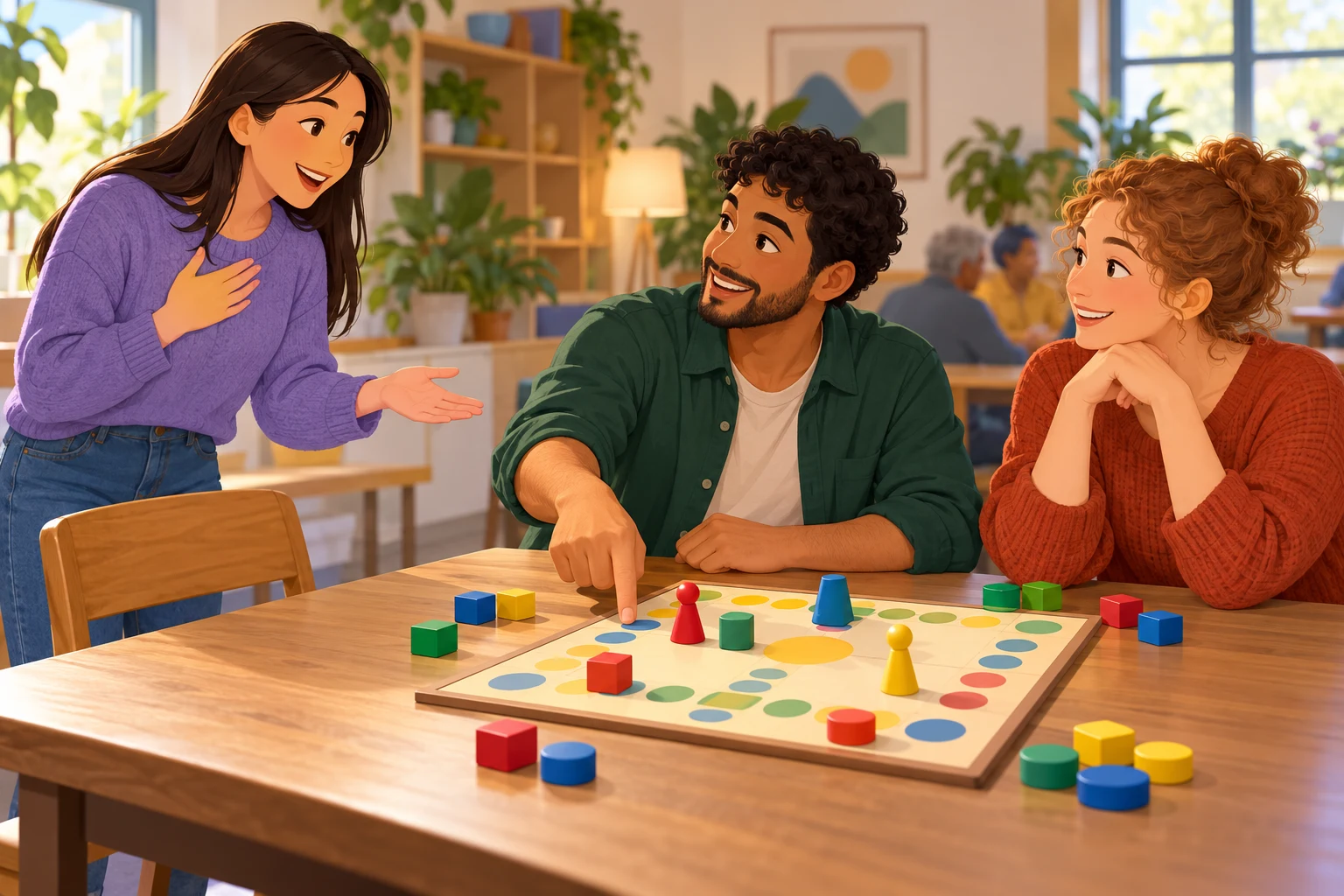
Léa approaches Maya and Sami at a games evening. Her opening vous addresses both players. Maya replies with ta and tu, and the exchange continues informally. The first instruction is to take one playing piece and place it in front of her.
- Léa
Bonsoir, je peux me joindre à vous ?
Good evening, may I join you?
English
Good evening, may I join you?
- Maya
Oui, bien sûr. Il reste une place.
English
Yes, of course. There is a place left.
- Léa
Merci. Je ne connais pas les règles.
Thank you. I don’t know the rules.
English
Thank you. I don’t know the rules.
- Maya
Pas de problème, c’est ta première partie ?
English
No problem, is this your first game?
- Léa
Oui, je débute.
Yes, I’m a beginner.
English
Yes, I’m a beginner.
- Maya
D’accord. On fait un premier tour pour apprendre.
English
All right. We’ll do a first round to learn.
- Léa
Tu peux m’expliquer ce qu’il faut faire ?
Can you explain what to do?
English
Can you explain what to do?
- Maya
Oui. Pour ce tour, tu prends un pion et tu le poses devant toi.
English
Yes. For this round, you take a playing piece and put it in front of you.
- Léa
Un seul pion ?
Just one playing piece?
English
Just one playing piece?
- Maya
Oui, un seul. Ensuite, c’est au tour de Sami.
English
Yes, just one. Then it is Sami’s turn.
- Léa
D’accord. Et maintenant, c’est à qui de jouer ?
All right. And whose turn is it now?
English
All right. And whose turn is it now?
- Maya
C’est à toi.
English
It’s your turn.
- Léa
Alors, je prends ce pion et je le pose ici.
So I take this piece and put it here.
English
So I take this piece and put it here.
- Maya
Oui, c’est ça. À toi, Sami !
English
Yes, that’s right. Your turn, Sami!
- Sami
Merci. Je prends un pion.
English
Thank you. I take a playing piece.
- Léa
Je comprends mieux maintenant. Merci pour l’explication.
I understand better now. Thank you for the explanation.
English
I understand better now. Thank you for the explanation.
Ask to join before asking for an explanation
Je peux me joindre à vous ? checks whether there is space and whether the group welcomes another player. Je débute then explains your experience level. You do not need a long account of everything you cannot do. One clear statement gives the other players a reason to demonstrate the first round slowly.
| French | Purpose |
|---|---|
| Je peux me joindre à vous ? | Ask to join the group. |
| Je ne connais pas les règles. | Explain the knowledge gap. |
| Tu peux m’expliquer ce qu’il faut faire ? | Ask for the next action. |
| C’est à qui de jouer ? | Ask whose turn it is. |
C’est à toi marks your turn
À toi means your turn in this context. C’est au tour de Sami names the next player with au tour de. Keep the person separate from the action: Maya tells Léa to take one playing piece, and then identifies Sami as next. Léa confirms the instruction by saying what she is doing.
C’est à moi de jouer ?
Is it my turn to play?
If the group keeps vous for each person, use Vous pouvez m’expliquer ? instead of Tu peux m’expliquer ? The information you need stays the same: permission to join, the next action and the current turn. A short confirmation such as Un seul pion ? checks the one detail that matters now.