Gap-fill
French A2 object-pronoun gap-fill: borrowing a neighbour’s ladder
Fill twelve object-pronoun gaps as a ladder goes from Karim to his neighbour and back. Includes picture vocabulary, a full translation and three questions.
- A2
- 12 gaps
- Translation included
- Learn this in the A2 notebook →
In short
Use la for l’échelle because ‘ladder’ is feminine. Use lui when the action is addressed à Karim: je lui demande, je lui téléphone. In the story, me refers to the narrator, le to Karim and les to the ladder’s two feet.
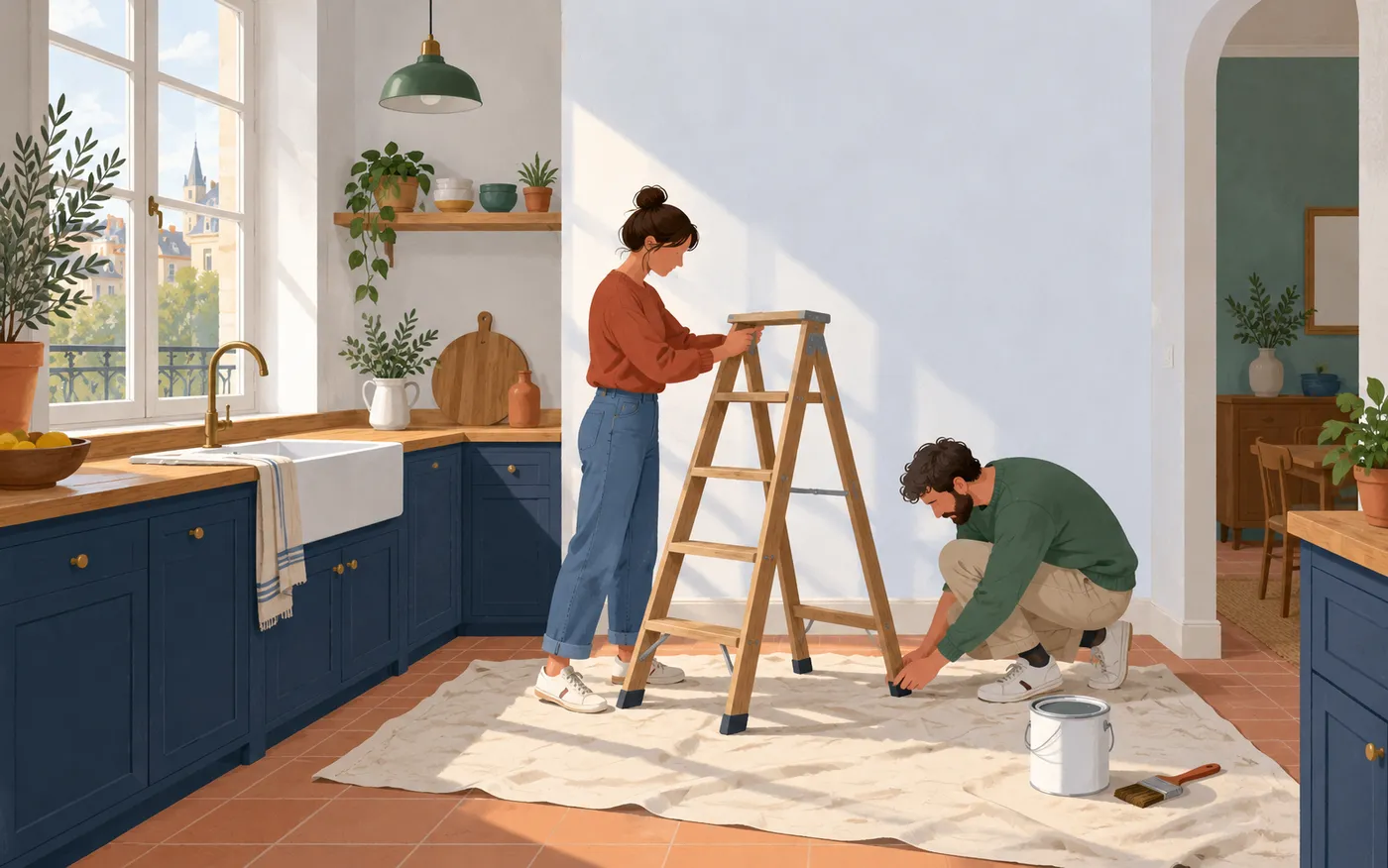
Four objects in the story
Find:
| Reference | Pronoun | Pattern |
|---|---|---|
| une chose féminine | la | Je la garde. |
| un homme | le | Je le connais. |
| plusieurs choses | les | Je les regarde. |
| à une personne | lui | Je lui réponds. |
| à moi | me | Il me répond. |
Write one pronoun in each of the twelve gaps. The hint names the person or object it replaces. Keep asking whether the verb takes a direct object or à + a person: remercier Karim gives le; téléphoner à Karim gives lui. Before an infinitive, put the pronoun with that infinitive: je vais la rendre.
L’échelle de Karim
Samedi matin, je veux peindre le haut du mur de ma cuisine. J’ai un pinceau et un pot de peinture, mais mon échelle est trop petite. Mon voisin Karim possède une grande échelle. Je (à Karim) demande si je peux l’emprunter pour la journée. Il (à moi) répond : « Oui, bien sûr ! » Nous nous retrouvons devant sa porte à neuf heures.
Karim apporte son échelle. Je (l’échelle) prends avec lui et nous entrons dans ma cuisine. Il (à moi) montre comment l’installer. Ensuite, il vérifie les deux pieds de l’échelle : il (les deux pieds) regarde attentivement. Tout est prêt. Je (Karim) remercie avant de commencer. Il rentre chez lui, et je commence à peindre.
À midi, le travail avance bien, mais je dois encore attendre que la peinture sèche. Est-ce que je peux (l’échelle) garder jusqu’à dix-sept heures ? Je (à Karim) téléphone pour poser la question. Il (à moi) dit qu’il n’en a pas besoin cet après-midi. Je peux donc finir tranquillement.
Vers seize heures, le mur est terminé. Il y a une petite trace de peinture sur l’échelle. Je (l’échelle) nettoie avec un chiffon humide. Ensuite, je vais (l’échelle) rendre à Karim. Il est content de retrouver son matériel propre. Je (à Karim) propose un café pour le remercier. Nous regardons le mur ensemble : la cuisine est beaucoup plus claire !
Read it in English
On Saturday morning, I want to paint the top of my kitchen wall. I have a paintbrush and a tin of paint, but my ladder is too small. My neighbour Karim owns a large ladder. I ask him whether I can borrow it for the day. He replies to me, ‘Yes, of course!’ We meet outside his door at nine o’clock.
Karim brings his ladder. I take it with him and we go into my kitchen. He shows me how to set it up. Then he checks the ladder’s two feet: he looks at them carefully. Everything is ready. I thank him before starting. He goes home, and I start painting.
At midday, the work is going well, but I still have to wait for the paint to dry. Can I keep it until five o’clock? I phone him to ask the question. He tells me that he does not need it this afternoon. So I can finish at my own pace.
Around four o’clock, the wall is finished. There is a small mark of paint on the ladder. I clean it with a damp cloth. Then I go to return it to Karim. He is pleased to get his equipment back clean. I offer him a coffee to thank him. We look at the wall together: the kitchen is much brighter!