Verb drill
French comparative drill: rewrite facts with plus and moins
Use size, price and speed data to write paired plus and moins comparisons. Reverse the subjects while keeping the same relationship and adjective agreement.
- A2
- 12 answers
- Checked all at once
- Accents count
- Learn this in the A2 notebook →
In short
Reverse the subjects and switch plus to moins to keep the same comparison: A est plus long que B → B est moins long que A. Keep the adjective’s meaning and agree it with the new subject.
Yellow the idea to rememberBlue French to learn
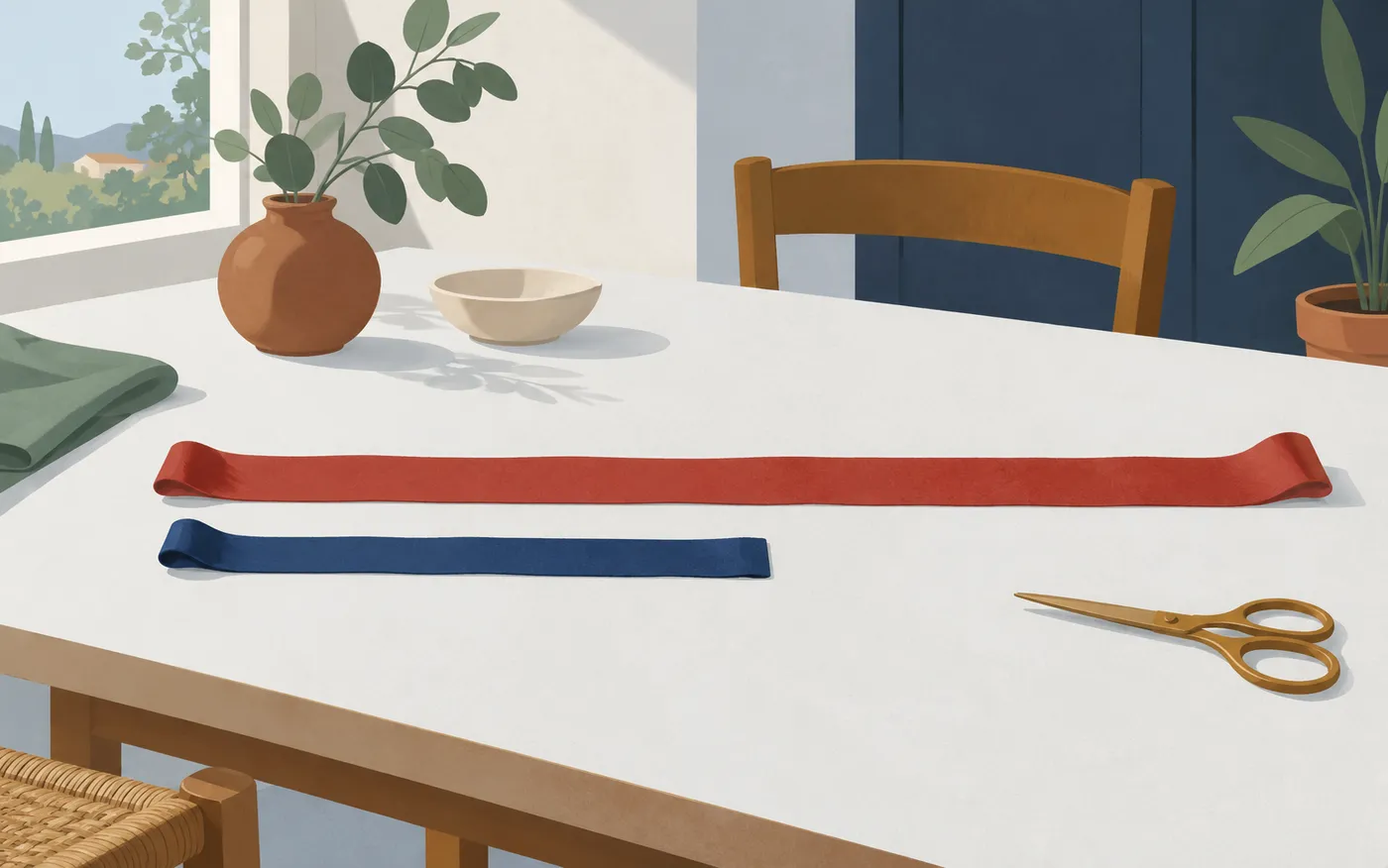
Le ruban rouge mesure trois mètres. Le ruban bleu mesure un mètre. Le ruban rouge est plus long que le ruban bleu. Le ruban bleu est moins long que le ruban rouge.
The red ribbon measures three metres. The blue ribbon measures one metre. The red ribbon is longer than the blue ribbon. The blue ribbon is less long than the red ribbon.
The viewpoint changes; the longer ribbon stays the red one.
| First viewpoint | Same fact, reversed |
|---|---|
| Le bureau est plus long que la table. | La table est moins longue que le bureau. |
| La chaise est plus chère que le tabouret. | Le tabouret est moins cher que la chaise. |
| Le vélo est plus rapide que la trottinette. | La trottinette est moins rapide que le vélo. |
Six things to compare
Find:
| Pair | Measure | First item | Second item |
|---|---|---|---|
| 1 | length | le bureau : 180 cm | la table : 120 cm |
| 2 | height | l’armoire : 200 cm | l’étagère : 150 cm |
| 3 | price | la lampe rouge : 40 € | la lampe bleue : 20 € |
| 4 | price | le sac noir : 80 € | le sac beige : 50 € |
| 5 | speed | le train : 90 km/h | le car : 60 km/h |
| 6 | speed | la voiture bleue : 80 km/h | la voiture rouge : 50 km/h |
Use the data exactly as shown. Write full comparisons with être in the present and que before the second item. For height, use haut; for length, long; for price, cher; for speed, rapide. Each pair has two answers: first a plus sentence, then a reversed moins sentence. Keep each colour with its original object so the comparison stays precise.
1 · From the larger number: use plus
- 1 · Start with Le bureau → (length · long)
- 2 · Start with L’armoire → (height · haut)
- 3 · Start with La lampe rouge → (price · cher)
- 4 · Start with Le sac noir → (price · cher)
- 5 · Start with Le train → (speed · rapide)
- 6 · Start with La voiture bleue → (speed · rapide)
2 · Same facts from the other side: use moins
- 1 · Start with La table → (agree long with la table)
- 2 · Start with L’étagère → (agree haut with l’étagère)
- 3 · Start with La lampe bleue → (the 20-euro lamp)
- 4 · Start with Le sac beige → (the 50-euro bag)
- 5 · Start with Le car → (the vehicle at 60 km/h)
- 6 · Start with La voiture rouge → (the car at 50 km/h)