Matching game
French economic trends: ralentissement is not a fall
Distinguish a French economic level from its rate of change, matching hausse, baisse, ralentissement de la hausse, stabilisation and reprise to small trajectories.
- C1
- 5 pairs
- Tap to match
- Learn this in the C1 notebook →
In short
Un ralentissement de la hausse means the increase is becoming slower; the level may still rise. In 100 → 110 → 116 → 119, every value is higher than the previous one, but the gains shrink. A fall would require a lower value.
Yellow the idea to rememberBlue French to learn
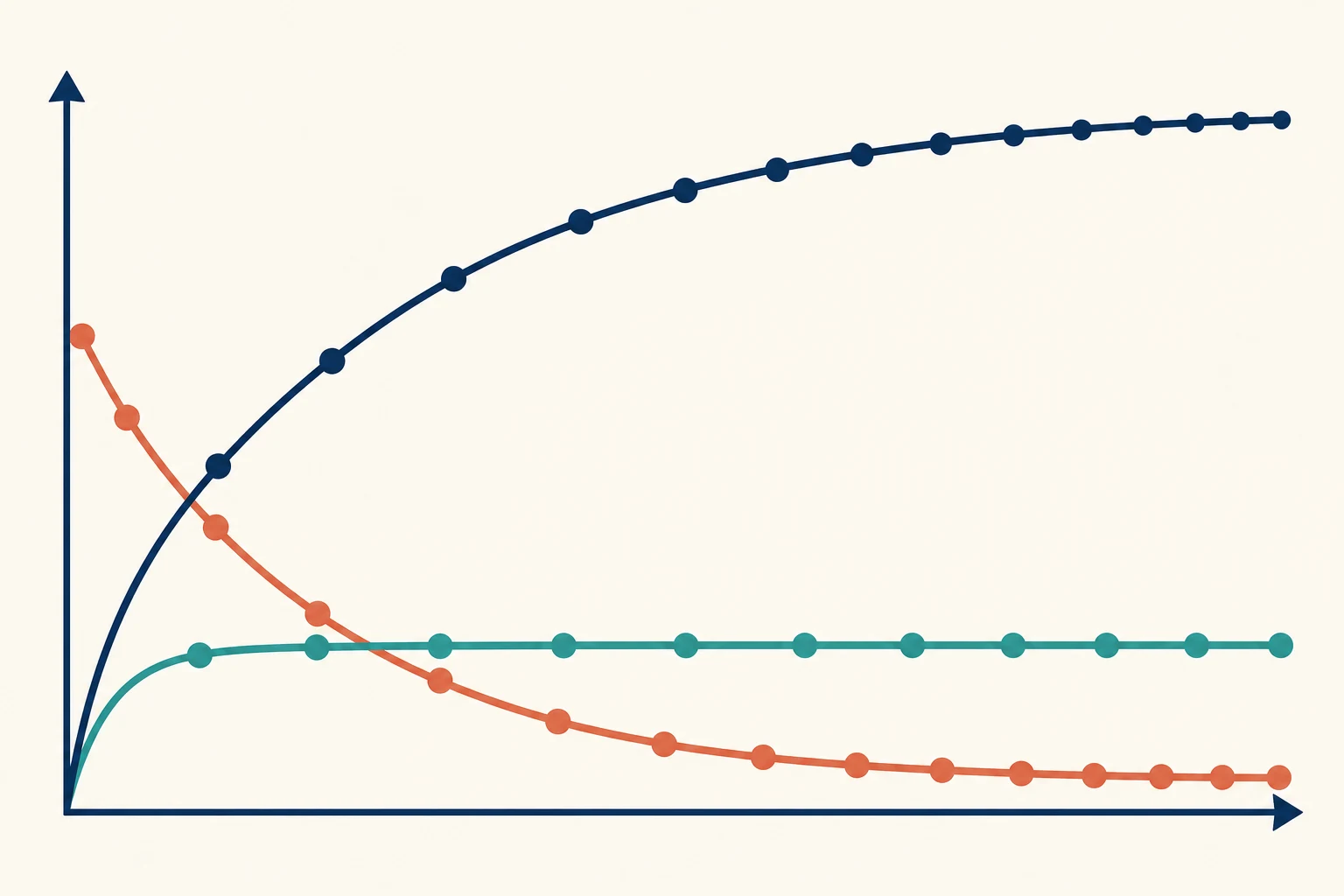
Read two things separately: the direction of the level and the size of the change. A writer can correctly describe a rise and a slowdown in the same period if the rise continues with smaller increments. The small sequences below use an arbitrary teaching indicator, measured at equally spaced dates.
| Values in order | Reading |
|---|---|
| 100 → 110 → 116 → 119 | The level rises; gains fall from 10 to 6 to 3. |
| 100 → 94 → 89 | The level falls at both steps. |
| 100 → 100 → 100 | The level is stable. |
| 100 → 90 → 95 | A recovery follows a fall, while the final level remains below 100. |
| 100 → 104 → 112 | The level rises and the latest gain is larger. |
Tap one on the left, then its partner on the right.
Recovery is not necessarily a return to the starting point
In the recovery example, the last value is five units above the preceding low but five units below the initial level. Both comparisons can be true. Name the comparison when summarising: une reprise par rapport à la période précédente, sans retour au niveau initial. Avoid writing tout est revenu à la normale when no normal range is defined.
La hausse se poursuit, mais elle ralentit : le gain passe de six à trois unités.
The increase continues, but slows: the gain drops from six to three units.
A complete summary names the indicator, the period and the relevant reference. These examples isolate the language distinction; they do not explain causes or predict a future movement.