Dialogue
French near-future dialogue: the weather changes the picnic plan
Follow a sixteen-line French conversation as rain changes a picnic plan. Practise aller + infinitive and separate an agreed lunch from a cinema suggestion.
- A1
- 16 lines
- Practice mode
- Learn this in the A1 notebook →
In short
Use On va changer de plan to announce a change and Je préfère… to offer an alternative. On peut… suggests an option. In this dialogue, lunch at Nora’s home is agreed; the film remains to be chosen, and Nora has no cinema tickets yet.
Yellow the idea to rememberBlue French to learn
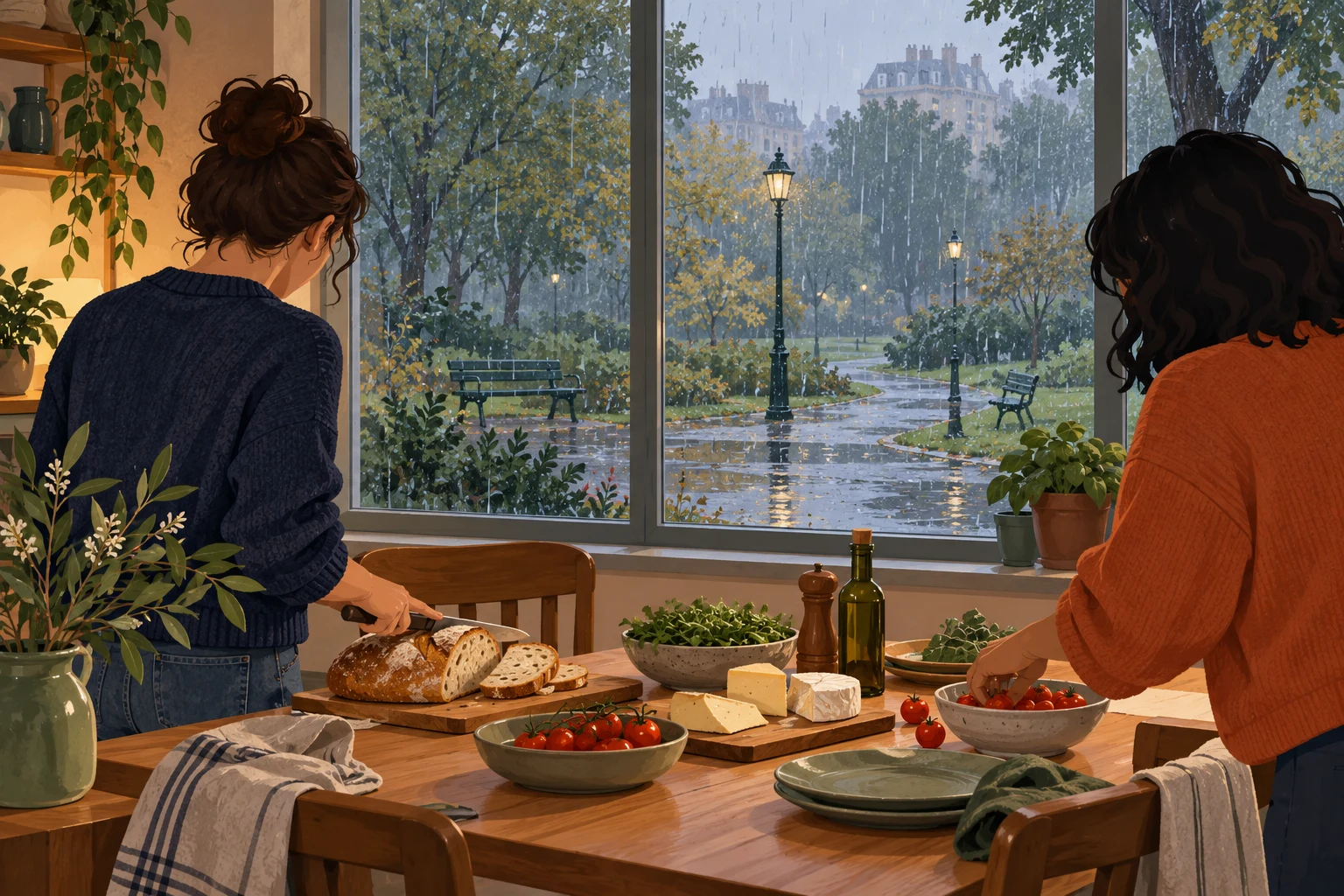
Nora and Léo first plan to eat outdoors. The rain makes them reconsider the place. Notice how they settle lunch before deciding whether to go out afterwards. Each future expression has a role: a suggestion, an intention or an arrangement they both accept.
- Nora
On va pique-niquer au parc à midi ?
English
Shall we have a picnic in the park at noon?
- Léo
Il pleut beaucoup. On va manger dehors ?
It’s raining a lot. Are we going to eat outside?
English
It’s raining a lot. Are we going to eat outside?
- Nora
Tu as raison. On va changer de plan.
English
You’re right. We’re going to change the plan.
- Léo
On peut aller au café près de la gare.
We can go to the café near the station.
English
We can go to the café near the station.
- Nora
Je préfère manger chez moi. J’ai du pain et du fromage.
English
I’d rather eat at my place. I have bread and cheese.
- Léo
D’accord. Je vais apporter des tomates.
All right. I’m going to bring tomatoes.
English
All right. I’m going to bring tomatoes.
- Nora
Très bien. Tu vas venir à quelle heure ?
English
Very good. What time are you going to come?
- Léo
Vers midi et quart. Ça te va ?
Around a quarter past twelve. Does that work for you?
English
Around a quarter past twelve. Does that work for you?
- Nora
Oui. On va manger dans la cuisine.
English
Yes. We’re going to eat in the kitchen.
- Léo
Et après, on va faire quoi ?
And afterwards, what are we going to do?
English
And afterwards, what are we going to do?
- Nora
On peut voir un film au cinéma.
English
We could see a film at the cinema.
- Léo
Bonne idée. Tu as déjà les billets ?
Good idea. Do you already have tickets?
English
Good idea. Do you already have tickets?
- Nora
Non, je vais regarder les séances.
English
No, I’m going to look at the showtimes.
- Léo
Alors, on choisit le film après le repas.
Then let’s choose the film after the meal.
English
Then let’s choose the film after the meal.
- Nora
D’accord. Pour le moment, on garde le déjeuner chez moi.
English
All right. For now, we’ll keep lunch at my place.
- Léo
Parfait. À tout à l’heure !
Perfect. See you soon!
English
Perfect. See you soon!
What is settled by the end?
| Detail | Status at the end | French evidence |
|---|---|---|
| Lunch in the park | Replaced | On va changer de plan. |
| Lunch at Nora’s home | Agreed | On garde le déjeuner chez moi. |
| Arrival around 12:15 | Accepted | Vers midi et quart. / Oui. |
| Cinema afterwards | Suggested; film still to choose | On peut voir un film. |
| Cinema tickets | Not yet held | Tu as déjà les billets ? / Non. |
The near future uses a present form of aller followed by an infinitive: je vais apporter, tu vas venir, on va manger. The infinitive gives the planned action. On here refers to Nora and Léo together and takes the same aller form as il or elle: va.
Je vais apporter des tomates.
I’m going to bring tomatoes.
To practise, change one detail at a time: the weather, the place or the arrival time. Keep the final decision explicit with D’accord or On garde…. A sentence about looking at showtimes expresses the next action; it does not by itself confirm a booking.