Gap-fill
La mie or l’amie? Find French word boundaries in context
Complete a short French scene with la mie, l’amie, la pelle and l’appel. Use the sentence to choose between phrases that share a pronunciation.
- B1
- 6 gaps
- Translation included
- Learn this in the B1 notebook →
In short
French speech runs across written spaces. La mie (the soft inside of bread) and l’amie (the female friend) can both sound /lami/. La pelle (the shovel) and l’appel (the call) share /lapɛl/. The sentence tells you which words fit.
Yellow the idea to rememberBlue French to learnRed watch out
| Sound | First reading | Second reading |
|---|---|---|
| /lami/ | la mie — the soft inside of bread | l’amie — the female friend |
| /lapɛl/ | la pelle — the shovel | l’appel — the call |
The apostrophe marks elision in writing: the article la becomes l’ before amie. It adds no sound or pause. Likewise, a syllable can cross a written space. La pelle and l’appel can both divide into spoken syllables [la.pɛl], even though their written words divide differently.
Four concrete words in the scene
Find:
A loaf, a friend and a ringing phone
Choose the whole phrase for each gap, including the article. The English hint identifies the meaning. Both apostrophe styles are accepted in the two elided phrases.
Avant le déjeuner
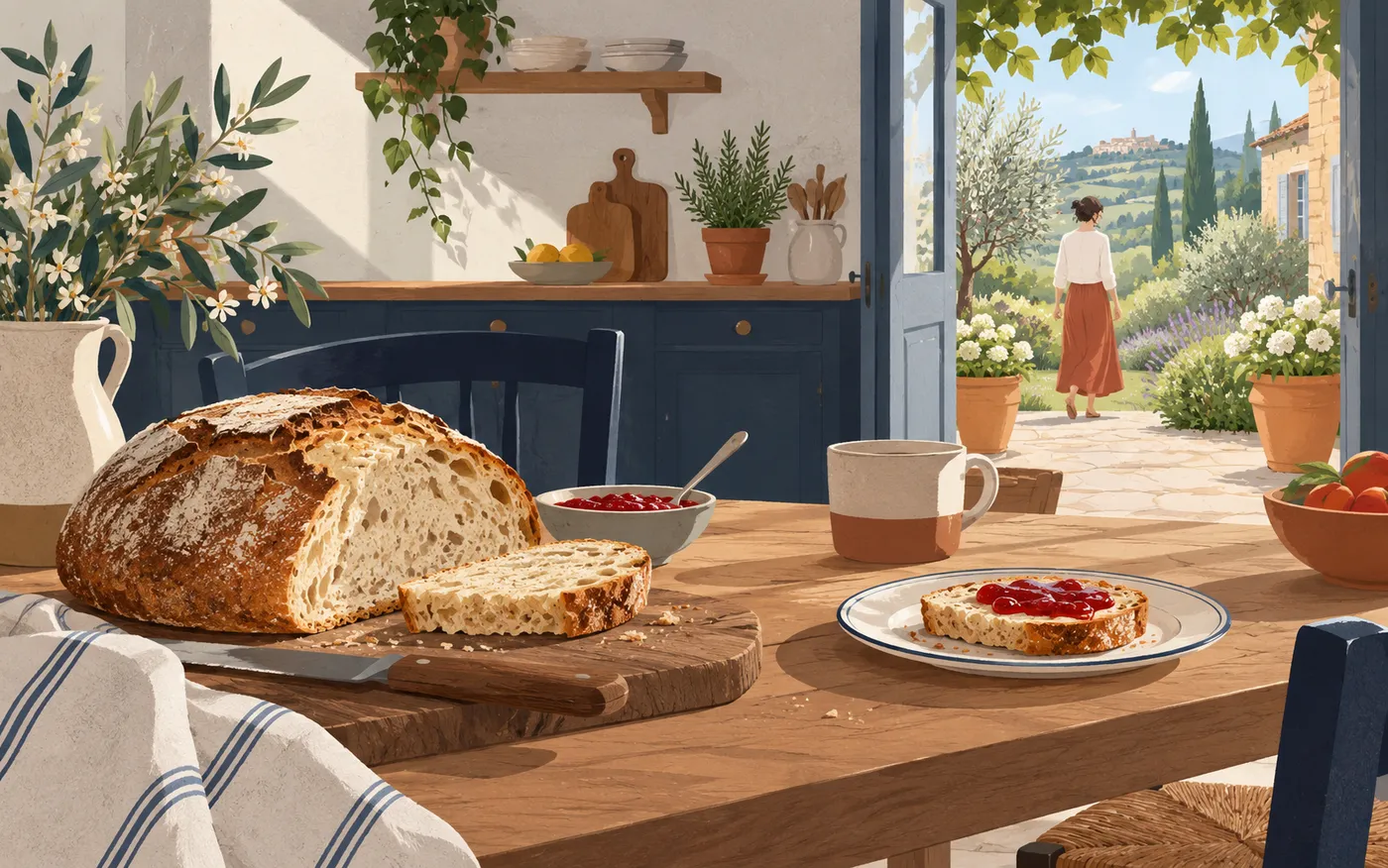
Léa prépare le déjeuner. Elle coupe un pain encore tiède. (the soft inside of bread) est très moelleuse. Elle en garde un morceau pour sa voisine.
(the female friend) de Léa arrive avec une tarte. Elle s’appelle Nora. « Tu peux poser la tarte ici », dit Léa. Puis le téléphone sonne. C’est Paul. (the call) dure deux minutes : Paul demande à emprunter un outil.
Nora regarde dans le jardin. (the shovel) est contre le mur, à côté des pots. Elle la prend pour Paul. Quand il arrive, il demande : « Où est (the shovel) ? » Nora lui montre l’outil. Léa retourne à la cuisine : (the soft inside of bread) est déjà couverte de confiture.
Read it in English
Léa is preparing lunch. She cuts some bread that is still warm. The inside is very soft and springy. She saves a piece for her neighbour.
Léa’s friend arrives with a tart. Her name is Nora. “You can put the tart here,” says Léa. Then the phone rings. It is Paul. The call lasts two minutes: Paul asks to borrow a tool.
Nora looks in the garden. The shovel is against the wall, next to the pots. She picks it up for Paul. When he arrives, he asks, “Where’s the shovel?” Nora shows him the tool. Léa returns to the kitchen: the soft bread is already covered with jam.
How do you hear where French words begin and end?
Les amis arrivent.
The friends are arriving.
The /z/ in les amis comes from liaison after les. The noun remains amis, starting with a vowel.
Compare un ami and les amis. The article changes, and the linking consonant changes with it. Keep the noun’s spelling in view. If you need to check a phrase in conversation, ask Tu parles de la personne ou du pain ? The extra context makes the intended meaning clear.