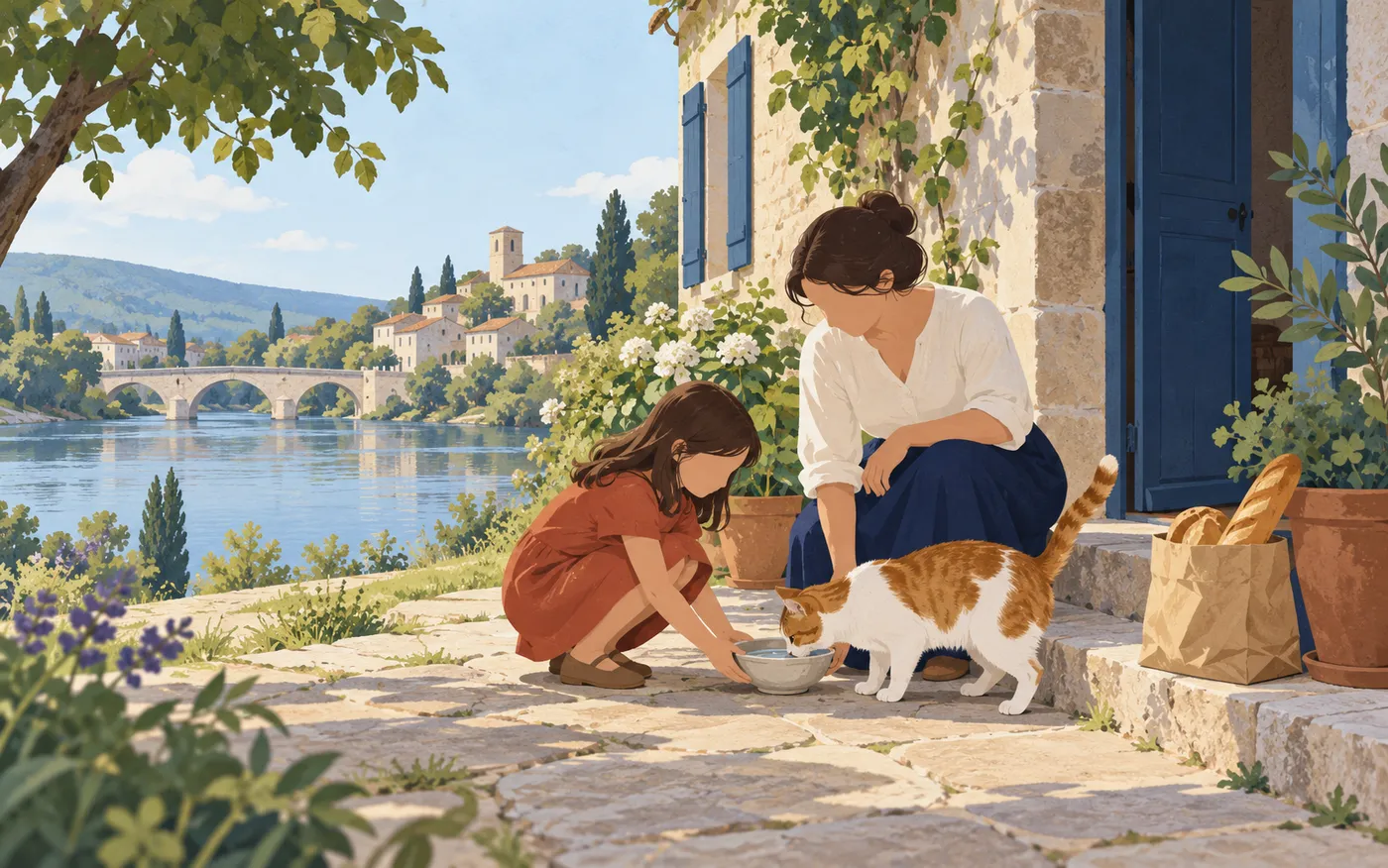
Start with one place and something you used to do there. Use the imparfait for that remembered setting and routine; add the passé composé if you want to tell one particular event.
Yellow the idea to rememberBlue French to learn
The memory turns on un jour, nous avons trouvé un chat. Illustration: Atelier
Choose a detail you can see
Find:
Study first: turn a planning note into a sentence
Planning note
French sentence
What it does
Age
Quand j’avais huit ans…
Sets the remembered period.
Place
Je passais les vacances chez ma tante.
Introduces a recurring situation.
Routine
Elle me racontait des histoires.
Shows a familiar activity.
One occasion
Un jour, nous avons trouvé un chat.
Introduces one completed event.
Now
Je me souviens encore de cette matinée.
Connects the memory with the present.
In the model, a woman remembers holidays at her aunt’s house. That explains petite. The details all belong to the same memory: the house, the morning walk and the cat. Your own paragraph can stay with a quiet routine if that is what you want to remember.
A2 · Guided writing · a childhood memoryNot an official exam paper
Racontez un souvenir d’enfance. Présentez le lieu et les personnes, décrivez une habitude et ajoutez un détail précis. Vous pouvez aussi raconter un événement particulier.
(60 mots minimum)
Tell a childhood memory. Introduce the place and people, describe a habit and add one precise detail. You can also include a particular event.
Your answer
Nothing you write is saved or sent. Copy it before you leave.
Read a model answer
Quand j’étais petite, je passais les vacances chez ma tante. Sa maison était près d’une rivière. Le matin, nous allions chercher du pain et elle me racontait des histoires. J’aimais beaucoup ces promenades parce que nous avions le temps de parler. Un jour, nous avons trouvé un chat devant la porte. Nous lui avons donné un peu d’eau. Il est resté avec nous toute la matinée. Je me souviens encore de son petit nez rose.
Review your draft
How do you write a childhood memory in French?
Nous allons → nous allions ; elle raconte → elle racontait.
We go → we used to go; she tells → she used to tell.
Build the imparfait from the present nous stem. être has the special stem ét-: j’étais.
English “would” can describe a childhood habit: “she would tell me stories” becomes elle me racontait des histoires. Here it is a remembered routine, so use the imparfait.