Impasse on a French street sign: does the road go through?
Understand impasse and rue sans issue in French street directions. Follow an original route sketch to distinguish a dead-end street from the road to the square.
In short
In its ordinary street sense, une impasse is a dead-end street, a voie sans issue. On this original plan, the impasse ends at houses, while the adjacent Rue des Érables continues to the square. The street word alone does not establish every possible pedestrian passage; use any separately shown access information.
Yellow the idea to rememberBlue French to learn
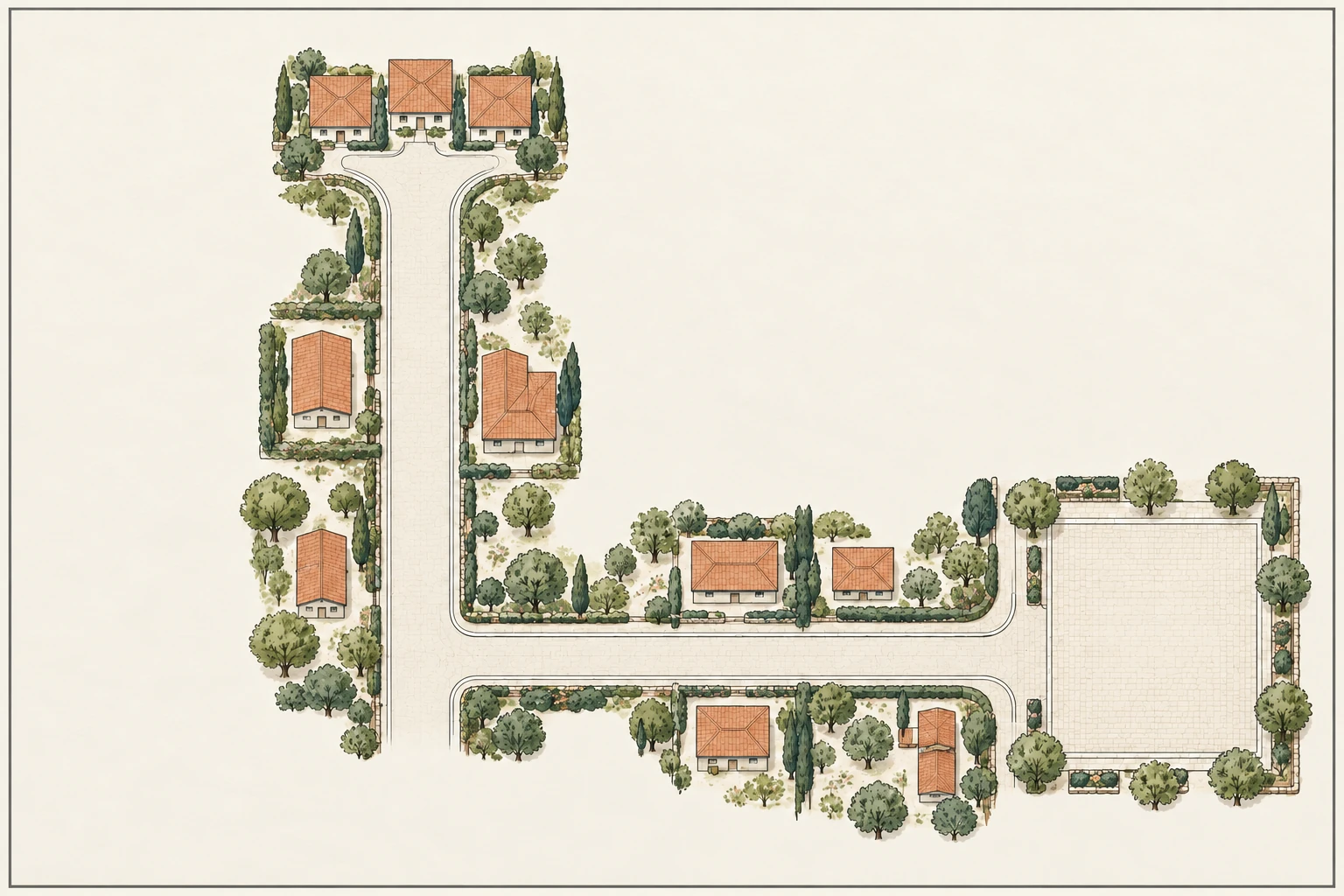
A learner heading toward a square sees Impasse des Amandiers and assumes it is a shortcut. The word impasse signals that the street itself does not continue through. The supplied sketch makes the practical contrast explicit: one branch stops at houses and the other continues to the destination.
At the junction
For this activity, Maya stands at the junction near the bottom left of the sketch, facing toward the top. Call the branch ahead Impasse des Amandiers: it ends at three houses. Call the branch to her right Rue des Érables: it leads to the square. The names are supplied here; the drawing has no printed labels. Her friend says Prends la rue des Érables.
Deux rues depuis le même départ
Branche devant Maya
NomImpasse des Amandiers
Fin dessinéeMaisons au bout de la rue
Autre passage montréAucun
Branche à droite de Maya
NomRue des Érables
Suite dessinéeLa rue continue jusqu’à la place
Impasse describes the street’s lack of a through continuation
The ordinary street meaning is a cul-de-sac or road without an outlet. Rue sans issue gives the same basic idea in a longer phrase. Entrée interdite means no entry: it tells you whether entry is allowed, rather than describing where the street ends.
Une impasse / une rue sans issueA dead-end street
Focus: The street does not continue through in the ordinary road sense.
L’impasse se termine devant les maisons.
The dead-end street ends in front of the houses.
La rue continue jusqu’à la place.The street continues to the square.
Focus: This supplied route has a visible continuation to the destination.
Prends la rue des Érables jusqu’à la place.
Take Rue des Érables as far as the square.
Two instructions for the shown layout
Tourne à droite dans la rue des Érables.
Turn right into Rue des Érables.
L’impasse des Amandiers se termine devant les maisons.
Impasse des Amandiers ends in front of the houses.
When asking for help, name both the destination and the street: Pour aller à la place, je prends la rue des Érables ? That lets the other person confirm the route you mean. A familiar street name is useful only when its actual continuation matches the journey.