Scale
Je me souviens, il me semble, j'imagine: French memory commitments
Compare five French statements about the same remembered door, from explicit imagination to a vivid memory claim, without treating confidence as proof.
- B2
- 5 steps
- Imagined reconstruction → Explicit, subjectively vivid recollection
- Learn this in the B2 notebook →
In short
J’imagine can present reconstruction; il me semble an impression; je me souviens an explicit memory claim. The complete sentence matters. A vivid recollection describes subjective clarity, not independent proof that every detail is accurate.
Yellow the idea to rememberBlue French to learn
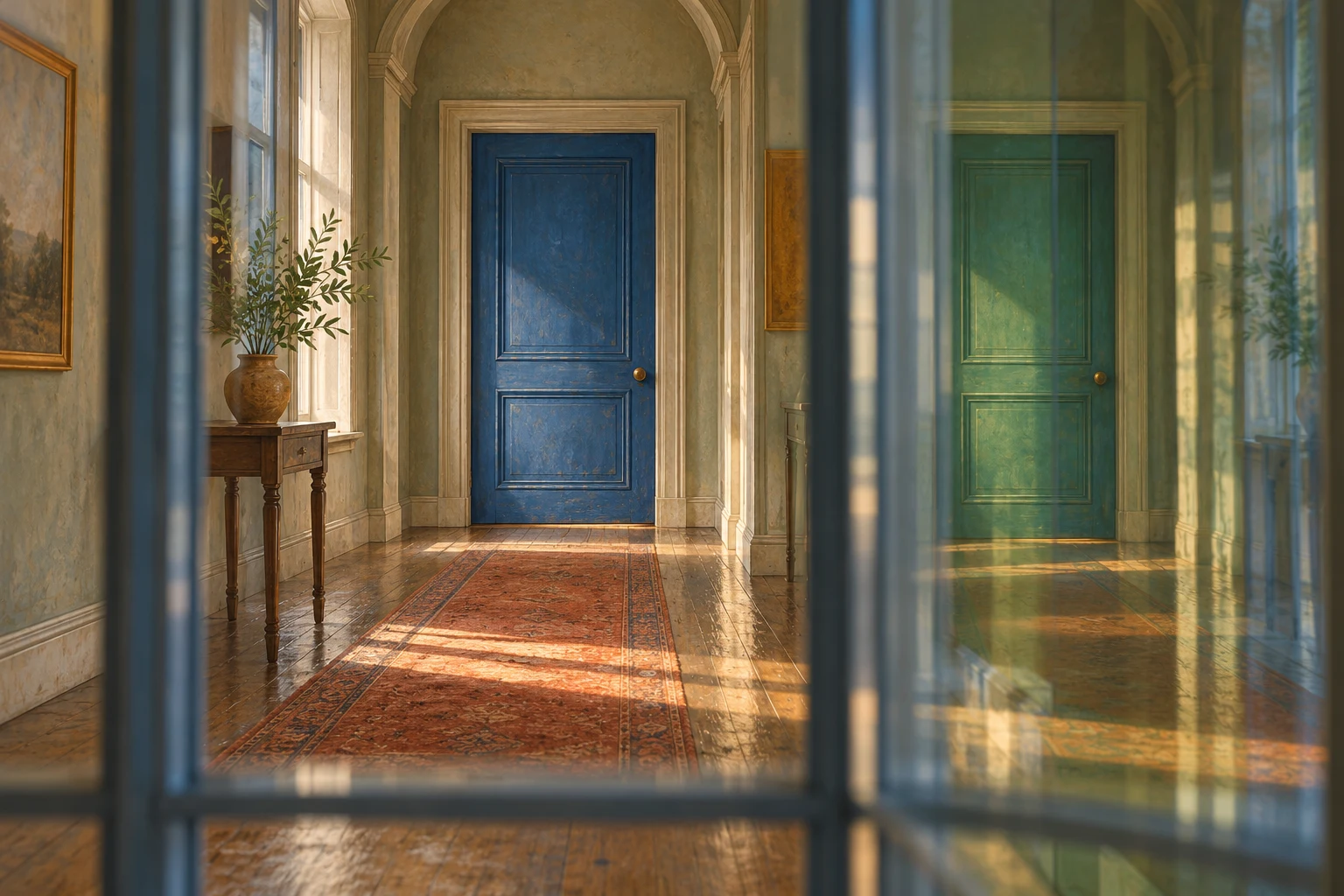
All five alternatives below concern a blue door. The axis is how directly the narrator presents the image as recollection in these exact sentences. It is not a scale of measured reliability, and the phrases can take different meanings in other contexts.
Explicit, subjectively vivid recollection
- Je me souviens très nettement de cette porte bleue et de sa poignée froide.I remember that blue door and its cold handle very clearly.The narrator adds subjective vividness, not independent verification.
- Je me souviens d’une porte bleue au fond du couloir.I remember a blue door at the end of the corridor.The narrator explicitly claims recollection without that qualifier.
- Je crois me souvenir d’une porte bleue au fond du couloir.I think I remember a blue door at the end of the corridor.A memory claim is made with an explicit qualification.
- Il me semble qu’une porte bleue se trouvait au fond du couloir.It seems to me that a blue door stood at the end of the corridor.An impression is offered without a direct claim of clear recollection.
- J’imagine une porte bleue ; aucun souvenir précis ne me revient.I imagine a blue door; no precise memory comes back.Explicit reconstruction: the image is supplied by imagination.
Imagined reconstruction
Read the qualification with the claim
The first version explicitly says no precise memory returns, so imagine is reconstruction here. The third introduces memory but keeps je crois. The fifth adds a sensory detail and très nettement. Those changes affect the narrator’s commitment and vividness, while leaving external verification entirely separate.
A document would add another dimension
Je m’en souviens nettement, mais la photo montre une porte verte.
I remember it clearly, but the photograph shows a green door.
This possible continuation creates a conflict between recollection and documentary detail. The adverb nettement cannot settle it alone. You would need to examine whether the photo shows the same door at the same time and whether the colour is represented reliably. The ladder itself supplies no such document.
When summarising a memory passage, preserve a decisive qualifier such as je crois or il me semble. Removing it may turn an impression into an unqualified recollection claim that the narrator did not make.