Conjugation table
Laver conjugation: washing an object versus se laver
Conjugate laver when washing an object, then distinguish se laver with its reflexive pronoun and auxiliary. Includes seven reference sections and common mistakes.
- A2
- 7 tenses
- Auxiliary: avoir
- Learn this in the A2 notebook →
In short
For washing an object, use laver with avoir: je lave la tasse, j’ai lavé la tasse. For washing yourself or a body part, use se laver: je me lave, je me lave les mains. The seven sections below cover non-reflexive laver; the reflexive construction is explained separately.
Yellow the idea to rememberBlue French to learn
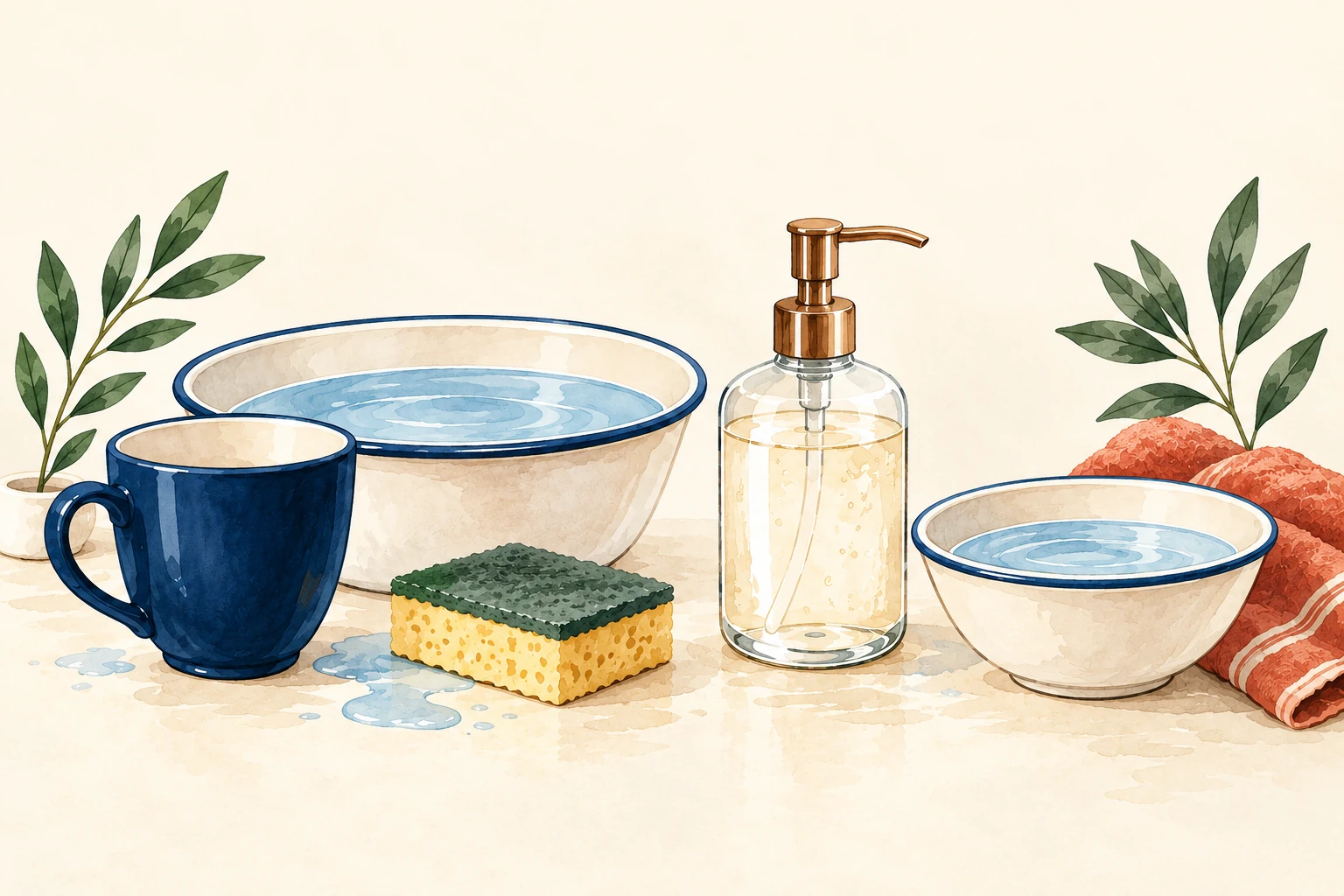
Laver la tasse names the cup as the direct object. Se laver adds a pronoun referring back to the subject. That small change affects the compound tense as well as the present. Keep the two complete constructions visible while learning their shared regular verb stem.
- Infinitive
- laver
- Past participle
- lavé
- Present participle
- lavant
- Auxiliary
- avoir
PrésentCore forms · washing an object
| je | lave |
| tu | laves |
| il / elle / on | lave |
| nous | lavons |
| vous | lavez |
| ils / elles | lavent |
Nous lavons les tasses.
We wash the cups.
Passé composéReference extension · a completed object-washing action
| j’ | ai lavé |
| tu | as lavé |
| il / elle / on | a lavé |
| nous | avons lavé |
| vous | avez lavé |
| ils / elles | ont lavé |
J’ai lavé le bol.
I washed the bowl.
ImparfaitReference extension · a repeated or ongoing past action
| je | lavais |
| tu | lavais |
| il / elle / on | lavait |
| nous | lavions |
| vous | laviez |
| ils / elles | lavaient |
Elle lavait les pinceaux après chaque atelier.
She used to wash the paintbrushes after every workshop.
Futur simpleReference extension · washing later
| je | laverai |
| tu | laveras |
| il / elle / on | lavera |
| nous | laverons |
| vous | laverez |
| ils / elles | laveront |
Vous laverez le linge demain.
You will wash the laundry tomorrow.
Conditionnel présentReference extension · a hypothetical action or suggestion
| je | laverais |
| tu | laverais |
| il / elle / on | laverait |
| nous | laverions |
| vous | laveriez |
| ils / elles | laveraient |
À ta place, je laverais ce tissu à la main.
In your place, I would wash this fabric by hand.
Subjonctif présentReference extension · after a subjunctive trigger
| je | lave |
| tu | laves |
| il / elle / on | lave |
| nous | lavions |
| vous | laviez |
| ils / elles | lavent |
Il faut que nous lavions les bols.
We need to wash the bowls.
ImpératifReference extension · an instruction with an object
| (tu) | lave |
| (nous) | lavons |
| (vous) | lavez |
Lave cette tasse, s’il te plaît.
Wash this cup, please.
Se laver: a separate reflexive construction
| Non-reflexive laver | Reflexive se laver | Meaning difference |
|---|---|---|
| Je lave la tasse. | Je me lave. | I wash the cup / I wash myself |
| Nous lavons le linge. | Nous nous lavons les mains. | We wash laundry / We wash our hands |
| Elle a lavé la tasse. | Elle s’est lavée. | She washed the cup / She washed herself |
Se laver uses être in the compound past: elle s’est lavée. In that simple reflexive example, the participle agrees with elle. With a body part as a following direct object, the agreement works differently: elle s’est lavé les mains, without e on lavé. Keep these two models distinct when you meet them.
Je me lave les mains.
I wash my hands.
The ordinary French body-part expression uses les mains because me already connects the action to the person. Je lave mes mains is not the standard routine model taught here. The same pattern gives je me lave le visage. These examples explain the language construction rather than a washing procedure.
Keep the pronouns and auxiliaries with their construction
| Incorrect for the intended meaning | Correct | Intended meaning |
|---|---|---|
| Je suis lavé la tasse. | J’ai lavé la tasse. | I washed the cup. |
| Je lave moi les mains. | Je me lave les mains. | I wash my hands. |
| Vous lavé le bol. | Vous lavez le bol. | You wash the bowl. |
| J’ai laver le bol. | J’ai lavé le bol. | I washed the bowl. |
Practise one object sentence and one body-part sentence: Je lave le bol. Je me lave les mains. Then repeat their completed-past models. The contrast keeps the pronoun and auxiliary connected to the meaning you intend.