Gap-fill
The red gloves are still at home: A1 French reading
Complete ten gaps in a cold-weather shopping trip. Track a red pair of gloves from a missing pocket to the shelf where they were left at home.
- A1
- 10 gaps
- Translation included
- Learn this in the A1 notebook →
In short
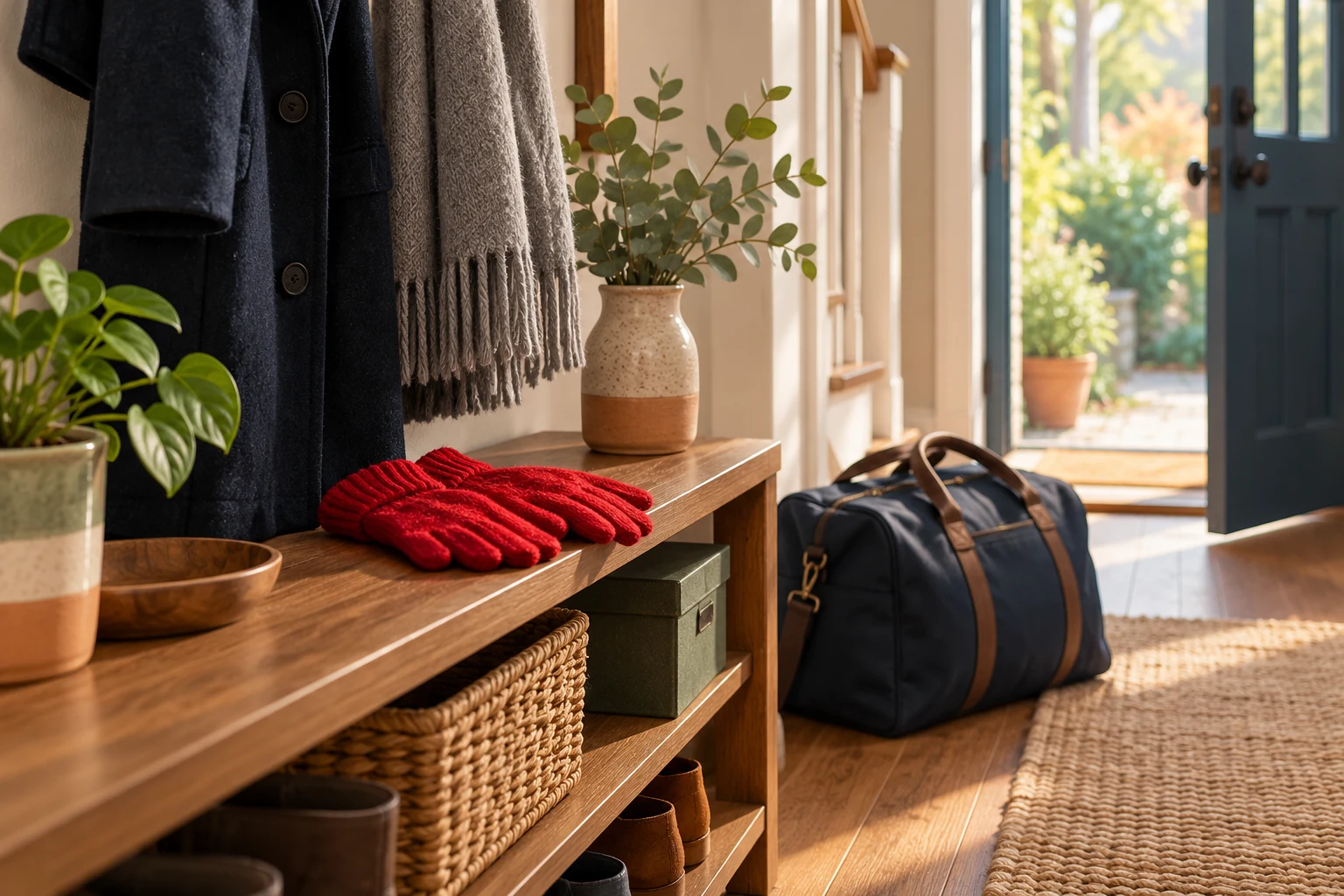
Nora’s brother finds the red gloves on the shelf at home, beside her sports bag. Nora has her black coat, grey scarf and wallet during the shopping trip. The phone call locates the gloves; she then returns home and puts them in her pocket for the next outing.
Yellow the idea to rememberBlue French to learn
Fill ten gaps from the hints. The story follows one person, Nora, as she goes to buy a notebook. Missing from her pockets does not mean lost in the shop. Read to the end to find the stated location of the gloves, then answer the questions from the text.
Les gants rouges de Nora
Ce matin, il fait froid. Nora met son manteau (black, masculine singular) et son écharpe (grey, feminine singular). Elle veut acheter un carnet au centre-ville. Elle prend (her, masculine singular before sac) sac et regarde ses poches. Elle a ses clés, mais elle ne trouve pas ses (gloves, plural). « Je regarde dans le sac plus tard », pense-t-elle.
Dans la rue, ses mains sont froides. Nora ouvre le sac devant la papeterie. À l’intérieur, elle trouve son portefeuille, une bouteille d’eau et (a, masculine before crayon) crayon. Ses gants (red, masculine plural) ne sont pas là. Elle téléphone à son frère, qui est à la maison. « Tu vois (my, plural before gants) gants ? » demande-t-elle.
Son frère regarde dans l’entrée. « Oui, ils sont sur (the shelf), à côté de ton sac de sport. » Nora répond : « Merci ! Alors, ils sont encore à la (home, after à la). » Elle achète son carnet puis rentre. Dans l’entrée, elle retrouve ses gants à côté du sac de sport. Elle les met dans (her, feminine singular before poche) poche pour la prochaine sortie.
Read it in English
This morning it is cold. Nora puts on her black coat and grey scarf. She wants to buy a notebook in the town centre. She takes her bag and checks her pockets. She has her keys, but she cannot find her gloves. “I’ll look in the bag later,” she thinks.
In the street, her hands are cold. Nora opens the bag outside the stationery shop. Inside, she finds her wallet, a bottle of water and a pencil. Her red gloves are not there. She phones her brother, who is at home. “Can you see my gloves?” she asks.
Her brother looks in the entrance hall. “Yes, they’re on the shelf, beside your sports bag.” Nora replies, “Thank you! Then they’re still at home.” She buys her notebook and then goes home. In the entrance hall, she finds her gloves beside the sports bag. She puts them in her pocket for the next outing.
| Object | Description | Where at the end? |
|---|---|---|
| Le manteau | Noir | With Nora |
| L’écharpe | Grise | With Nora |
| Les gants | Rouges | Found at home, then put in her pocket |
The noun controls son, sa and ses
Son sac is masculine singular because sac is masculine. Sa poche is feminine singular because poche is feminine. Ses gants is plural because gants is plural. Nora’s gender does not change those choices. The speaker changes in the phone call, but the named objects keep their own grammatical gender and number.
Track the two locations in order. During the phone call, the gloves are on the shelf at home. After Nora returns, she puts them in her pocket. A question about where her brother finds them needs his reported location; a question about the end of the story needs the later action.