Gap-fill
Which glass is mine? A1 French table reading
Complete ten gaps in an A1 table mix-up. Use coloured coasters, possessives and drink articles to identify whose glass contains water or orange juice.
- A1
- 10 gaps
- Translation included
- Learn this in the A1 notebook →
In short
Mon verre means my glass, while ton verre means your glass. The possessive agrees with verre, a masculine noun. In this text, coloured coasters identify the glasses: blue for Léa, green for Tom and red for Nora. Read that written key before filling the gaps.
Yellow the idea to rememberBlue French to learn
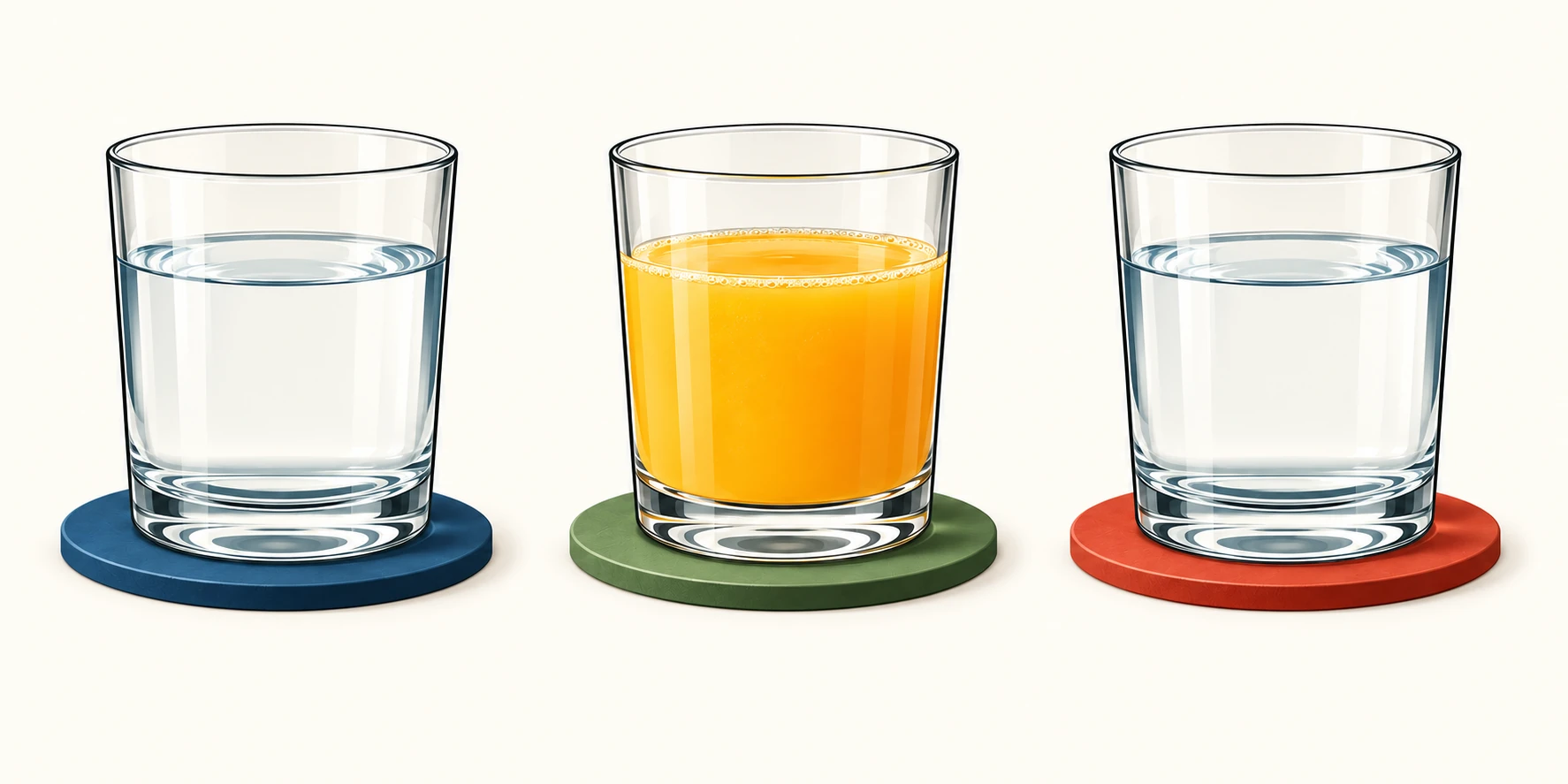
The glasses are identical, so the friends place them on coloured coasters. Each person keeps the same coaster. The colour words describe dessous-de-verre, a masculine noun, not the drinks. Use the written key and the named speaker to decide whether a sentence needs mon or ton.
| Person | Coaster | Drink |
|---|---|---|
| Léa | bleu | eau |
| Tom | vert | jus d’orange |
| Nora | rouge | eau |
Trois verres sur la table
À midi, Léa, Tom et Nora déjeunent ensemble. Léa pose son verre sur un dessous-de-verre (blue, masculine). Tom choisit le dessous-de-verre (green, masculine). Nora prend le dessous-de-verre (red). Les trois verres sont transparents, mais les dessous-de-verre ont des couleurs différentes.
Léa boit (some water). Nora boit aussi de l’eau. Tom, lui, boit (some, before masculine jus) jus d’orange. Quand Tom revient de la cuisine, il regarde le verre de Léa. « C’est (my, masculine singular) verre ? » demande-t-il. Léa répond : « Non, celui-ci est sur le dessous-de-verre bleu. C’est mon verre. (Your, masculine singular, sentence-initial) verre est sur le vert. »
Tom regarde alors le verre sur le dessous-de-verre vert. « Oui, il contient (some, before masculine jus) jus d’orange. C’est bien le mien. » Nora montre son propre verre : « Et moi, je prends (some water), dans le verre sur le dessous-de-verre rouge. » Maintenant, chaque personne retrouve (their own, masculine singular before verre) verre. Les amis posent les carafes au milieu de la table et commencent leur repas.
Read it in English
At noon, Léa, Tom and Nora have lunch together. Léa puts her glass on a blue coaster. Tom chooses the green coaster. Nora takes the red coaster. The three glasses are transparent, but the coasters have different colours.
Léa drinks water. Nora also drinks water. Tom drinks orange juice. When Tom returns from the kitchen, he looks at Léa’s glass. “Is that my glass?” he asks. Léa replies, “No, this one is on the blue coaster. It’s my glass. Your glass is on the green one.”
Tom then looks at the glass on the green coaster. “Yes, it contains orange juice. That is mine.” Nora points to her own glass: “And I’m having water, in the glass on the red coaster.” Now each person finds their own glass. The friends put the jugs in the middle of the table and start their meal.
Mon changes reference when the speaker changes
Tom’s mon verre refers to Tom’s glass because he is speaking. Léa’s mon verre refers to Léa’s glass. When Léa says ton verre to Tom, she means his glass. The possessive form is tied to the speaker and the noun, while the coaster key helps you track the actual object.
De l’eau and du jus d’orange identify the contents. They do not replace the possessive information: two people here both have water. Combine the written colour key, the named speaker and the drink to identify the glass without relying on only one clue.