Myth or fact
A French study summary: no difference found is not proof of equality
Interpret French no-difference findings without turning them into proof of equality, using clear study notes and six verdict questions.
- C1
- 6 claims
- Vrai ou faux ?
- Learn this in the C1 notebook →
In short
Aucune différence détectée reports that this study did not detect a difference. It does not automatically show equality. To assess an equivalence claim, look for a defined equivalence margin, an appropriate analysis and enough precision to address that margin.
Yellow the idea to rememberBlue French to learn
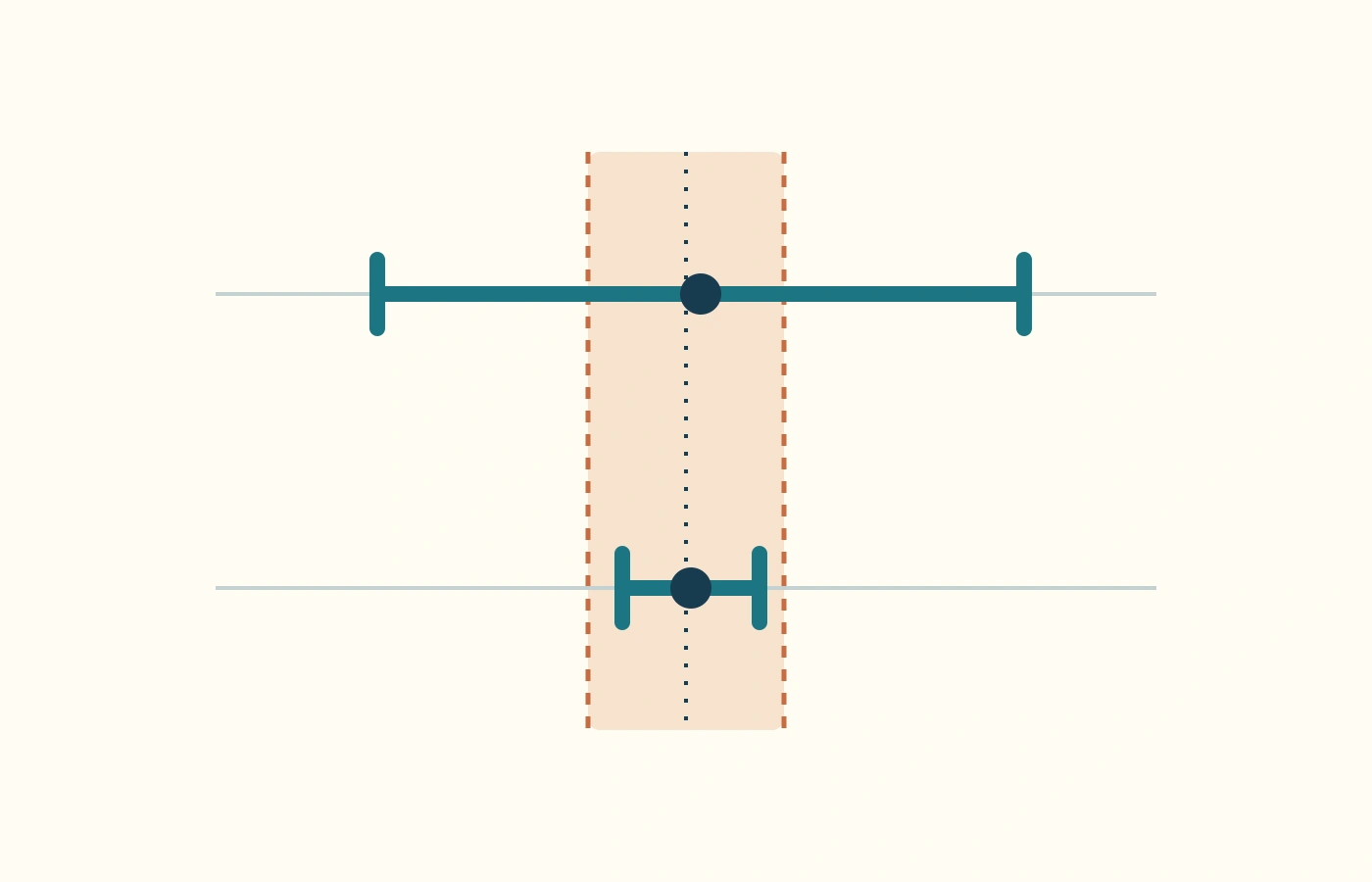
Two training groups complete a task. The report says their average scores differ slightly, but the study did not detect a clear difference. It gives no equivalence margin and notes that the group sizes are small. The language-learning task is to preserve that limited finding rather than replace it with “the methods are identical”.
Note de résultat · deux méthodes d’entraînement
Comparaison
Méthode APetit groupe ; score moyen proche de celui du groupe B.
Méthode BPetit groupe ; variation importante entre les personnes.
Conclusion du rapportAucune différence nette n’a été détectée avec ce dispositif.
LimiteAucune analyse d’équivalence ni marge d’équivalence n’est fournie.
Vrai ou faux ? Decide before you see the verdict.
The report says no clear difference was detected in this setup.
VraiThat is the report’s stated result, with scope limited to the supplied design.
The methods are therefore identical for every learner.
FauxThe study neither establishes identity nor supports a claim about every learner.
Small groups and high variation can leave the estimate imprecise.
VraiImprecision may prevent the design from distinguishing effects that matter; the report’s limitation remains relevant.
An equivalence claim needs more than the phrase no difference detected.
VraiYou need to know the defined margin and whether the analysis supports differences staying within it.
The absence of a detected difference proves the opposite method is better.
FauxNo such directional advantage is established by the negative finding.
The cautious summary can retain the need for a more informative comparison.
VraiThe result and the information gap can be reported together without pretending the study found nothing of any value.
Use the report’s actual verb
L’étude ne détecte pas de différence nette, mais elle ne permet pas d’affirmer l’équivalence des méthodes.
The study does not detect a clear difference, but it does not allow the methods’ equivalence to be asserted.
This preserves the negative finding and the separate equivalence question. Avoid treating non significatif as a synonym for “no effect exists”. Equally, do not claim a hidden difference must exist: insufficient information can leave both possibilities open.