Gap-fill
French y in context: a place, an idea and an eight-gap story
Follow a morning of errands to practise y for a place or an à complement. Explore six stops, then choose y, en and person forms in an eight-gap text.
- A2
- 8 gaps
- Translation included
- Learn this in the A2 notebook →
In short
Y replaces a known place: Tu vas à la poste ? — Oui, j’y vais. It also replaces suitable à complements: Je pense au rendez-vous → j’y pense. For a place you come from with de, use en: J’en reviens.
Yellow the idea to rememberBlue French to learnRed watch out
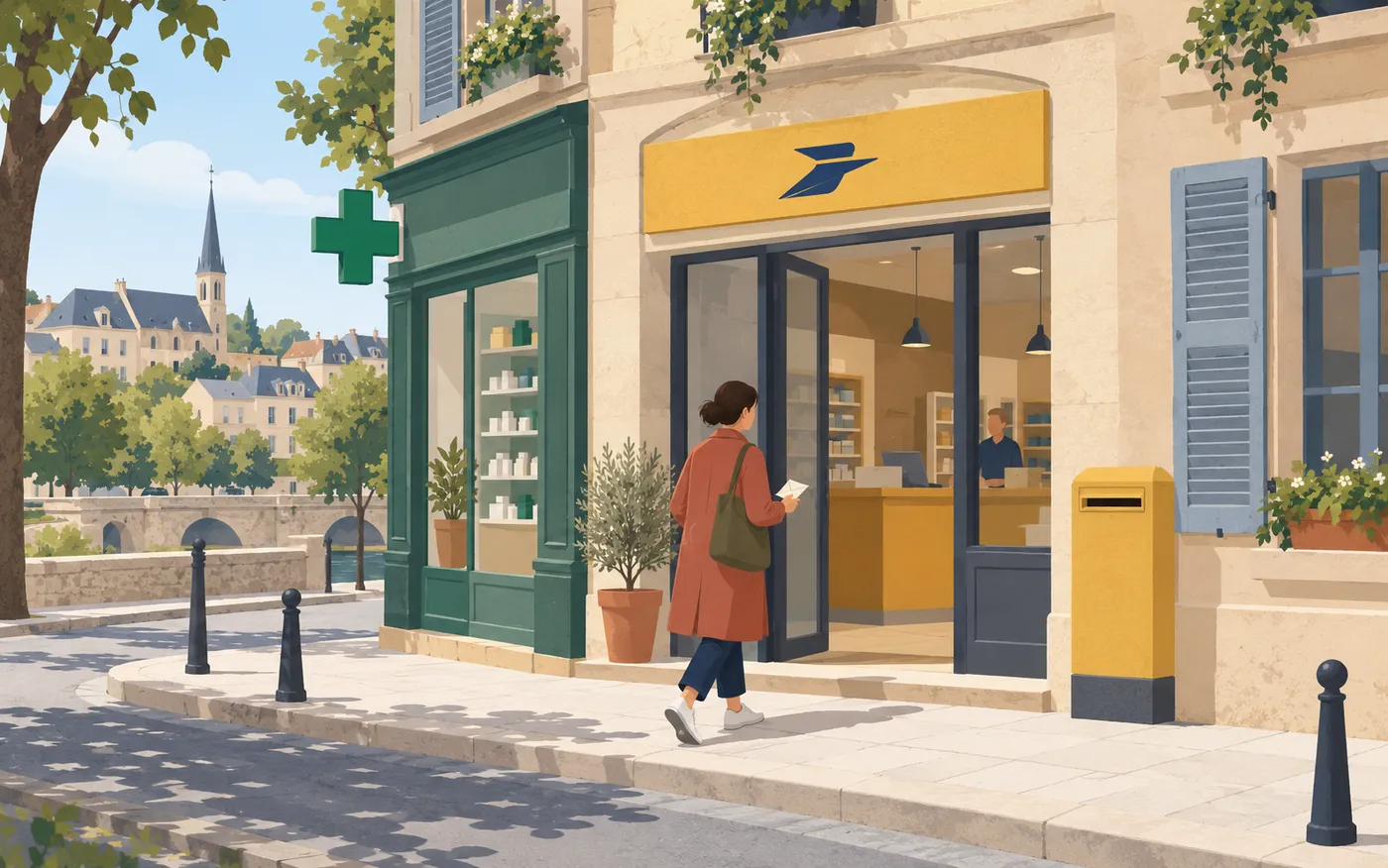
Six stops in the neighbourhood
Find:

Study first: a place, a person or an idea?
| Full sentence | Replacement |
|---|---|
| Je travaille dans ce quartier. | J’y travaille. |
| Je réfléchis à cette proposition. | J’y réfléchis. |
| Je reviens de la mairie. | J’en reviens. |
| Je téléphone à Nora. | Je lui téléphone. |
| Je pense à Nora. | Je pense à elle. |
A place can begin with dans, chez or en: Je vais chez Nora → j’y vais. With an idea, learn the verb’s preposition: réfléchir à gives y réfléchir, while parler de gives en parler. With a person, téléphoner à takes lui; penser à keeps à elle or à lui.
Je n’y travaille pas. Je vais y passer. Vas-y ! N’y va pas !
I don’t work there. I’m going to stop by there. Go there! Don’t go there!
Put y before its verb, including the infinitive in je vais y passer. A positive command attaches it after the verb. Fill the eight gaps below with y, en, lui or à elle. Each hint names the full phrase you are replacing.
Une matinée bien remplie
La poste ouvre à neuf heures. J’(à la poste) vais pour envoyer une lettre. La pharmacie est juste à côté ; je vais (à la pharmacie) passer ensuite.
J’ai aussi rendez-vous à la mairie. J’(à la mairie) vais à dix heures. À onze heures, j’(de la mairie) reviens et je fais une pause.
Nora m’a proposé de déjeuner ensemble. Je (à Nora, avec téléphoner) téléphone pour confirmer. Elle a une réunion difficile ce matin ; je pense (à Nora, avec penser).
Elle me propose aussi un atelier de conversation à la bibliothèque. Cet atelier m’intéresse : je vais (à cet atelier, avec réfléchir) réfléchir. Le café ouvre à midi. Nous allons (au café) déjeuner.
Read it in English
The post office opens at nine. I’m going there to send a letter. The pharmacy is right next door; I’m going to stop by there afterwards.
I also have an appointment at the town hall. I’m going there at ten. At eleven, I come back from there and take a break.
Nora suggested having lunch together. I phone her to confirm. She has a difficult meeting this morning; I’m thinking of her.
She also suggests a conversation workshop at the library. That workshop interests me: I’m going to think about it. The cafe opens at noon. We’re going to have lunch there.