Verb drill
French noun plurals: practise the whole phrase
Turn singular French phrases into plurals, from tables and sofas to journals and eyes. Check articles, noun endings, adjectives and verbs together.
- A2
- 10 answers
- Checked all at once
- Accents count
- Learn this in the A2 notebook →
In short
Practise the article, noun and adjective together: une petite table → deux petites tables. Most nouns add -s, some keep their spelling, and some change more: un journal → des journaux. In a full sentence, check the verb too: La fenêtre est ouverte → Les fenêtres sont ouvertes.
Yellow the idea to rememberBlue French to learnRed watch out
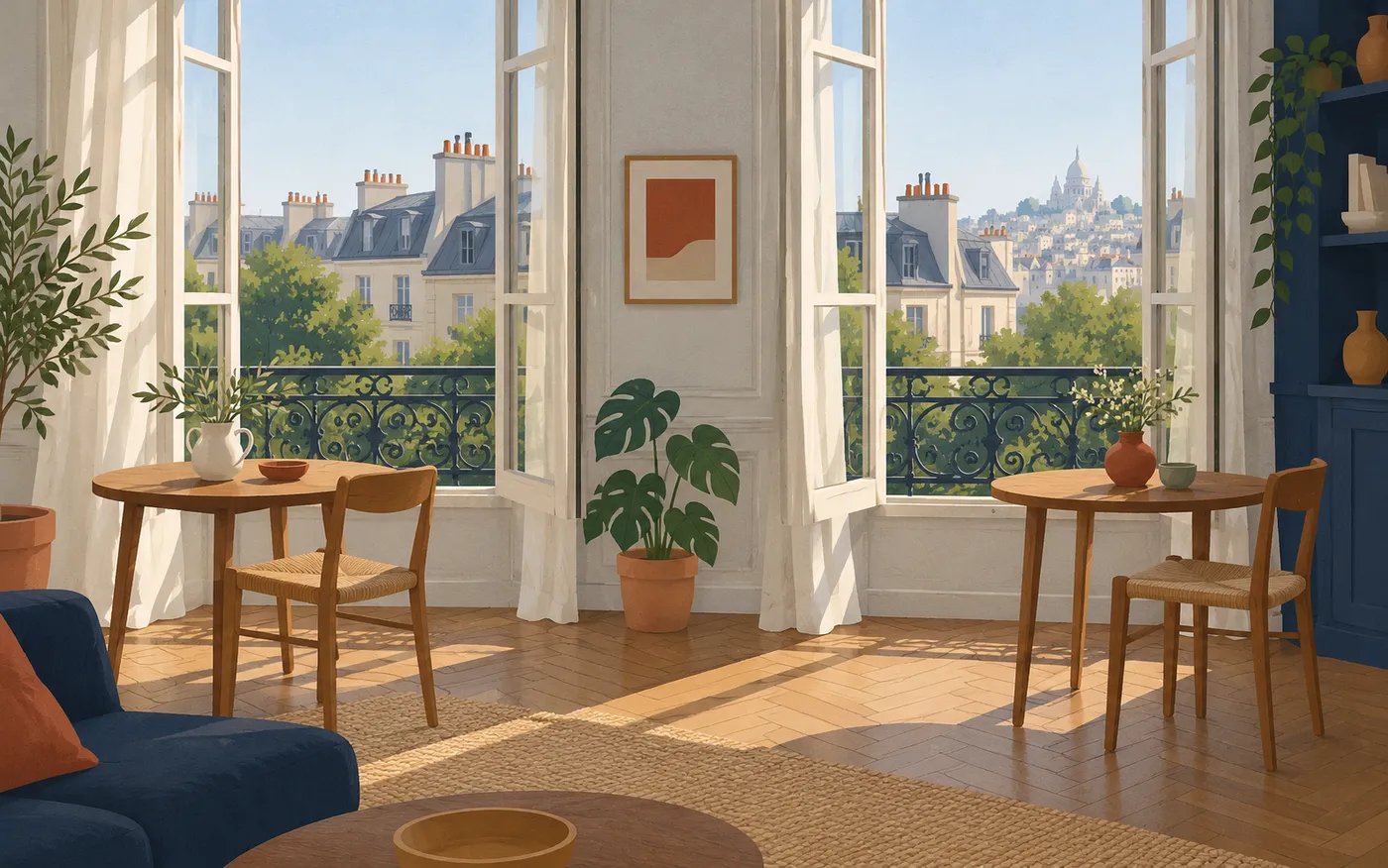
Four plural phrases to picture
Find:
| Singular | Plural | What changes |
|---|---|---|
| un placard blanc | deux placards blancs | Noun and adjective add -s. |
| un canapé rouge | trois canapés rouges | Keep the accent in canapés. |
| un prix élevé | des prix élevés | Prix keeps its spelling. |
| un journal local | des journaux locaux | Both endings change to -aux. |
| un œil bleu | deux yeux bleus | Œil becomes yeux. |
| un festival annuel | des festivals annuels | Festival takes -s, unlike journal. |
A final -s, -x or -z usually stays as it is in the plural: un prix → des prix. The spelling of the noun alone may hide the change in number. In Les prix sont élevés, the article, verb and adjective all show a plural group.
Which part needs another look?
- Les fenêtres est ouvertes.Les fenêtres sont ouvertes.
The noun group is plural. Its verb must be plural too.
- Deux petite tables.Deux petites tables.
The adjective describes two feminine nouns, so petite takes plural -s.
- Il y ont trois lits.Il y a trois lits.
The expression il y a stays singular even when several things follow it.
How do you form the plural of French nouns?
Keep the adjective and use the number or article supplied. Type the whole missing phrase. The noun’s gender stays the same when its number changes.
1 · Article, noun and adjective
- Une petite table → deux (table: feminine)
- Un canapé rouge → trois (keep the accent)
- Un prix élevé → des (prix stays unchanged)
- Un journal local → des (two irregular endings)
- Un œil bleu → deux (irregular noun)
- Un festival annuel → des (regular -s plural)
2 · Now change the full sentence
- La fenêtre est ouverte. → Les fenêtres . (verb + adjective)
- Le placard est blanc. → Les placards . (masculine plural)
- Il y a un lit dans la chambre. → Il y a trois dans la chambre. (il y a stays unchanged)
- Mon œil est rouge. → Mes yeux . (plural subject)
For your next round, change the furniture rather than the rule: try two white cupboards or three red chairs. Keep irregular pairs together on a separate card. A familiar ending is a clue, but the complete pair journal / journaux or festival / festivals gives you the form you need.