Gap-fill
French determiners in a paragraph: which flat, which objects?
Follow un, le, ce and chaque through a flat viewing, then complete a linked paragraph. Includes a room scene and questions on reference and group size.
- A2
- 6 gaps
- Translation included
- Learn this in the A2 notebook →
In short
Read a determiner with its noun. Un can introduce something new; le can pick it up once it is identifiable; ce, cette, ces select something in the text or situation. Quantity words matter too: chaque visiteur means every visitor, while certains visiteurs means some visitors.
Yellow the idea to rememberBlue French to learnRed watch out
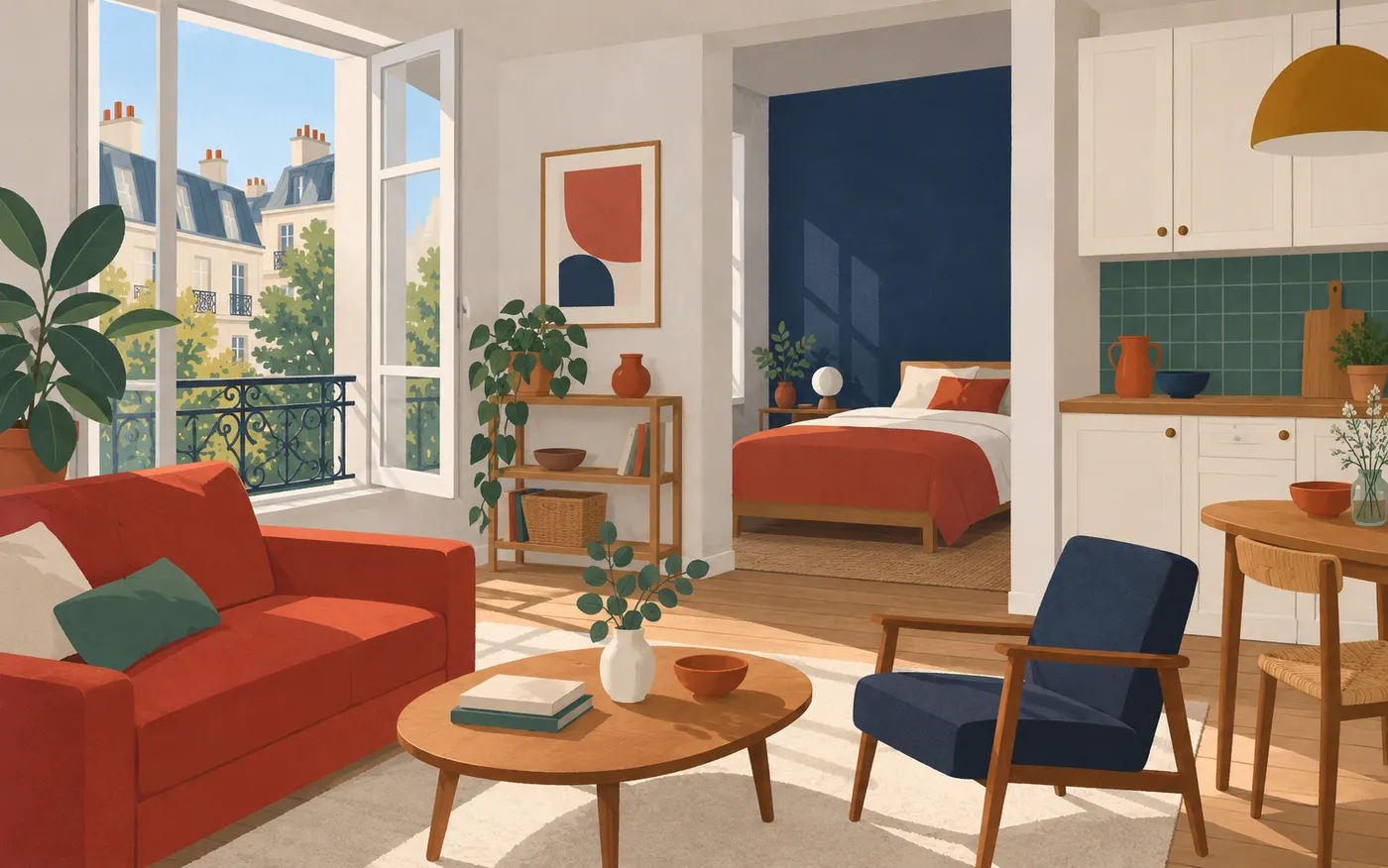
Explore the flat before the viewing
Find:
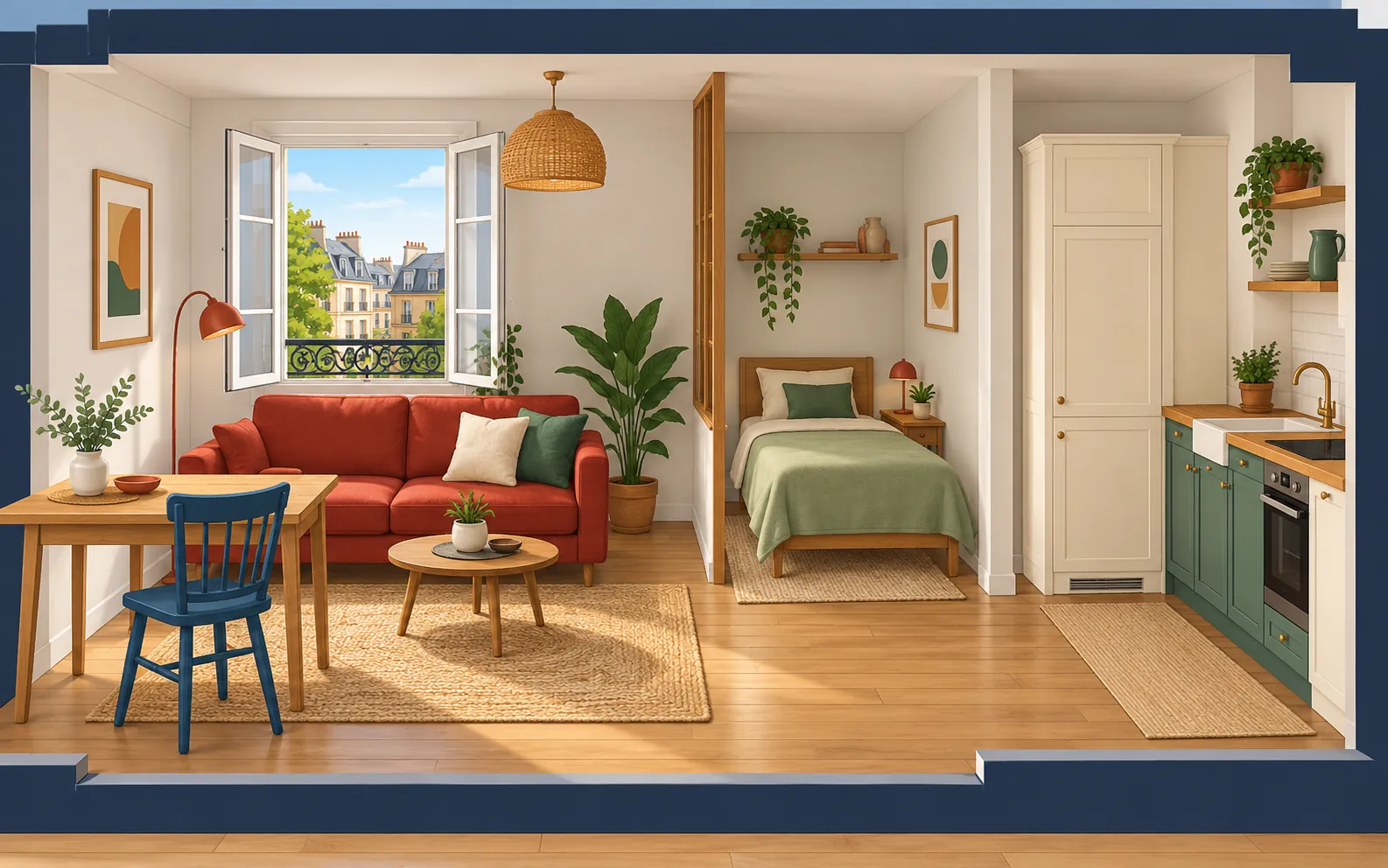
Follow one chain through the viewing
Nora visite un studio. Le studio a une grande fenêtre. Cette fenêtre donne sur une cour.
Nora views a studio flat. The flat has a large window. This window overlooks a courtyard.
Un studio introduces the flat. Le studio returns to it. Cette fenêtre picks up the window just mentioned.
| Phrase | What the reader can identify |
|---|---|
| un studio | A newly introduced flat. |
| le studio | The flat Nora is viewing. |
| cette fenêtre | The window introduced in that flat. |
| une cour | A courtyard introduced at the end. |
A definite article can also rely on the situation. In a flat viewing, la porte est ouverte can identify the visible door even on its first mention. Follow the scene as well as the previous sentence.
How do French determiners show which thing you mean?
Tous les visiteurs reçoivent une fiche. Certains visiteurs demandent une deuxième visite.
All the visitors receive an information sheet. Some visitors ask for a second viewing.
Everyone gets a sheet. The text attributes the request to some visitors; it gives no exact number.
Son sac can mean “his bag” or “her bag”. Here the preceding sentence names Malik as the owner. The form son agrees with masculine sac; it cannot identify the owner by itself.
Complete a second viewing
Use each hint to keep the reference clear. The paragraph first introduces a flat, returns to it, then follows its furniture and visitors. Where a possessive appears, its form agrees with the thing possessed.
La visite de Lina
Lina cherche un logement. Elle visite (one flat, first mention) appartement avec Malik. (this, masculine before a vowel) appartement a une petite cuisine. Dans la cuisine, il y a une table. (the same table) table est près de la fenêtre.
Malik pose son sac sur une chaise. (his, before masculine sac) sac est noir. Deux autres personnes arrivent pour la visite. (each, followed by a singular noun) visiteur reçoit une fiche. (all, masculine plural) les visiteurs peuvent poser des questions.
Read it in English
Lina is looking for somewhere to live. She views a flat with Malik. This flat has a small kitchen. In the kitchen, there is a table. The table is near the window.
Malik puts his bag on a chair. His bag is black. Two other people arrive for the viewing. Each visitor receives an information sheet. All the visitors can ask questions.