Quiz

L'âne de Buridan: recognise a French allusion to paralysing choice

Recognise l’âne de Buridan through nine focused questions, distinguishing paralysing choice from endless labour, costly victory and a justified delay for evidence.

In short

L’âne de Buridan conventionally evokes being unable to choose between apparently equivalent options. It differs from a repetitive task of Sisyphe or a costly victory à la Pyrrhus. In a commentary, explain the particular impasse represented rather than treating every delay as the same failure.

Yellow the idea to rememberBlue French to learn
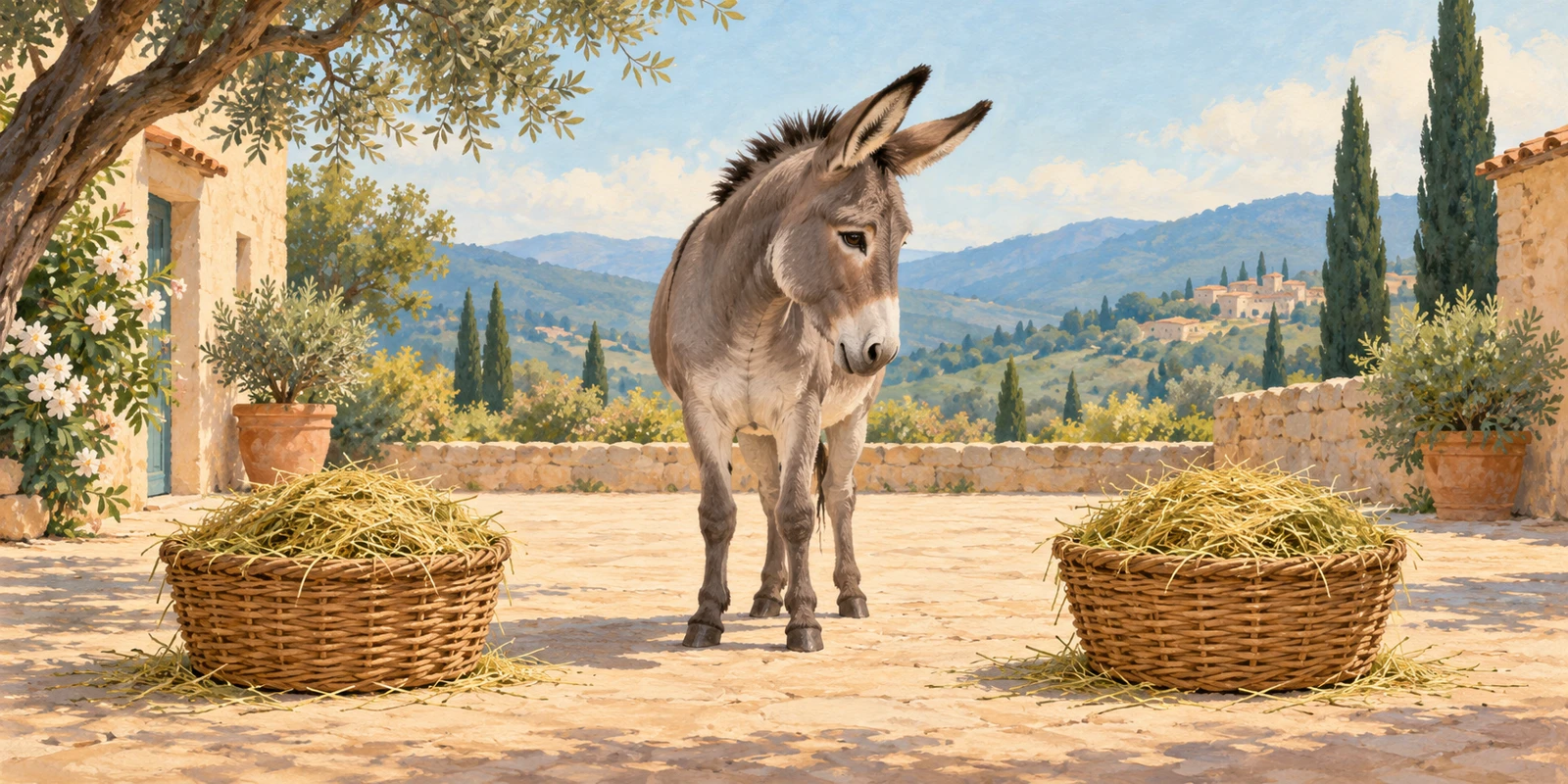
A donkey stands between two similar baskets of hay without choosing either one.
Apparently balanced alternatives can leave the chooser unable to act. Illustration: Atelier

The familiar illustrative story concerns an ass unable to choose between equally attractive inducements. French writers can invoke it without retelling the scene. The allusion is associated with Jean Buridan’s name, but do not invent a verbatim quotation or precise original passage when none is supplied. Recognising a conventional reference is different from documenting its textual history.

AllusionCentral comparisonLimit
l’âne de BuridanParalysing choice between apparently balanced options.Does not establish every option is objectively equal.
un travail de SisypheEffort repeatedly renewed as its result is undone.Not just any modest daily task.
une victoire à la PyrrhusSuccess obtained at a ruinous cost.Not a failure to choose.
  1. Question 1No account needed
    « Il hésite entre deux offres équivalentes et ne signe aucune : un âne de Buridan. » What is imported?

    Choose one answer.

    Answer and explanation

    Paralysing indecision between balanced options. The comparison concerns failure to choose.

  2. Question 2No account needed
    « Chaque dossier terminé revient au point de départ. » Which comparison is closest?

    Choose one answer.

    Answer and explanation

    A Sisyphean task. Repetition and renewed effort differ from balanced alternatives.

  3. Question 3No account needed
    « Ils ont gagné, mais au prix de presque toutes leurs ressources. » Which allusion fits?

    Choose one answer.

    Answer and explanation

    Une victoire à la Pyrrhus. The result is success at a ruinous cost.

  4. Question 4No account needed
    Does Buridan’s allusion prove that both options are objectively identical?

    Choose one answer.

    Answer and explanation

    No. It is an analogy about the represented choice.

  5. Question 5No account needed
    « Elle choisit vite le meilleur dossier. » Does the standard Buridan allusion fit?

    Choose one answer.

    Answer and explanation

    No. The key paralysis is absent.

  6. Question 6No account needed
    « Il reporte le choix parce qu’une donnée essentielle manque. » What should a reader avoid?

    Choose one answer.

    Answer and explanation

    Assuming irrational paralysis without examining the missing evidence. Not every postponed decision is a balanced-choice impasse.

  7. Question 7No account needed
    What is the familiar illustrative story?

    Choose one answer.

    Answer and explanation

    An ass unable to choose between equivalent inducements. That structure supplies the conventional allusion.

  8. Question 8No account needed
    What should a commentary explain?

    Choose one answer.

    Answer and explanation

    Which feature is compared and where the analogy stops. A useful interpretation has a limited mapping.

  9. Question 9No account needed
    Is the conventional story securely a verbatim passage to quote from Jean Buridan without a source?

    Choose one answer.

    Answer and explanation

    No. Treat it as the familiar allusion associated with his name, not an unsourced exact quotation.

A writer may use the allusion to criticise a committee that keeps comparing two plans without a decision criterion. Your analysis can say that the writer presents the alternatives as balanced and the delay as paralysing. Whether that criticism is justified requires further evidence: perhaps the options differ substantially, or an essential fact is still missing.

Preserve this distance in a summary. “The editorial likens the committee to Buridan’s ass” attributes the comparison. “The committee is incapable of rational choice” adopts a broader judgement and may invent a psychological explanation. A precise cultural reference sharpens an analysis only when its scope remains visible.