Conjugation table
Ouvrir conjugation: ouvre, ouvrons and ouvert
Learn ouvrir in seven tenses. Use present endings like an -er verb, remember ouvert in the past, and practise ouvre, ouvriez and ouvrirai.
- A2
- 7 tenses
- Auxiliary: avoir
- Learn this in the A2 notebook →
In short
Ouvrir means “to open”. Although the infinitive ends in -ir, its present endings follow the -er pattern: j’ouvre, tu ouvres, il ouvre, nous ouvrons, vous ouvrez, ils ouvrent. The past participle is ouvert: j’ai ouvert.
Yellow the idea to rememberBlue French to learn
Study first: seven tense tables
- Infinitive
- ouvrir
- Past participle
- ouvert
- Present participle
- ouvrant
- Auxiliary
- avoir
PrésentNow and regular habits
| j’ | ouvre |
| tu | ouvres |
| il / elle / on | ouvre |
| nous | ouvrons |
| vous | ouvrez |
| ils / elles | ouvrent |
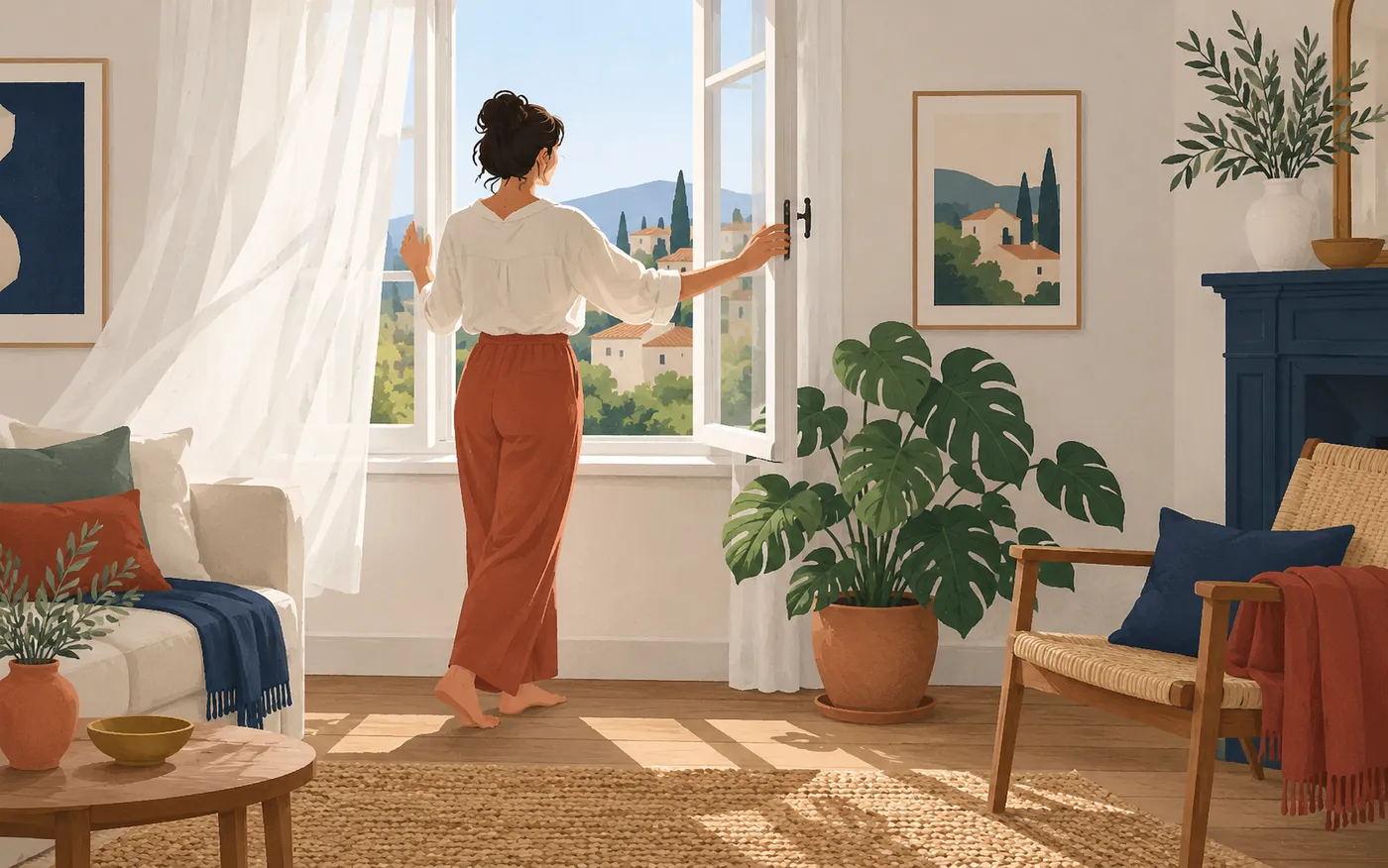
J’ouvre la fenêtre chaque matin.
I open the window every morning.
Passé composéA completed past action
| j’ | ai ouvert |
| tu | as ouvert |
| il / elle / on | a ouvert |
| nous | avons ouvert |
| vous | avez ouvert |
| ils / elles | ont ouvert |
Nous avons ouvert la porte.
We opened the door.
ImparfaitPast habits and background
| j’ | ouvrais |
| tu | ouvrais |
| il / elle / on | ouvrait |
| nous | ouvrions |
| vous | ouvriez |
| ils / elles | ouvraient |
Le café ouvrait à sept heures.
The café used to open at seven.
Futur simpleWhat will happen
| j’ | ouvrirai |
| tu | ouvriras |
| il / elle / on | ouvrira |
| nous | ouvrirons |
| vous | ouvrirez |
| ils / elles | ouvriront |
Ils ouvriront la boutique lundi.
They will open the shop on Monday.
Conditionnel présentWhat would happen
| j’ | ouvrirais |
| tu | ouvrirais |
| il / elle / on | ouvrirait |
| nous | ouvririons |
| vous | ouvririez |
| ils / elles | ouvriraient |
J’ouvrirais la fenêtre si j’avais trop chaud.
I would open the window if I were too hot.
Subjonctif présentAfter a trigger such as il faut que
| que j’ | ouvre |
| que tu | ouvres |
| qu’il / elle / on | ouvre |
| que nous | ouvrions |
| que vous | ouvriez |
| qu’ils / elles | ouvrent |
Il faut que vous ouvriez vos livres.
You need to open your books.
ImpératifInstructions and encouragement
| (tu) | ouvre |
| (nous) | ouvrons |
| (vous) | ouvrez |
Ouvre la porte, s’il te plaît.
Open the door, please.
How do you conjugate ouvrir in the present?
Keep ouvr- and add -e, -es, -e, -ons, -ez, -ent. The imperfect also uses ouvr-: j’ouvrais. The future keeps the whole infinitive: ouvrir- + -ai gives j’ouvrirai. For the conditional, change the ending: j’ouvrirais. In the subjunctive, watch nous and vous: que nous ouvrions, que vous ouvriez. The other subjunctive forms match the present indicative in spelling.
- Lina
Tu peux ouvrir la fenêtre ?
Can you open the window?
- Hugo
Oui. J’ouvre aussi la porte ?
Yes. Shall I open the door too?
- Lina
Non, juste la fenêtre, merci.
No, just the window, thanks.
- Hugo
Voilà. J’ai ouvert la petite fenêtre.
There. I’ve opened the small window.
Four things to open
Find:
The imperative for one person is ouvre, with no final -s: Ouvre la boîte. Use ouvrons for “let’s open” and ouvrez for a group or formal address. J’ouvre la porte describes your action; la porte est ouverte describes its state. In that second sentence, ouverte agrees with the feminine noun porte.
What mistakes do learners make with ouvrir?
- J’ouvres la fenêtre.J’ouvre la fenêtre.
The first-person present ends in -e. The -es ending belongs to tu.
- Nous ouvrissons la porte.Nous ouvrons la porte.
Ouvrir has no -iss- in the present plural.
- J’ai ouvri le livre.J’ai ouvert le livre.
The irregular participle is ouvert, with avoir.
- Ouvres la boîte !Ouvre la boîte !
The ordinary tu imperative loses the final -s.
Recall the forms, then use them
1 · Write only the verb form; include the auxiliary for the past
- nous · Présent
- ils / elles · Présent
- tu · Passé composé
- vous · Imparfait
- nous · Futur simple
- j’ · Conditionnel présent
- que nous · Subjonctif présent
- qu’ils / elles · Subjonctif présent
- (tu) · Impératif
2 · Complete the sentences in the tense shown
- Chaque matin, j’ la fenêtre. (présent)
- Hier, vous la boutique à neuf heures. (passé composé)
- Il faut que nous la porte. (subjonctif présent)
- Demain, elles le magasin plus tôt. (futur simple)