Gap-fill
The missing desk lamp: A1 French location reading
Complete ten French gaps while searching three rooms for a desk lamp. Follow here, over there and exact locations, with a full English translation.
- A1
- 10 gaps
- Translation included
- Learn this in the A1 notebook →
In short
Ici means here; là-bas means over there. In this search, the desk lamp is not in its usual bedroom place. Paul looks in the kitchen, then finds it in the living room. Use the named room and supporting object to keep each location clear.
Yellow the idea to rememberBlue French to learn
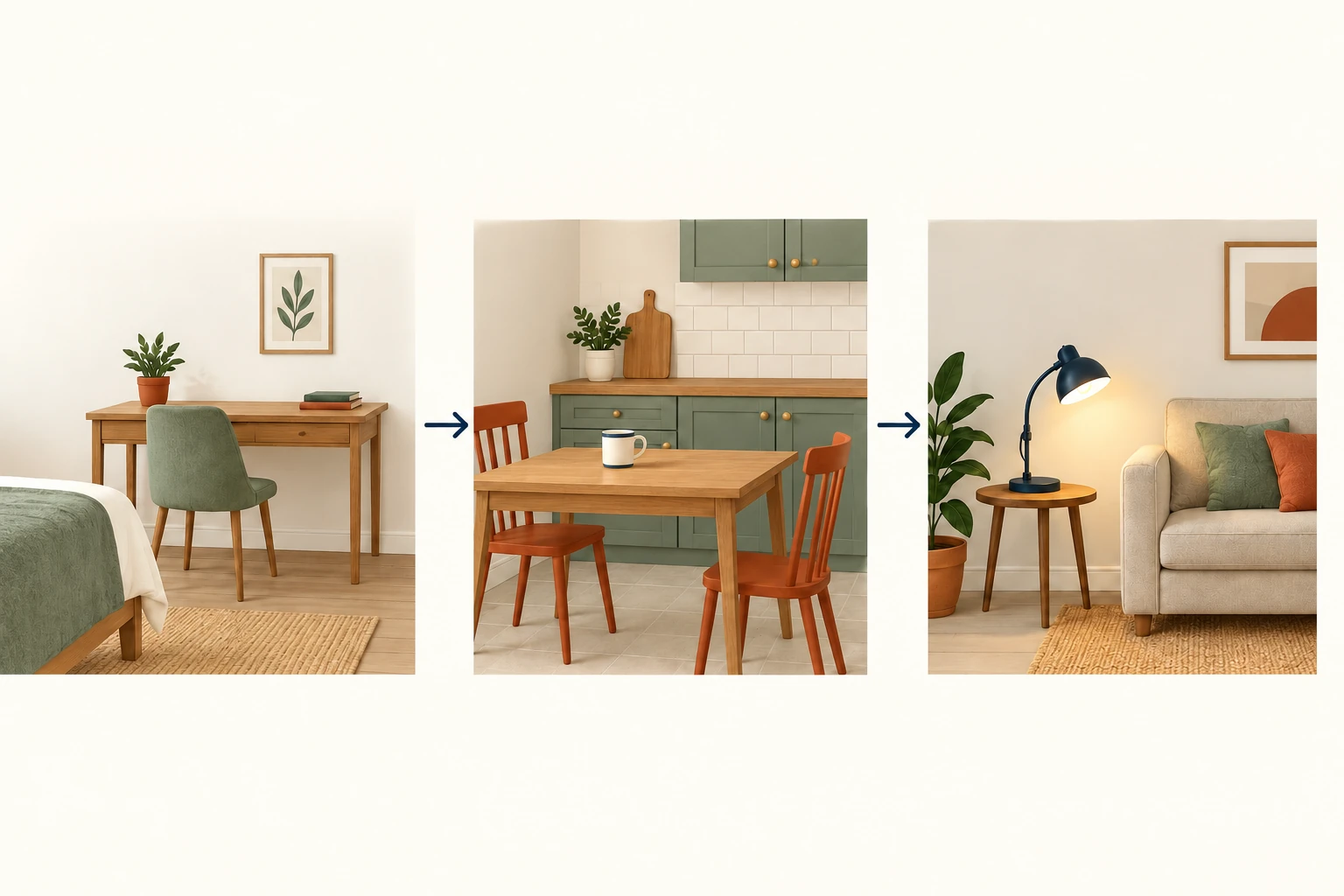
Paul wants his desk lamp. Follow his search through the bedroom, kitchen and living room. The words ici and là-bas depend on where Paul is when he speaks, while the room names remain stable. Fill the ten gaps using the supplied grammatical or meaning hints.
La lampe change de pièce
Paul (chercher, il) sa lampe de bureau. D’habitude, elle est (inside) sa chambre. Il regarde le bureau, mais il n’y a pas (word after pas before an indefinite noun) lampe. « Elle n’est (not) ici », dit-il. Il va dans la cuisine. Une tasse est (on) la table, mais la lampe n’est pas là.
Julie, sa sœur, (être, elle) dans le salon. Elle lit (near, before de) du canapé. « Tu cherches (the, feminine singular) lampe ? Elle est là-bas, sur la petite table ! » Paul entre dans le salon. Il y (missing word in il y a) bien une lampe sur cette table. C’est la sienne. Il (prendre, il) la lampe et retourne dans sa chambre. Julie ouvre les rideaux pour lire près de la fenêtre.
Read it in English
Paul is looking for his desk lamp. Usually, it is in his bedroom. He looks at the desk, but there is no lamp. “It isn’t here,” he says. He goes into the kitchen. A cup is on the table, but the lamp is not there.
Julie, his sister, is in the living room. She is reading near the sofa. “Are you looking for the lamp? It’s over there, on the little table!” Paul enters the living room. There is indeed a lamp on that table. It is his. He takes the lamp and goes back to his bedroom. Julie opens the curtains to read near the window.
Here changes with the person’s position
Paul says Elle n’est pas ici while he is in the bedroom. Ici therefore refers to that room at that moment. Julie says là-bas from within the living room, pointing toward the small table. The next sentence names the living room again, so the reader can locate the lamp even without seeing her gesture.
| Room | Object detail | Does Paul find his lamp there? |
|---|---|---|
| Bedroom | The usual desk place is empty. | No |
| Kitchen | A cup is on the table. | No |
| Living room | The lamp is on the small table. | Yes |
A location phrase such as sur la petite table is more precise than là-bas by itself. In a spoken search, the two can work together with a gesture. In a written story or message, adding the room name keeps the reference usable for someone who cannot see the speaker.