Conjugation table
Tourner in French: verb forms for turning a corner or a page
Conjugate tourner for directions and turning a page. Start with the present, then use seven reference sections, construction contrasts, mistakes and a quiz.
- A2
- 7 tenses
- Auxiliary: avoir
- Learn this in the A2 notebook →
In short
Tourner is regular: je tourne, nous tournons, vous tournez. For directions, say tourner à gauche / à droite. With an object, say tourner la page: turn the page. Both uses take avoir in the completed past examples here: j’ai tourné.
Yellow the idea to rememberBlue French to learn
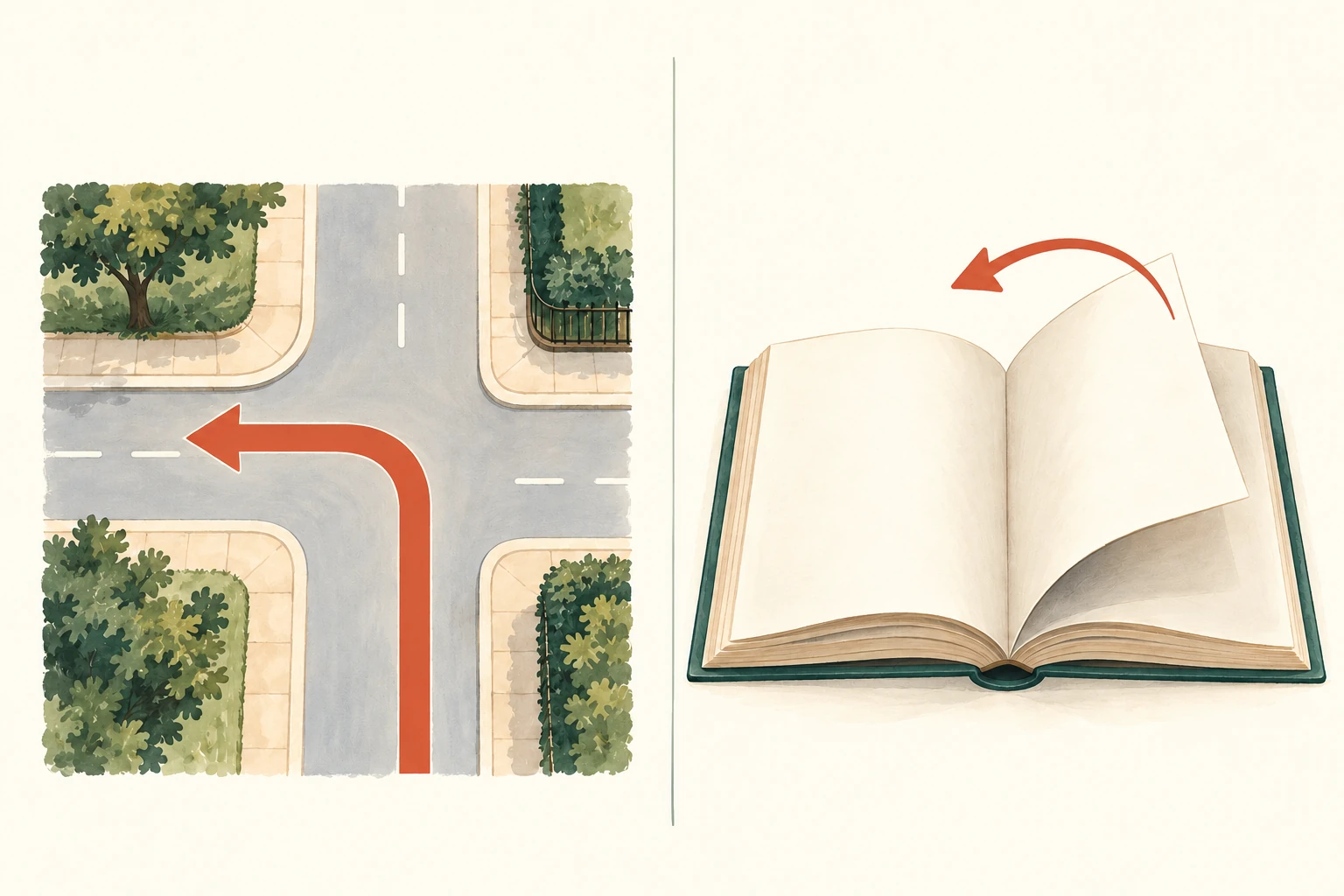
A street instruction and a page-turning action use the same verb forms, but the words after tourner differ. In Tu tournes à gauche, the phrase à gauche gives a direction. In Tu tournes la page, la page is the thing being turned. Start by recognising that construction difference in the present.
- Infinitive
- tourner
- Past participle
- tourné
- Present participle
- tournant
- Auxiliary
- avoir
PrésentPresent-first core · a current turn or regular action
| je | tourne |
| tu | tournes |
| il / elle / on | tourne |
| nous | tournons |
| vous | tournez |
| ils / elles | tournent |
Vous tournez à droite après la pharmacie.
You turn right after the pharmacy.
Passé composéReference extension · a completed turn
| j’ | ai tourné |
| tu | as tourné |
| il / elle / on | a tourné |
| nous | avons tourné |
| vous | avez tourné |
| ils / elles | ont tourné |
J’ai tourné la page.
I turned the page.
ImparfaitReference extension · an ongoing or habitual past action
| je | tournais |
| tu | tournais |
| il / elle / on | tournait |
| nous | tournions |
| vous | tourniez |
| ils / elles | tournaient |
Le ventilateur tournait près de la fenêtre.
The fan was turning near the window.
Futur simpleReference extension · a future action
| je | tournerai |
| tu | tourneras |
| il / elle / on | tournera |
| nous | tournerons |
| vous | tournerez |
| ils / elles | tourneront |
Nous tournerons à gauche au prochain carrefour.
We will turn left at the next crossroads.
Conditionnel présentReference extension · a hypothetical action
| je | tournerais |
| tu | tournerais |
| il / elle / on | tournerait |
| nous | tournerions |
| vous | tourneriez |
| ils / elles | tourneraient |
À ta place, je tournerais à droite ici.
In your place, I would turn right here.
Subjonctif présentReference extension · an action after a subjunctive trigger
| je | tourne |
| tu | tournes |
| il / elle / on | tourne |
| nous | tournions |
| vous | tourniez |
| ils / elles | tournent |
Il faut que tu tournes la page doucement.
You need to turn the page gently.
ImpératifReference extension · a route instruction or request
| (tu) | tourne |
| (nous) | tournons |
| (vous) | tournez |
Tournez à gauche, puis continuez tout droit.
Turn left, then continue straight on.
Direction phrase or direct object?
| French | Construction | Meaning |
|---|---|---|
| Elle tourne à gauche. | No direct object; à gauche gives direction | She turns left. |
| Elle tourne la page. | La page is the direct object | She turns the page. |
| La roue tourne. | No direct object | The wheel turns. |
Do not add à before la page in the ordinary object-taking expression. Conversely, keep à in à gauche and à droite. Tourner also has wider uses, such as filming, but the examples on this page centre on a turn in movement or a concrete object turning.
The regular forms keep tourn-
The present nous form is tournons, with one n at the end of the stem and the -ons ending. The past participle tourné carries an acute accent. Future tournerons retains the infinitive tourner before -ons, whereas present tournons does not include er.
| Incorrect | Correct | Reason |
|---|---|---|
| Nous tourneront | Nous tournons | For a present action with nous, use tournons. The future would be tournerons. |
| Elle a tourner | Elle a tourné | The compound past needs the participle. |
| Tournes à gauche ! | Tourne à gauche ! | The ordinary tu imperative has no final s. |
| Il tourne la gauche | Il tourne à gauche | The route expression uses à gauche. |
Practise the two core meanings side by side: Je tourne à droite. Je tourne la page. Then change je to nous and vous. Keeping the two endings and the following phrases distinct makes the same conjugation useful in more than one everyday task.