Conjugation table
Traverser conjugation: cross the road with a direct object
Use traverser with a road, bridge or courtyard directly after the verb. Learn seven tense sections, regular endings, construction mistakes and a form quiz.
- A2
- 7 tenses
- Auxiliary: avoir
- Learn this in the A2 notebook →
In short
Say traverser la rue, with la rue directly after the verb. The regular present is je traverse, nous traversons, vous traversez. The completed past uses avoir: j’ai traversé. A road or bridge is the direct object of traverser; do not insert à or de before it.
Yellow the idea to rememberBlue French to learn
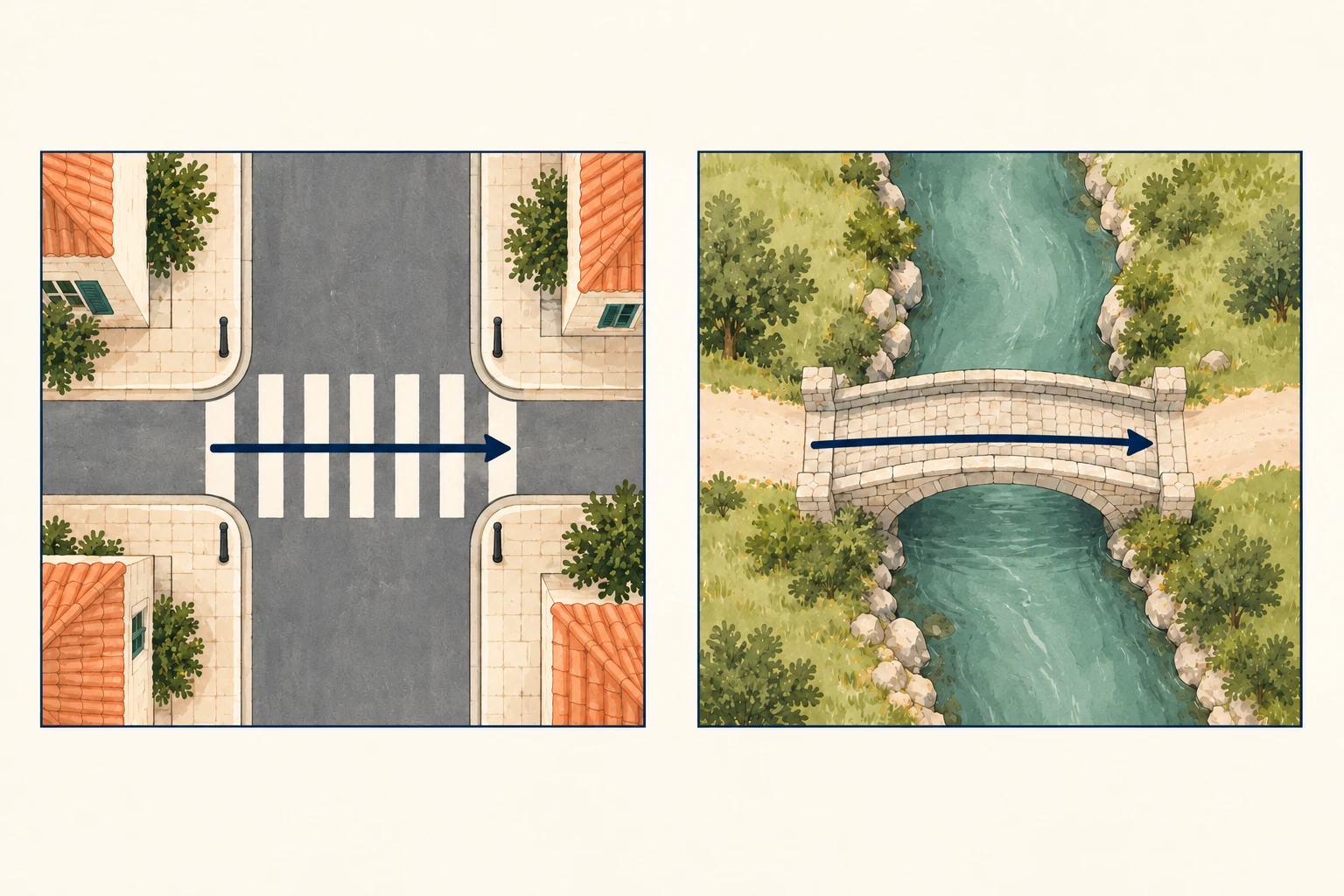
A route may ask you to go across a square, a courtyard or a bridge. Traverser names that crossing. The place being crossed follows directly: traverser la place, traverser la cour, traverser le pont. A later phrase can add the way you travel, such as à pied, without changing the direct object.
- Infinitive
- traverser
- Past participle
- traversé
- Present participle
- traversant
- Auxiliary
- avoir
PrésentCore pattern · crossing now or as part of a route
| je | traverse |
| tu | traverses |
| il / elle / on | traverse |
| nous | traversons |
| vous | traversez |
| ils / elles | traversent |
Nous traversons la place.
We cross the square.
Passé composéReference extension · a completed crossing
| j’ | ai traversé |
| tu | as traversé |
| il / elle / on | a traversé |
| nous | avons traversé |
| vous | avez traversé |
| ils / elles | ont traversé |
J’ai traversé le pont.
I crossed the bridge.
ImparfaitReference extension · an ongoing or repeated past crossing
| je | traversais |
| tu | traversais |
| il / elle / on | traversait |
| nous | traversions |
| vous | traversiez |
| ils / elles | traversaient |
Elle traversait ce parc chaque matin.
She used to cross this park every morning.
Futur simpleReference extension · a crossing later
| je | traverserai |
| tu | traverseras |
| il / elle / on | traversera |
| nous | traverserons |
| vous | traverserez |
| ils / elles | traverseront |
Vous traverserez la cour avant d’entrer.
You will cross the courtyard before going in.
Conditionnel présentReference extension · a hypothetical route
| je | traverserais |
| tu | traverserais |
| il / elle / on | traverserait |
| nous | traverserions |
| vous | traverseriez |
| ils / elles | traverseraient |
Avec un guide, nous traverserions le village à pied.
With a guide, we would cross the village on foot.
Subjonctif présentReference extension · after a trigger such as il faut que
| je | traverse |
| tu | traverses |
| il / elle / on | traverse |
| nous | traversions |
| vous | traversiez |
| ils / elles | traversent |
Il faut que nous traversions la cour pour atteindre l’accueil.
We need to cross the courtyard to reach reception.
ImpératifReference extension · a route instruction
| (tu) | traverse |
| (nous) | traversons |
| (vous) | traversez |
Traversez la place, puis prenez la rue à gauche.
Cross the square, then take the street on the left.
Do not copy the preposition from another route verb
Nous traversons le parc à pied.
We cross the park on foot.
Nous passons par le parc.
We go through the park.
Traverser le parc makes le parc the direct object. Passer par le parc uses another construction, with par. Both can describe a route through the park, but their structures are different. Keep the whole chunk with its verb rather than moving par into traverser par le parc.
A stable stem with regular endings
The stem travers- remains visible in traverse, traversons and traversaient. The future uses traverser-: traverserai, traverserons. The extra er distinguishes nous traverserions, conditional, from nous traversions, imparfait or present subjunctive according to context.
| Form | Use | Example |
|---|---|---|
| Traverser | Infinitive | Je vais traverser la cour. |
| Traversez | Present vous or imperative | Vous traversez la place. |
| Traversé | Past participle | Elle a traversé le village. |
| Traversions | Imparfait or subjunctive | Il faut que nous traversions la cour. |
To build a route sentence, put one crossing action before the next direction: Traverse la place, puis tourne à gauche. Each imperative gives one task, and puis connects their order. Change the place noun to practise the construction while preserving the regular verb form.