Myth or fact
What does fait maison mean on a French food notice?
Interpret fait maison in an informal French shared-meal note. Compare homemade and bought food, then practise fait, faite, faits and faites agreement.
- A1
- 5 claims
- Vrai ou faux ?
- Learn this in the A1 notebook →
In short
In this informal note, fait maison means homemade. The word fait agrees with the food noun: un gâteau fait maison, une salade faite maison, des biscuits faits maison, des tartes faites maison. Maison stays unchanged. Read the maker’s statement to distinguish homemade food from something bought.
Yellow the idea to rememberBlue French to learn
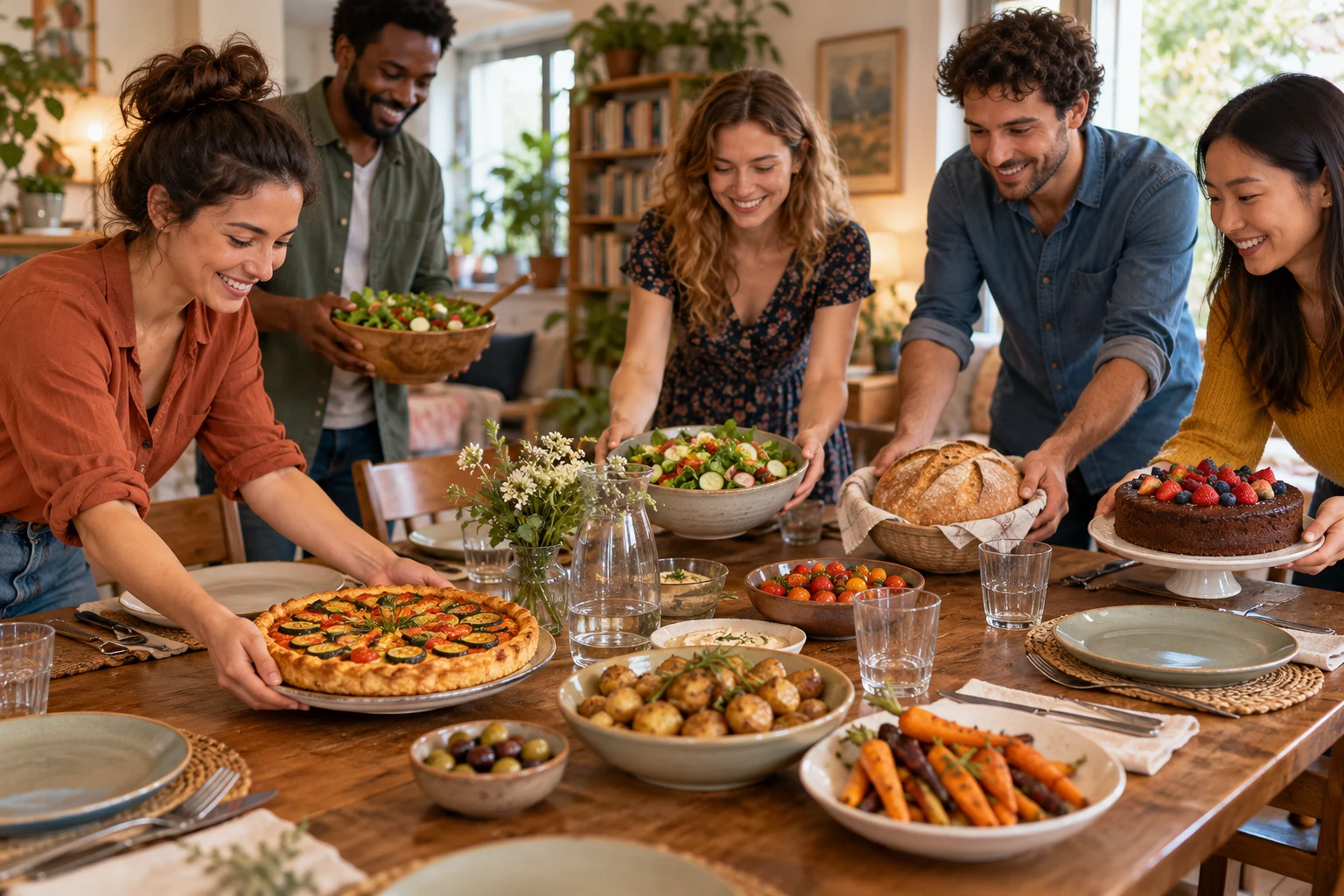
Friends are bringing food to a shared meal. Two people explain where their contribution comes from. Read their messages to distinguish making food from buying it, then choose the agreement in four food labels.
Pour le repas de samedi
Nora
J’apporte une salade faite maison. La salade, je l’ai faite moi-même.
Hugo
J’apporte un gâteau. Je l’ai acheté à la boulangerie.
Vrai ou faux ? Decide before you see the verdict.
Nora says she made the salad herself.
VraiNora writes La salade, je l’ai faite moi-même. That explicitly identifies her as its maker.
The note says that Hugo made the cake himself.
FauxHugo says Je l’ai acheté à la boulangerie. The cake is bought, unlike Nora’s homemade salad.
Maison stays unchanged in the four example labels.
VraiThe labels use fait, faite, faits and faites, but maison remains the same word each time.
The plural label for biscuits uses faits.
VraiBiscuits is masculine plural, so the supplied label is biscuits faits maison.
Fait maison in this note proves that a dish is healthier or tastes better.
FauxThe note describes who prepared the food. It gives no nutrition measurement or quality comparison.
Make fait agree; leave maison alone
| Food noun | Label | Agreement |
|---|---|---|
| Un gâteau | Un gâteau fait maison | Masculine singular: fait |
| Une salade | Une salade faite maison | Feminine singular: faite |
| Des biscuits | Des biscuits faits maison | Masculine plural: faits |
| Des tartes | Des tartes faites maison | Feminine plural: faites |
In these descriptions, fait changes to match the gender and number of the food. Salade is feminine, so use faite. Tartes is feminine plural, so use faites. Maison does not become maisons in the plural labels. The agreement tells you how the expression attaches to the noun, rather than adding a new kind of food.
The surrounding sentence supplies the contrast
Je l’ai faite moi-même says I made it myself when l’ refers to la salade. The feminine e in faite matches that preceding feminine object. This completed-tense sentence is useful as a recognition chunk at A1; the main label pattern remains salade faite maison. Je l’ai acheté says I bought it when the reference is the masculine gâteau.
Cette tarte est faite maison.
This tart is homemade.
Ces biscuits sont faits maison.
These biscuits are homemade.
Preparation and ingredients are separate details. Fait maison identifies homemade preparation in this note. To find out about an ingredient, ask a specific question such as Il y a des noix dedans ? The maker can then give the detail you need.