Conjugation table
Déménager conjugation: déménageons, déménagions and déménagé
Conjugate déménager with the correct g/ge spelling. Learn déménageons, déménagions and déménagé in seven sections, plus moving-from and moving-to examples.
- A2
- 7 tenses
- Auxiliary: avoir
- Learn this in the A2 notebook →
In short
Write nous déménageons but nous déménagions. The extra e before o preserves the soft g in the present. Before i, that extra e is unnecessary. The compound past uses avoir: j’ai déménagé. Moving house does not make this verb take être.
Yellow the idea to rememberBlue French to learn
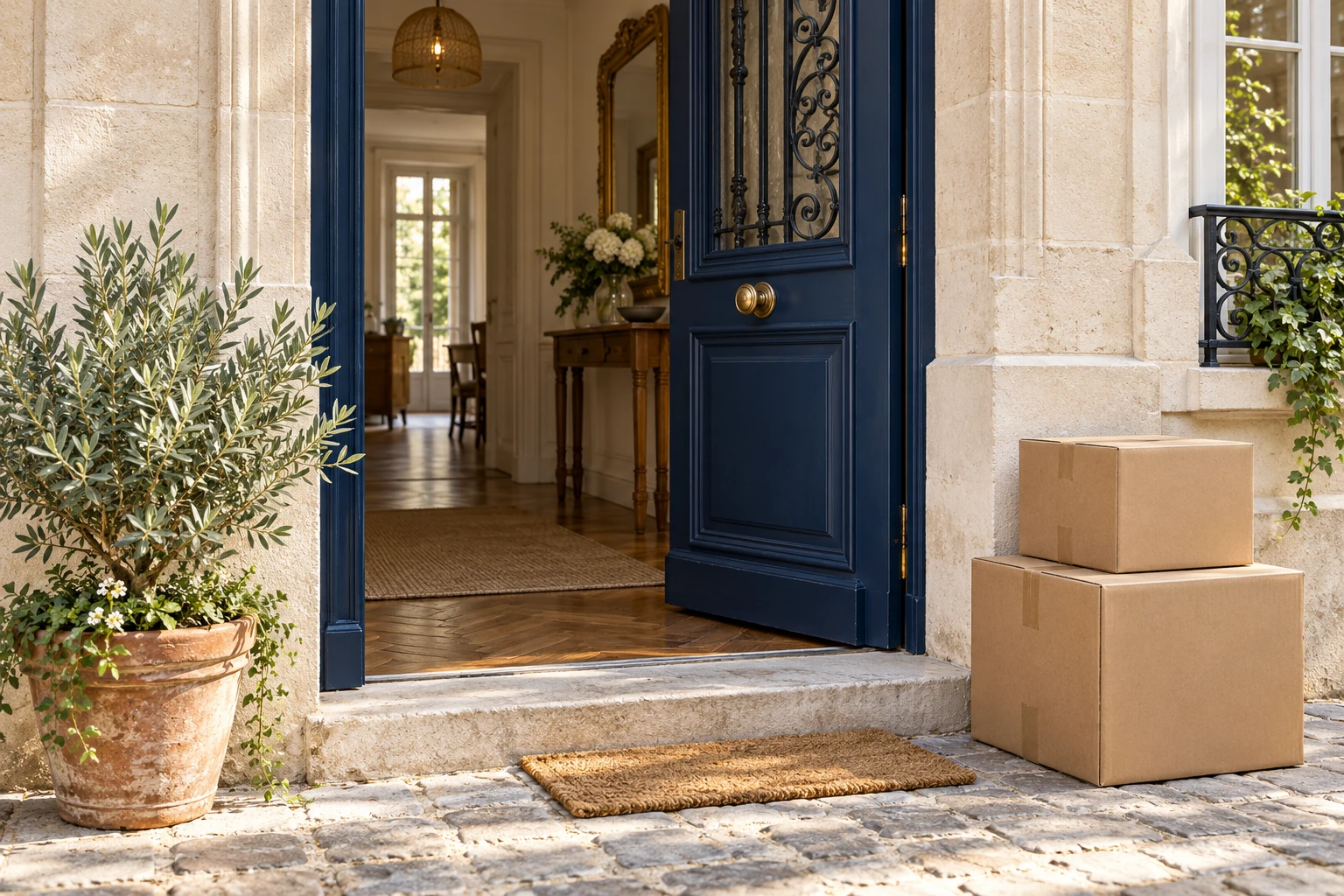
Déménager follows an -er pattern with a spelling adjustment around g. Keep the ending and the stem spelling connected: déménage-ons in the present, déménag-ions in the imparfait. The seven sections keep the present as the starting point and label the remaining tenses as reference material.
- Infinitive
- déménager
- Past participle
- déménagé
- Present participle
- déménageant
- Auxiliary
- avoir
PrésentForms · moving house now or in a scheduled plan
| je | déménage |
| tu | déménages |
| il / elle / on | déménage |
| nous | déménageons |
| vous | déménagez |
| ils / elles | déménagent |
Nous déménageons à Rouen.
We are moving to Rouen.
Passé composéA completed move
| j’ | ai déménagé |
| tu | as déménagé |
| il / elle / on | a déménagé |
| nous | avons déménagé |
| vous | avez déménagé |
| ils / elles | ont déménagé |
J’ai déménagé de Rouen à Caen.
I moved from Rouen to Caen.
ImparfaitAn ongoing or repeated move in the past
| je | déménageais |
| tu | déménageais |
| il / elle / on | déménageait |
| nous | déménagions |
| vous | déménagiez |
| ils / elles | déménageaient |
Nous déménagions souvent à cette époque-là.
We used to move often at that time.
Futur simpleMoving later
| je | déménagerai |
| tu | déménageras |
| il / elle / on | déménagera |
| nous | déménagerons |
| vous | déménagerez |
| ils / elles | déménageront |
Vous déménagerez en septembre.
You will move in September.
Conditionnel présentA hypothetical move
| je | déménagerais |
| tu | déménagerais |
| il / elle / on | déménagerait |
| nous | déménagerions |
| vous | déménageriez |
| ils / elles | déménageraient |
Avec un travail plus proche, je ne déménagerais pas.
With a job closer by, I would not move.
Subjonctif présentAfter a subjunctive trigger
| je | déménage |
| tu | déménages |
| il / elle / on | déménage |
| nous | déménagions |
| vous | déménagiez |
| ils / elles | déménagent |
Il faut que nous déménagions avant octobre.
We need to move before October.
ImpératifA direct instruction, stronger than advice
| (tu) | déménage |
| (nous) | déménageons |
| (vous) | déménagez |
Déménageons d’abord les cartons, puis les meubles.
Let’s move the boxes first, then the furniture.
Look at the vowel following g
| Form | Spelling clue | Context |
|---|---|---|
| Déménageons | Ge before o | Nous present or imperative |
| Déménageais | Ge before a | Je / tu imparfait |
| Déménagions | G before i | Nous imparfait or subjunctive |
| Déménagiez | G before i | Vous imparfait or subjunctive |
| Déménageant | Ge before a | Present participle |
The past participle déménagé ends in -é. The future déménagerai keeps the complete infinitive before the ending. Do not add another e to déménagions by copying the present nous form unchanged. The following vowel is different.
Name the destination and origin clearly
Elle déménage à Lille pour son travail.
She is moving to Lille for work.
Nous avons déménagé de Caen à Rouen.
We moved from Caen to Rouen.
À introduces the destination town in these examples; de introduces the starting town. Déménager concerns changing home or moving possessions. Emménager focuses on settling into a new home. The imperative example in the table uses the transitive possession-moving meaning: déménager les cartons.
- Nous déménagons samedi.Nous déménageons samedi.
Keep e before -ons to preserve the soft g sound.
- Nous déménageions souvent.Nous déménagions souvent.
The i in -ions already preserves the soft g sound; do not insert e.
Practise the three forms together: nous déménageons, nous déménagions, nous avons déménagé. Each preserves the verb’s sound while using the spelling and auxiliary required by its construction.