Conjugation table
Être conjugation: present, past, future and everyday uses
Conjugate être in seven essential tenses and moods, then practise c’est, être en train de and être à with examples, common mistakes and a quiz.
- A1
- 7 tenses
- Auxiliary: avoir
- Learn this in the A1 notebook →
In short
Être means ‘to be’: je suis, tu es, il est, nous sommes, vous êtes, ils sont. Its past participle is été, used with avoir: j’ai été. Start with the present; the other tables give you the forms for past events, future plans and later course work.
Yellow the idea to rememberBlue French to learnRed watch out
- Infinitive
- être
- Past participle
- été
- Present participle
- étant
- Auxiliary
- avoir
Présentidentity, location and a state now
| je | suis |
| tu | es |
| il / elle / on | est |
| nous | sommes |
| vous | êtes |
| ils / elles | sont |
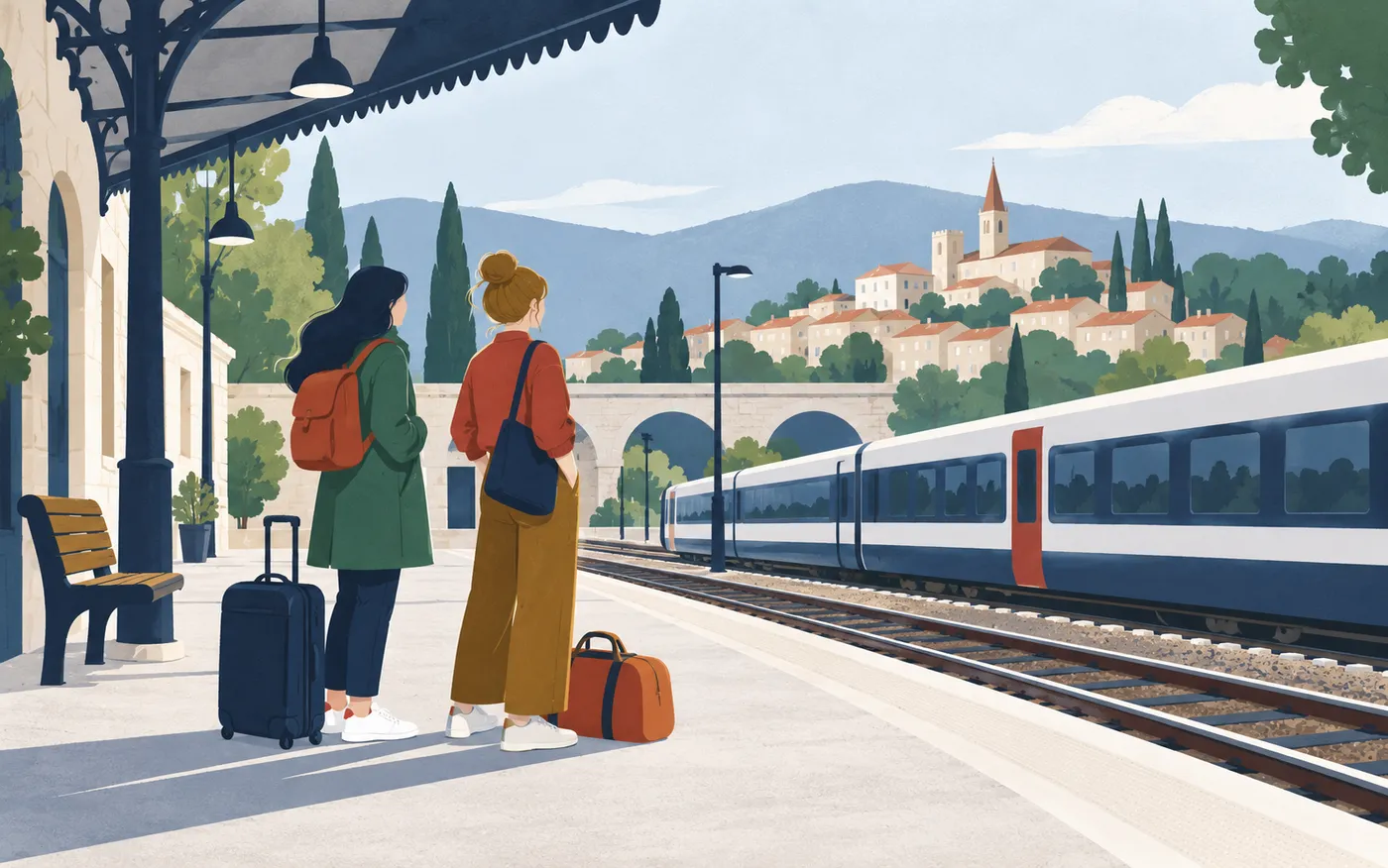
Nous sommes à la gare.
We are at the station.
Passé composéa completed past period or experience
| j’ | ai été |
| tu | as été |
| il / elle / on | a été |
| nous | avons été |
| vous | avez été |
| ils / elles | ont été |
J’ai été malade pendant trois jours.
I was ill for three days.
Imparfaita past state, background or habit
| j’ | étais |
| tu | étais |
| il / elle / on | était |
| nous | étions |
| vous | étiez |
| ils / elles | étaient |
Quand j’étais enfant, j’étais très timide.
When I was a child, I was very shy.
Futur simplea future state
| je | serai |
| tu | seras |
| il / elle / on | sera |
| nous | serons |
| vous | serez |
| ils / elles | seront |
Demain, je serai au bureau.
Tomorrow, I’ll be at the office.
Conditionnel présentan imagined state or a softened response
| je | serais |
| tu | serais |
| il / elle / on | serait |
| nous | serions |
| vous | seriez |
| ils / elles | seraient |
Avec un jardin, cette maison serait parfaite.
With a garden, this house would be perfect.
Subjonctif présentafter expressions such as il faut que
| que je | sois |
| que tu | sois |
| qu’il / elle / on | soit |
| que nous | soyons |
| que vous | soyez |
| qu’ils / elles | soient |
Il faut que vous soyez à l’heure.
You need to be on time.
Impératifan instruction or encouragement
| (tu) | sois |
| (nous) | soyons |
| (vous) | soyez |
Sois patient ! Soyez prudents !
Be patient! Be careful!
What are the most common expressions with être?
| Pattern | Example | Meaning |
|---|---|---|
| être + adjective | Léa est prête. | Léa is ready. |
| c’est + noun phrase | C’est une bonne idée. | That’s a good idea. |
| être en train de + infinitive | Je suis en train de cuisiner. | I’m cooking right now. |
| être à + person | Ce sac est à Léa. | This bag belongs to Léa. |
| être à + place | Léa est à Paris. | Léa is in Paris. |
C’est introduces or identifies: C’est mon voisin. For a plural noun phrase, use ce sont in careful writing: Ce sont mes voisins. Describe a known person with il est or elle est: Elle est gentille. A profession used this way usually has no article: Elle est médecin.
Être en train de highlights an action in progress. The ordinary present also translates English ‘am doing’: Je cuisine can mean ‘I’m cooking’. With ownership, change the person after à: C’est à moi, c’est à toi, c’est à elle. The verb follows the object: Ces clés sont à moi.
What mistakes do learners make with être?
- Je suis été malade.J’ai été malade.
The passé composé of être uses avoir. The participle été stays unchanged.
- Elles sont prêt.Elles sont prêtes.
An adjective after être agrees with its subject: feminine plural prêtes.
- Je suis vingt ans.J’ai vingt ans.
Age uses avoir in French. English ‘I am’ cannot be translated word for word here.
- Je suis en train cuisiner.Je suis en train de cuisiner.
Keep de before the infinitive; it becomes d’ before a vowel: en train d’écrire.