L'intrus
French people words: collègue, voisin and colocataire in one home
Tell French coworkers, neighbours and roommates apart using explicit descriptions. Six odd-one-out rows show which relationship each sentence actually supports.
- A1
- 6 rows
- Find the odd one out
- Learn this in the A1 notebook →
In short
A collègue works with you, a voisin / une voisine lives nearby, and a colocataire shares your rented home. Someone can hold more than one of these relationships. Use the facts stated in each row, rather than assuming the labels are mutually exclusive.
Yellow the idea to rememberBlue French to learn
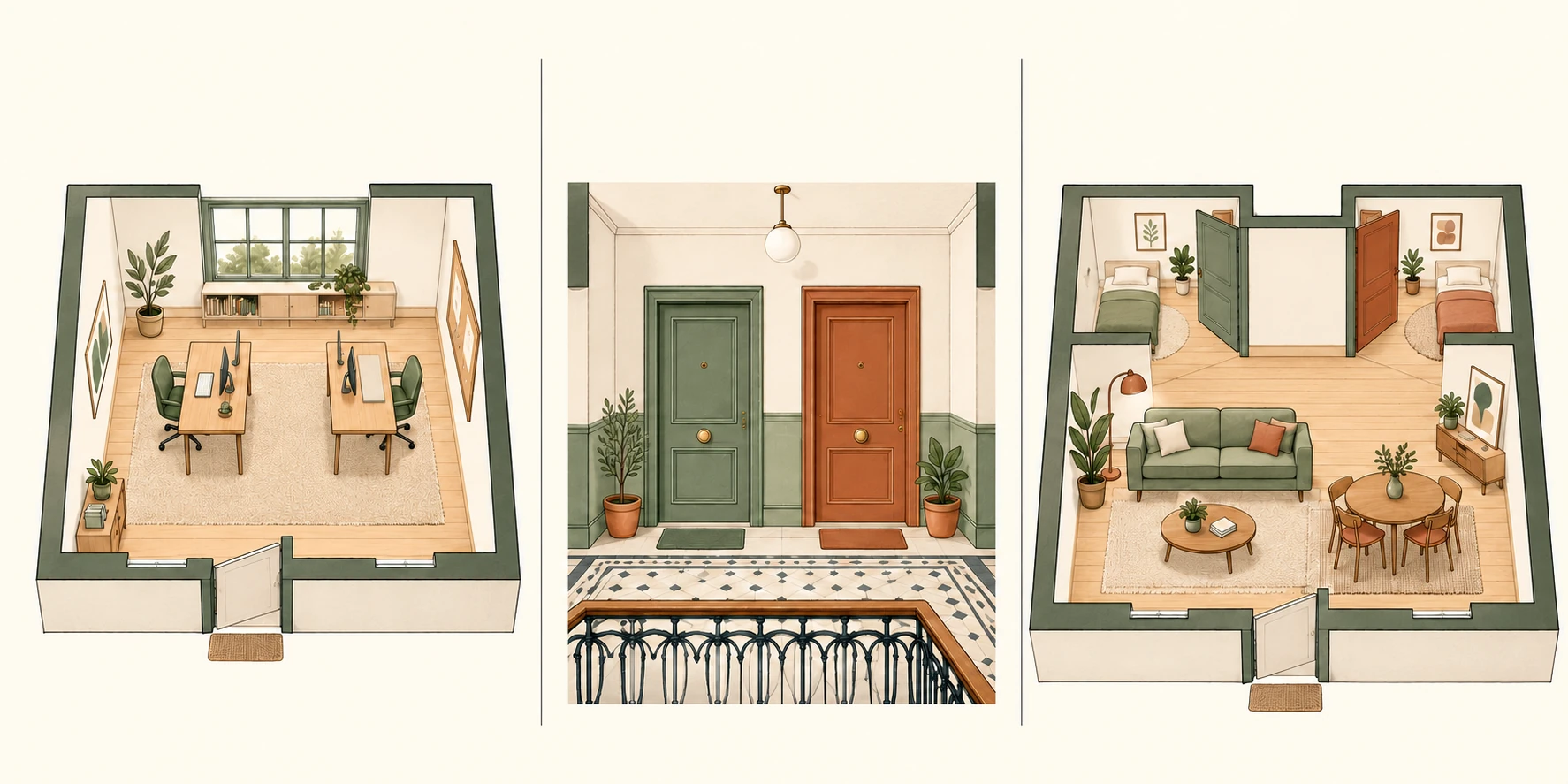
Nora is the reference person throughout. Each row is a separate practice scenario, so the names do not build one large household. In rows 3 and 6, Nora and the people sharing her apartment rent it together. Three descriptions match the row’s stated grouping. Choose the one that explicitly describes a different situation.
| Row | Group to keep | What must be stated |
|---|---|---|
| 1 | Coworkers in Nora’s team | Working with Nora in the same team |
| 2 | Neighbours in Nora’s building | Living in the same building as Nora |
| 3 | People sharing Nora’s apartment | Sharing that apartment |
| 4 | Coworkers at Nora’s office | Working with Nora at the office |
| 5 | Neighbours in Nora’s building | Living in Nora’s building |
| 6 | People sharing Nora’s apartment | Sharing that apartment |
Tap the word that doesn't belong in each row.
Mina is described as living nearby but working elsewhere; the other three work in Nora’s team.
Inès lives in a different building far away; the other three share Nora’s building.
Louis has a separate apartment next door; he does not share the apartment with Nora.
Noé is explicitly not a coworker; the other three work with Nora at the office.
Marc lives in another town; the other three live in Nora’s building.
Axel lives with his parents rather than in Nora’s shared apartment.
One person can be both
Ma collègue est aussi ma voisine.
My coworker is also my neighbour.
That sentence gives two relationships with the same person. It does not say that the two people share an apartment. Two separate apartments in one building can make people neighbours. In contrast, partager l’appartement explicitly tells you that people live in the same apartment.
Nous habitons dans le même immeuble, mais dans deux appartements différents.
We live in the same building, but in two different apartments.
Articles identify the person
| Masculine | Feminine | Relationship |
|---|---|---|
| Un collègue | Une collègue | Coworker |
| Un voisin | Une voisine | Neighbour |
| Un colocataire | Une colocataire | Roommate / flatmate in a shared rented home |
Collègue and colocataire have the same written noun form with un and une. Voisin adds e for voisine. Mon voisin and ma voisine tell you whose neighbour you mean; Nora’s neighbours become mes voisins when Nora herself speaks.
Use a full description when the relationship matters: Elle habite dans mon immeuble or Nous partageons un appartement. The first supplies a building relationship; the second supplies a shared home. Neither sentence alone tells you whether the people also work together.