Sorting game
French recent past: je viens de partir versus je viens du bureau
Sort venir de sentences into recent actions and places of origin. Use the infinitive or place name after de to distinguish the two meanings.
- A2
- 10 words to sort
- 2 boxes
- Tap to play
- Learn this in the A2 notebook →
In short
Venir de + infinitive says an action has just happened; venir de + place gives an origin. Je viens de partir means “I’ve just left”. Je viens du bureau means “I’m coming from the office”. Look at what follows de, d’ or du.
Yellow the idea to rememberBlue French to learn
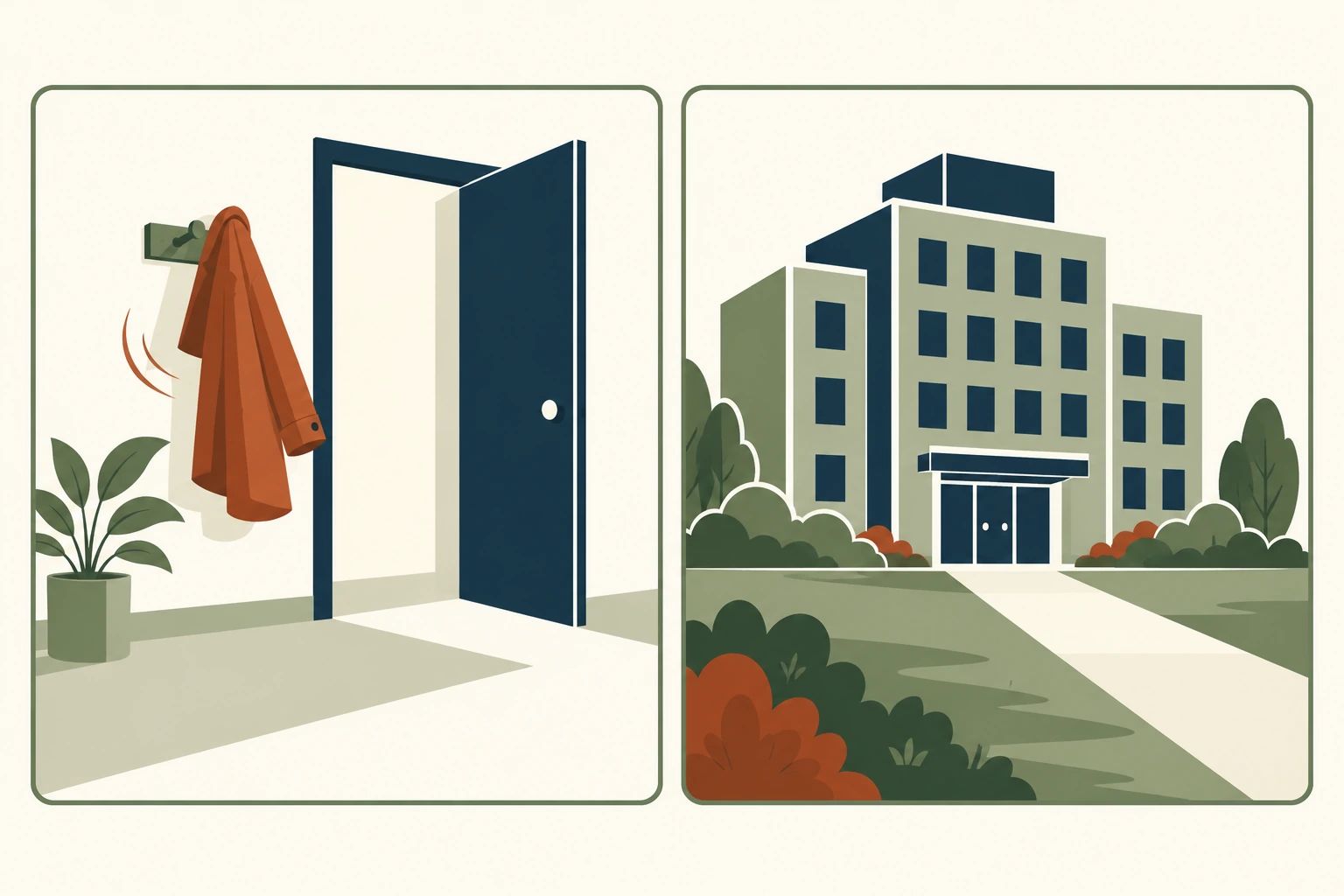
The same verb can introduce two different pieces of information. In the recent-past construction, partir is an infinitive naming the action. In the origin construction, le bureau is a place and de + le contracts to du. Do not translate every sentence beginning je viens as “I have just”.
Tap a word, then the box it belongs in.
D’ alone does not settle the meaning
Compare d’arriver and d’Italie. Both have an apostrophe because the following word starts with a vowel, but arriver is a verb and Italie is a place name. The apostrophe is a spelling clue about elision, not a guarantee of the recent past. Read the whole following word.
Je viens d’Italie et je viens d’arriver à l’hôtel.
I’m coming from Italy and I’ve just arrived at the hotel.
Keep the action and the origin distinct
Je viens de quitter l’hôtel contains a place later in the sentence, but the word immediately following de is quitter. The structure therefore describes a recent departure. Je viens de l’hôtel contains no infinitive after de and identifies the origin. A place elsewhere in the sentence does not remove the recent-action construction.
| French | Following element | Meaning |
|---|---|---|
| de partir | partir: infinitive | has just left |
| du bureau | le bureau: place | from the office |
| d’arriver | arriver: infinitive | has just arrived |
| d’Italie | Italie: country | from Italy |
For a final spoken practice, give your origin and one recent action in separate clauses. Keep the nouns and infinitives clear: Je viens de la gare. Je viens d’acheter mon billet. This lets the listener follow both the route and the sequence of events.