Gap-fill
Past habits in French: complete a childhood memory
Complete a French childhood memory with the imparfait. Compare habitual would, present routines and a completed series of repeated events.
- A2
- 8 gaps
- Translation included
- Learn this in the A2 notebook →
In short
Use the imparfait for a past routine: Le dimanche, nous allions chez mes grands-parents. English “used to” and habitual “would” often match this use. Frequency words describe the pattern; the whole context gives the tense its meaning.
Yellow the idea to rememberBlue French to learn
| Now | In the childhood memory |
|---|---|
| Nous allons chez ma grand-mère. | Nous allions chez ma grand-mère. |
| Elle prépare une tarte. | Elle préparait une tarte. |
| Nous jouons dehors. | Nous jouions dehors. |
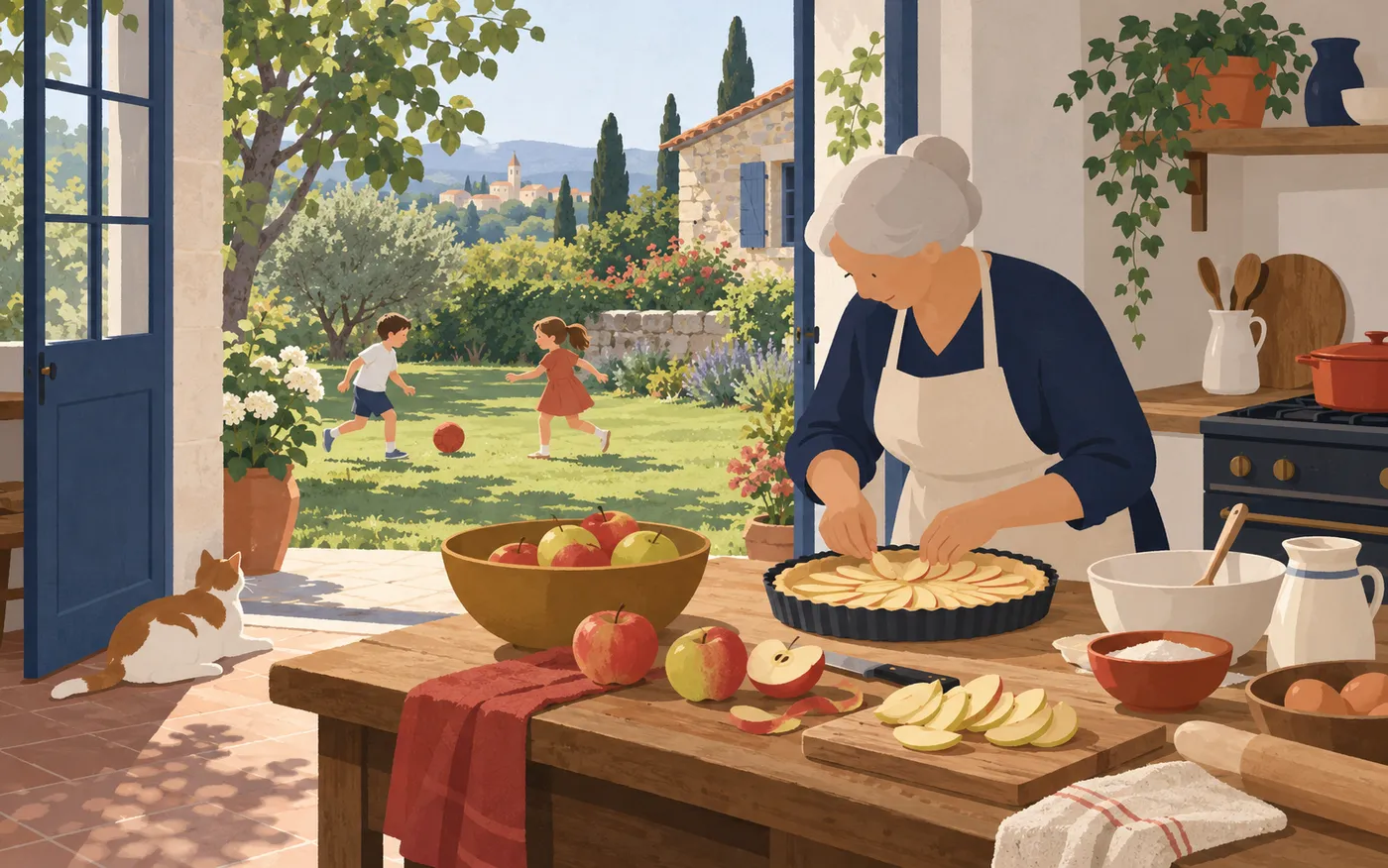
Le dimanche, ma grand-mère préparait une tarte.
On Sundays, my grandmother would make a tart.
Here “would” recalls something she regularly did. For an imagined result, English “would” has another job: Si elle avait le temps, elle préparerait une tarte means “If she had time, she would make a tart.” Préparait recalls the routine; préparerait imagines the result.
Things from the Sunday memory
Find:
Complete the Sunday routine with the imparfait of each hinted verb. The memory is told by a woman, hence petite. Each gap asks for the conjugated verb alone. The final present sentence brings her back to today.
Les dimanches chez mes grands-parents
Quand j’(être) petite, nous (aller) chez mes grands-parents le dimanche. Ils (habiter) à la campagne. Ma grand-mère (préparer) une tarte aux pommes.
Mon grand-père (cultiver) des tomates et il (remplir) l’arrosoir après le repas. Mon frère et moi, nous (jouer) au ballon dans le jardin. Les adultes (discuter) dehors. Ces dimanches me manquent aujourd’hui.
Read it in English
When I was little, we used to go to my grandparents’ on Sundays. They lived in the countryside. My grandmother would make an apple tart.
My grandfather grew tomatoes and would fill the watering can after lunch. My brother and I would play ball in the garden. The adults would chat outside. I miss those Sundays today.
À cette époque, j’appelais ma mère tous les soirs.At that time, I used to call my mother every evening.
Focus: A routine viewed from within that past period.
La semaine dernière, j’ai appelé ma mère tous les soirs.Last week, I called my mother every evening.
Focus: A completed set of calls, summed up over a finished week.
Both sentences contain tous les soirs. The frequency phrase tells you how often the calls happened. The imparfait presents the routine; the passé composé sums up the calls. To make a change explicit, add today’s routine: Avant, j’appelais le soir. Maintenant, j’appelle le matin.