Conjugation table
Marcher: conjugation for walking and things that work
Use marcher for walking and for a device working. Learn its regular present, seven reference sections and the construction difference from faire une marche.
- A2
- 7 tenses
- Auxiliary: avoir
- Learn this in the A2 notebook →
In short
Marcher means walk, and can also mean work or function: je marche, l’imprimante marche. Its regular present plural is nous marchons, vous marchez, ils marchent. The completed past uses avoir: j’ai marché. The subject and situation identify which meaning is intended.
Yellow the idea to rememberBlue French to learn
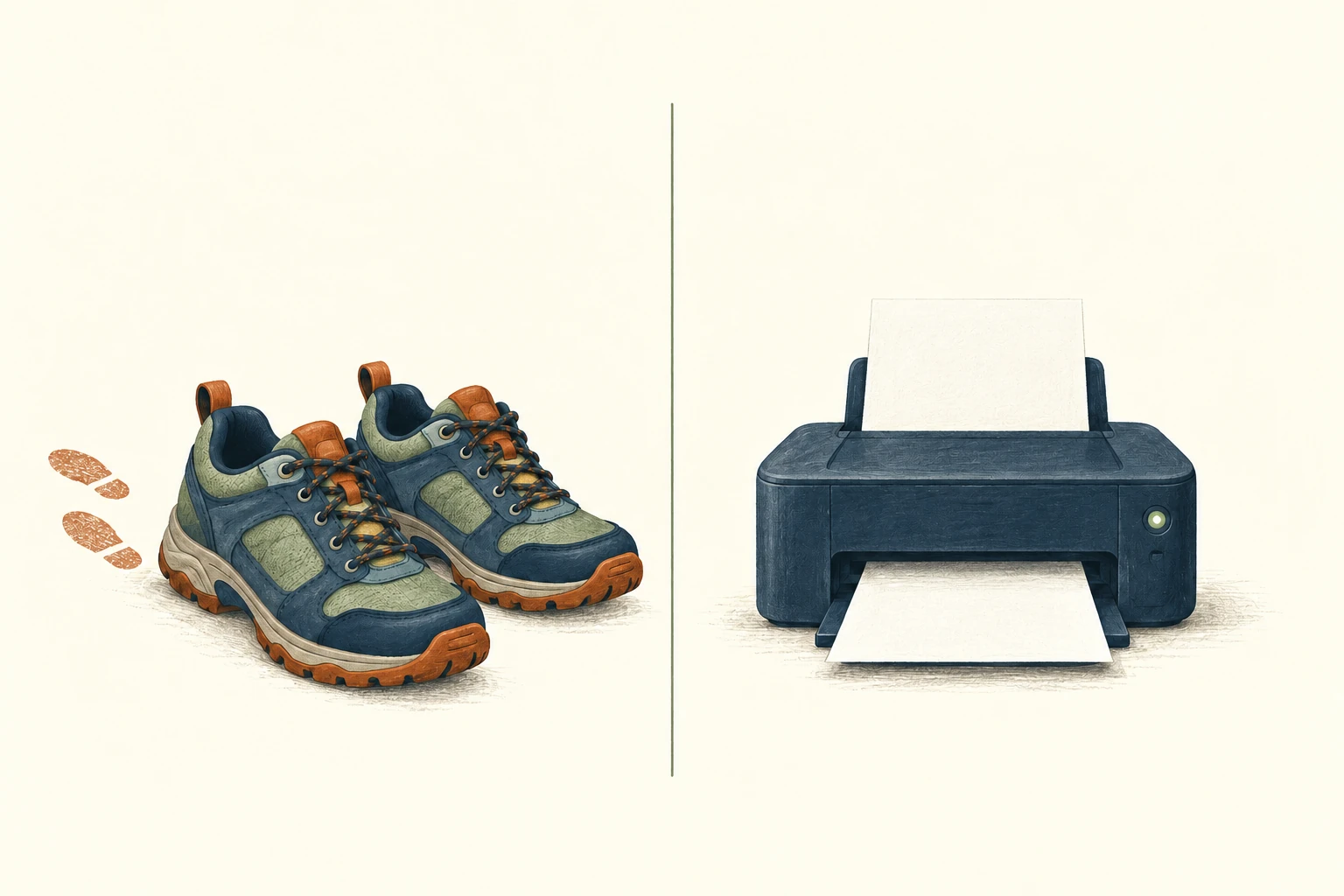
When a person is travelling on foot, marcher describes the movement. When a printer is the subject, marcher commonly means fonctionner, to work. You do not need a different conjugation for the second meaning. Read the subject before choosing the English translation.
- Infinitive
- marcher
- Past participle
- marché
- Present participle
- marchant
- Auxiliary
- avoir
PrésentCore forms · walking or functioning now
| je | marche |
| tu | marches |
| il / elle / on | marche |
| nous | marchons |
| vous | marchez |
| ils / elles | marchent |
Nous marchons jusqu’à la gare.
We walk to the station.
Passé composéReference extension · a completed walk or past functioning
| j’ | ai marché |
| tu | as marché |
| il / elle / on | a marché |
| nous | avons marché |
| vous | avez marché |
| ils / elles | ont marché |
J’ai marché pendant vingt minutes.
I walked for twenty minutes.
ImparfaitReference extension · a past habit or continuing state
| je | marchais |
| tu | marchais |
| il / elle / on | marchait |
| nous | marchions |
| vous | marchiez |
| ils / elles | marchaient |
Cette imprimante marchait très bien avant.
This printer used to work very well.
Futur simpleReference extension · walking or functioning later
| je | marcherai |
| tu | marcheras |
| il / elle / on | marchera |
| nous | marcherons |
| vous | marcherez |
| ils / elles | marcheront |
Demain, vous marcherez avec le groupe.
Tomorrow, you will walk with the group.
Conditionnel présentReference extension · an imagined action or result
| je | marcherais |
| tu | marcherais |
| il / elle / on | marcherait |
| nous | marcherions |
| vous | marcheriez |
| ils / elles | marcheraient |
Avec plus de temps, nous marcherions jusqu’au parc.
With more time, we would walk to the park.
Subjonctif présentReference extension · after a subjunctive trigger
| je | marche |
| tu | marches |
| il / elle / on | marche |
| nous | marchions |
| vous | marchiez |
| ils / elles | marchent |
Je veux que l’imprimante marche pour la réunion.
I want the printer to work for the meeting.
ImpératifReference extension · an instruction or suggestion to walk
| (tu) | marche |
| (nous) | marchons |
| (vous) | marchez |
Marchons jusqu’à la place.
Let’s walk to the square.
Two subjects, two useful translations
Lina marche jusqu’au bureau.Lina walks to the office.
Focus: A person moving on foot
Nous marchons dans le quartier.
We walk around the neighbourhood.
L’imprimante marche.The printer works.
Focus: A device functioning in ordinary speech
Le téléphone ne marche plus.
The phone no longer works.
For a more technical description of a device, fonctionner is a useful alternative. Marche also occurs in Ça marche ! as agreement—That works! or Okay! The conversational situation supplies that meaning; it does not describe someone taking steps.
Faire une marche uses a different verb
Je marche pendant une heure.
I walk for an hour.
Je fais une marche d’une heure.
I go for an hour-long walk.
In the first sentence, marche is a form of the verb marcher. In the second, une marche is a noun after fais, a form of faire. Do not combine them as Je fais marcher for an ordinary walk: faire marcher quelque chose usually means making something work or run.
Present, infinitive and participle
Vous marchez uses the present ending -ez. Vous allez marcher needs the infinitive after allez. Vous avez marché needs the past participle after avez. The accent on marché belongs to that participle, while the infinitive keeps -er.
Use a two-line practice pair with the same ending: Elle marche dans la rue. Cette machine marche bien. Then change each to the completed past. The form remains regular while the subject determines the action you describe.