Conjugation table
Montrer conjugation: show someone, from je montre to j’ai montré
Use montrer to show an object or a room to someone. Learn its present forms, a seven-tense reference and the spelling difference from monter.
- A2
- 7 tenses
- Auxiliary: avoir
- Learn this in the A2 notebook →
In short
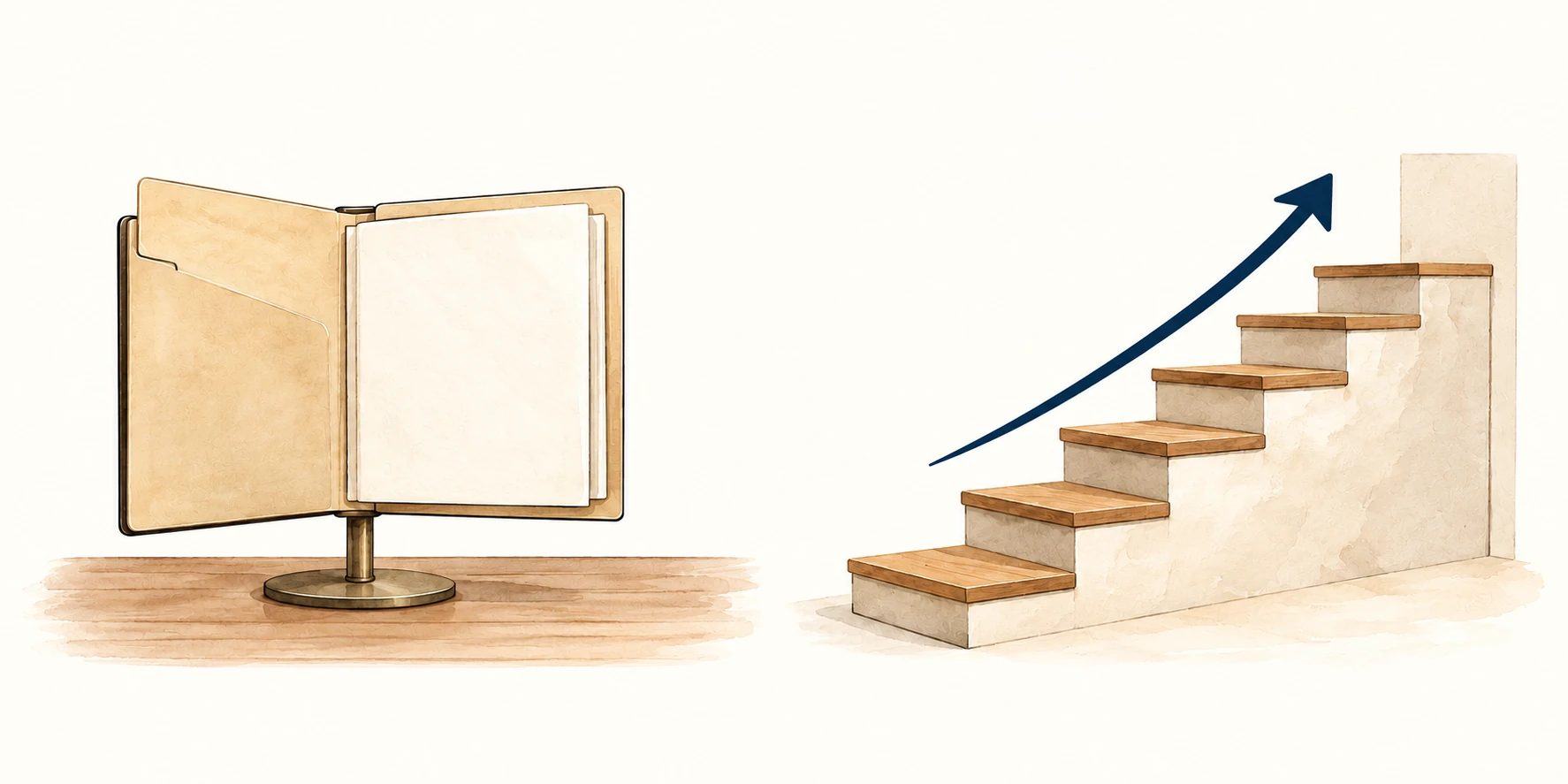
Montrer means to show: je montre, nous montrons, vous montrez. Use montrer quelque chose à quelqu’un: Je montre le plan à Nora. Keep the r: monter, without r before the e, is a different verb meaning to go up or climb in Je monte l’escalier.
Yellow the idea to rememberBlue French to learn
When you welcome someone at home, showing a room combines an action, the room and the visitor. Je montre la cuisine à Léa identifies all three. The direct object is la cuisine; à Léa identifies the person who sees it. Begin with that concrete pattern before exploring the reference tenses.
- Infinitive
- montrer
- Past participle
- montré
- Present participle
- montrant
- Auxiliary
- avoir
PrésentStart here · showing something now or regularly
| je | montre |
| tu | montres |
| il / elle / on | montre |
| nous | montrons |
| vous | montrez |
| ils / elles | montrent |
Je montre la cuisine à Léa.
I show Léa the kitchen.
Passé composéReference extension · a completed act of showing
| j’ | ai montré |
| tu | as montré |
| il / elle / on | a montré |
| nous | avons montré |
| vous | avez montré |
| ils / elles | ont montré |
Nous avons montré le plan à nos amis.
We showed our friends the plan.
ImparfaitReference extension · a repeated or ongoing action in the past
| je | montrais |
| tu | montrais |
| il / elle / on | montrait |
| nous | montrions |
| vous | montriez |
| ils / elles | montraient |
Elle montrait les photos pendant la pause.
She was showing the photos during the break.
Futur simpleReference extension · a future action
| je | montrerai |
| tu | montreras |
| il / elle / on | montrera |
| nous | montrerons |
| vous | montrerez |
| ils / elles | montreront |
Vous montrerez votre billet à l’entrée.
You will show your ticket at the entrance.
Conditionnel présentReference extension · an imagined action or advice
| je | montrerais |
| tu | montrerais |
| il / elle / on | montrerait |
| nous | montrerions |
| vous | montreriez |
| ils / elles | montreraient |
À ta place, je montrerais ce message au responsable.
In your place, I would show the manager this message.
Subjonctif présentReference extension · after a subjunctive trigger
| je | montre |
| tu | montres |
| il / elle / on | montre |
| nous | montrions |
| vous | montriez |
| ils / elles | montrent |
Il faut que vous montriez votre carte.
You need to show your card.
ImpératifReference extension · asking someone to show something
| (tu) | montre |
| (nous) | montrons |
| (vous) | montrez |
Montre le dessin à Nora.
Show Nora the drawing.
Montrer and monter keep different stems
Je montre le dossier.I show the folder.
Focus: montr- includes r and describes showing
Elle montre la photo à son frère.
She shows her brother the photo.
Je monte l’escalier.I go up the stairs.
Focus: mont- has no r and describes going up here
Nous montons au deuxième étage.
We go up to the second floor.
The difference remains in the past participles: montré is shown, while monté belongs to monter. In the table, montrer uses avoir: j’ai montré. The ending -é marks the past participle; -er marks the infinitive in je vais montrer.
Three frequent repairs
| Incorrect | Correct | Why |
|---|---|---|
| Nous montront | Nous montrons | Nous takes the present ending -ons. |
| J’ai montrer le plan | J’ai montré le plan | The completed-past construction takes montré. |
| Je montre à le voisin la photo | Je montre la photo au voisin | À + le contracts to au; the example places the object first. |
Montrions appears twice in the reference: nous montrions in the imparfait and que nous montrions in the present subjunctive. A sentence about an ongoing past action selects the first. A trigger such as il faut que selects the second. The form alone does not supply that context.
Make the core pattern personal with an object you can point to: Je montre mon carnet à mon amie. Change only the subject first, then the recipient. That makes it easier to hear and write the verb separately from the two noun phrases.