Timeline
Si nous avions agi, nous aurions moins de travail aujourd'hui
Map an unreal earlier decision and its present consequence in a French mixed conditional, then contrast a consequence completed in the past.
- C1
- 4 moments
- Put-in-order game
- Learn this in the C1 notebook →
In short
The condition looks back; the consequence describes the imagined present. Si nous avions agi uses the plus-que-parfait for the unreal earlier action. Nous aurions moins de travail aujourd’hui uses the conditionnel présent for the current result. Nous aurions terminé en 2024 instead places a completed result in the past.
Yellow the idea to rememberBlue French to learn
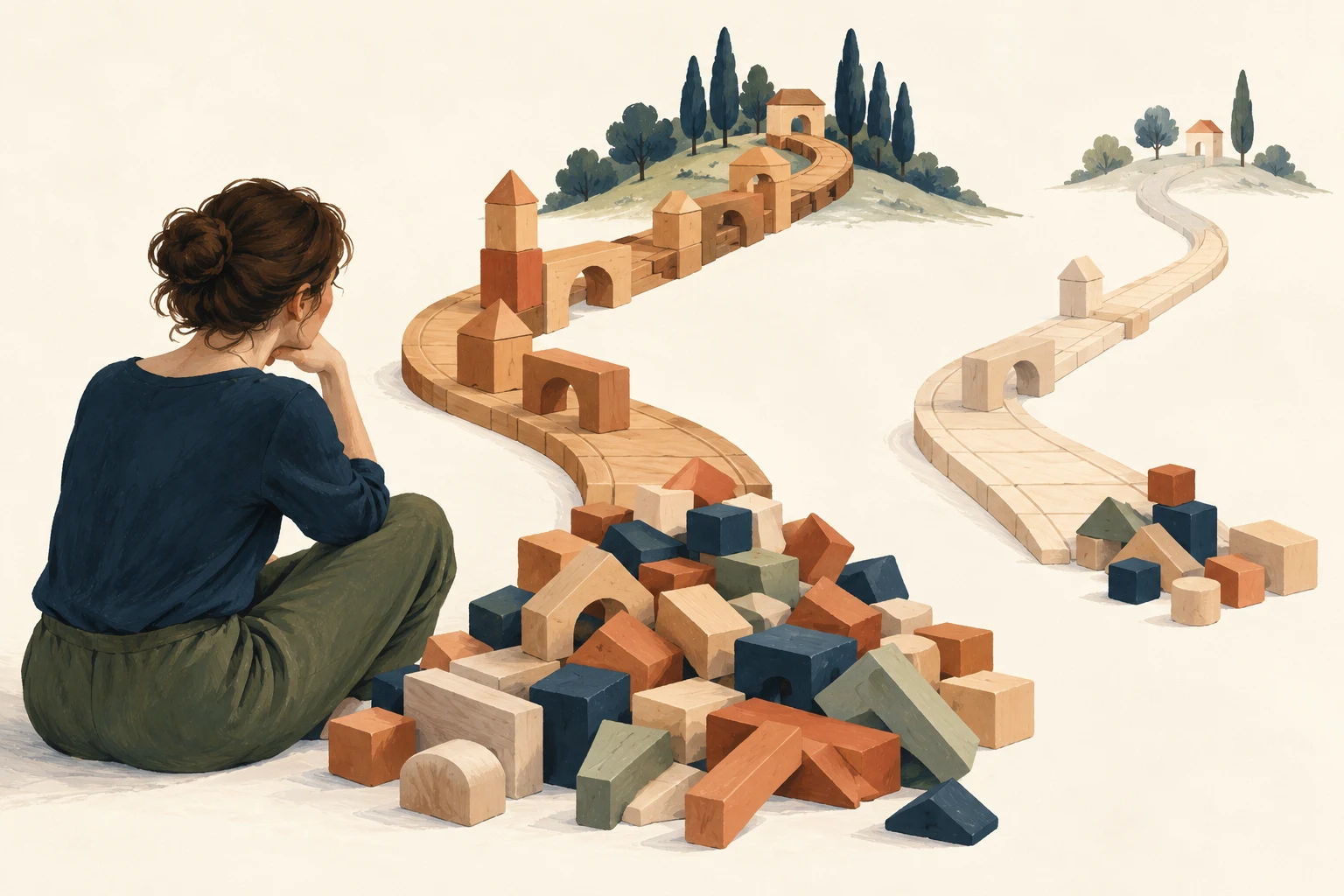
In this teaching scenario, a team left its measurement records unsorted in 2023. It is now 2025 and sorting remains to be done. The counterfactual imagines an earlier decision while holding the rest of the scenario constant. It does not report that the sorting actually happened. Read the earlier decision before the present workload; at each date, compare the real situation first and its unreal alternative second. The ordering activity follows this comparison, not four events that all occurred.
- 2023 · réelL’équipe ne classe pas les fiches.The team does not sort the records.
- 2023 · hypothèse irréelleSi nous avions classé les fiches à ce moment-là…If we had sorted the records at that point…
- 2025 · réelIl nous reste beaucoup de classement à faire.We still have much sorting to do.
- 2025 · conséquence imaginée…nous aurions moins de travail aujourd’hui.…we would have less work today.
Aurions can belong to two different structures
| French | Analysis | Time of the result |
|---|---|---|
| Nous aurions moins de travail. | Avoir in the present conditional, with a noun object. | A current imagined amount of work. |
| Nous aurions terminé le classement. | Past conditional: auxiliary aurions + participle terminé. | An imagined completed action. |
Aurions moins de travail is not a past conditional merely because it contains aurions. Avoir is the main verb there. In aurions terminé, it is the auxiliary of a compound tense. Read the complement rather than classifying the first word alone.
Change the result’s time, not the whole condition
Si nous avions classé les fiches en 2023, nous aurions terminé le dossier en 2024.
If we had sorted the records in 2023, we would have completed the file in 2024.
The earlier unreal condition remains avions classé. The result is now a completion before the 2025 speaking point, so the model uses aurions terminé. Time markers help, but meaning matters: aujourd’hui can also accompany an imagined completed action. It does not mechanically require a simple tense in every sentence.
To plan a mixed conditional, mark the time of the imagined condition and the time of the imagined result separately. Then choose the forms for those meanings. The sentence is mixed because the two parts concern different times, not because it randomly combines advanced tenses.