Quiz

One imperfect subjunctive in a French pastiche: make the register consistent

Choose a coherent French register for literary pastiche and practical messages. Recognise the imperfect subjunctive without treating archaism as automatic improvement.

In short

An imperfect subjunctive can serve a deliberately sustained literary voice; it is not an automatic upgrade. Il souhaitait qu’elle vînt belongs naturally to some classical literary textures. In an ordinary scheduling message, il souhaitait qu’elle vienne usually fits better. Judge the whole passage and genre.

Yellow the idea to rememberBlue French to learn
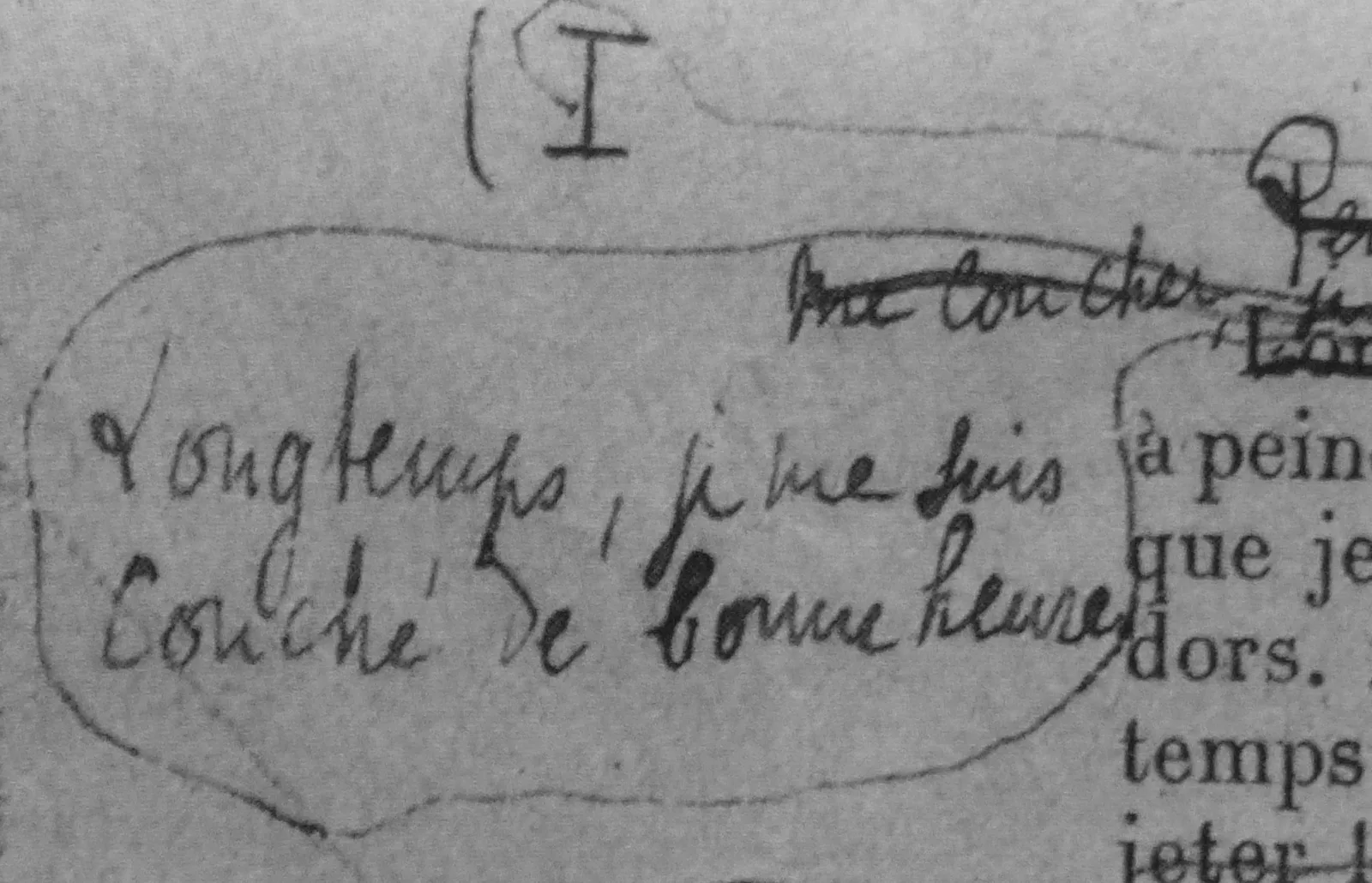
A manuscript reproduction shows the opening of Proust’s À la recherche du temps perdu.
A Proust manuscript as a reference for literary texture; the exercises below use separately authored sentences. Warburg · CC BY-SA 3.0 · https://creativecommons.org/licenses/by-sa/3.0/ · resized and converted to WebP

The practice contrasts an explicitly literary pastiche with workplace messages and conversational narration. The target is appropriate choice, not a rule that every past reporting verb requires a literary subjunctive in contemporary French.

  1. Question 1No account needed
    A practical email asks a colleague to attend tomorrow. Which normally fits?

    Choose one answer.

    Answer and explanation

    Je souhaite que tu viennes demain. The contemporary present subjunctive fits the practical request.

  2. Question 2No account needed
    An explicitly classical teaching pastiche says il craignait qu’elle ne partît. What is the form?

    Choose one answer.

    Answer and explanation

    Imperfect subjunctive in a literary texture. Partît is a literary imperfect subjunctive; ne can be expletive after fear.

  3. Question 3No account needed
    A pastiche has a restrained contemporary narrator. Must you add fût everywhere?

    Choose one answer.

    Answer and explanation

    No. The chosen voice may not call for classical concordance.

  4. Question 4No account needed
    A source says « Il souhaitait qu’il vînt. » What should a plain-language gloss preserve?

    Choose one answer.

    Answer and explanation

    The intended coming and its relation to the wish. A wish does not establish its fulfilment.

  5. Question 5No account needed
    Which is a sound reason to use a marked form?

    Choose one answer.

    Answer and explanation

    A coherent chosen literary voice and specific effect. The form should support the chosen genre and voice.

  6. Question 6No account needed
    Can a practical message be formal with vienne?

    Choose one answer.

    Answer and explanation

    Yes. Contemporary subjunctive use is compatible with formal French.

  7. Question 7No account needed
    A pastiche shifts into an unexplained casual slogan. What needs attention?

    Choose one answer.

    Answer and explanation

    The coherence of the register transition. The surrounding voice determines whether the shift is intentional or disruptive.

  8. Question 8No account needed
    What should stylistic commentary explain?

    Choose one answer.

    Answer and explanation

    Where the form contributes to the voice. Commentary connects form to a local stylistic purpose.

Revise the context as well as the ending

A single rare ending surrounded by incompatible informal wording may sound like a badge of difficulty. Either sustain the literary texture for a reason, or use a contemporary construction that fits the passage. A deliberate register collision is possible, but it needs an interpretable function such as irony or a clearly marked change of voice.

Pastiche : Il attendit sans qu’elle parût. Compte rendu courant : Il a attendu, mais elle ne s’est pas montrée.

Pastiche: he waited without her appearing. Current account: he waited, but she did not show herself.

These two versions change more than a suffix: they also change the narrative tense and sentence architecture. That is why register work is best done across a complete passage. Recognition of a form and choosing to produce it are separate skills.

Built from