Prix Goncourt 2026: who won, and how France’s book-prize season works
Philippe Jaenada won the 2026 Prix Goncourt for L’Inconnue du quai de Javel. The vote, the season’s other prizes on one shelf, and why the cheque is ten euros.
The 2026 Prix Goncourt went to Philippe Jaenada for L’Inconnue du quai de Javel (Flammarion), announced on Tuesday 3 November at the Drouant restaurant in Paris. The prize is worth ten euros and hundreds of thousands of sales.
Yellow the idea to rememberBlue French to learn
The vote
6 votes
Philippe Jaenada
L’Inconnue du quai de Javel, Flammarion3 votes
Sylvain Prudhomme
The other finalist in the last roundSix votes to three, reported by Livres Hebdo. The jury votes aloud over lunch, in up to fourteen rounds; from the fourteenth the president’s vote counts double.
This season’s prizes on one shelf
Goncourt 2026
L’Inconnue du quai de Javel
Philippe Jaenada, Flammarion
An investigation into the murder of a young Breton woman at the end of the 1950s. Jaenada, 62, a journalist and novelist, is known for long true-crime inquiries full of digressions and jokes at his own expense. Published on 12 August.
- Pages
- 528
- Price
- €23
- To read it in French
- C1: long sentences, many asides
Renaudot 2026
Le Palais
François-Henri Désérable, Gallimard
The Renaudot is announced in the same room, minutes after the Goncourt, and by tradition goes to a different book.
- Pages
- 300
- To read it in French
- B2 and up
Médicis 2026
Dans les grandes lignes
Philippe Vasset, Flammarion
The Médicis favours writers with a distinctive voice who are less widely known. At 190 pages this is the shortest book on the shelf.
- Pages
- 190
- Price
- €21
- To read it in French
- B2: the short one to try first
Goncourt 2025
La Maison vide
Laurent Mauvignier, Minuit
Last year’s winner: a family saga across more than a century, drawn from stories of the author’s father’s family.
- Pages
- 750
- To read it in French
- C1
Goncourt 2024
Houris
Kamel Daoud, Gallimard
The 2024 winner. Each year’s Goncourt stays in every bookshop window until the next one arrives.
- Pages
- 410
- To read it in French
- C1
How the season works
- Lunch at Drouant
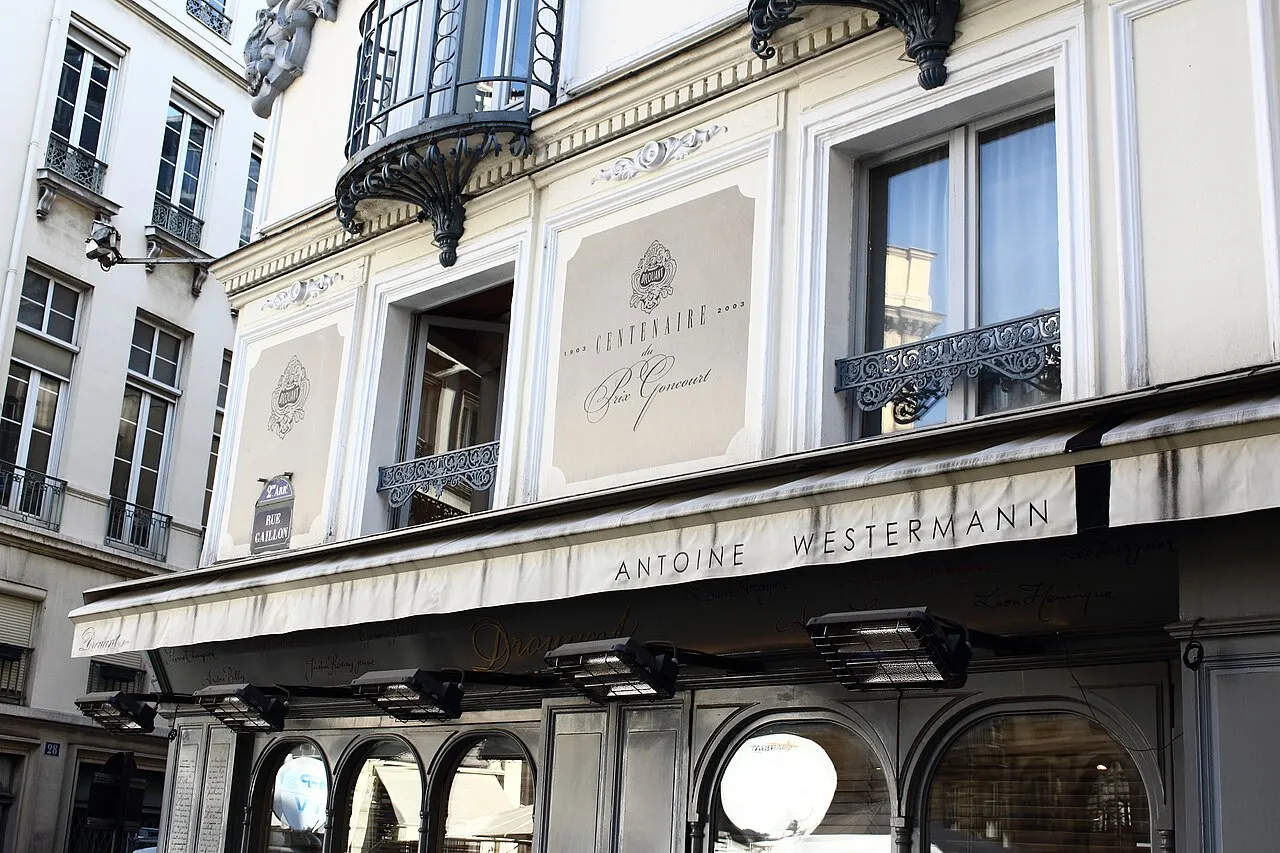
The ten jurors of the Académie Goncourt meet in a Paris restaurant, chez Drouant, on the first Tuesday of November and announce the winner from the staircase.
- A cheque for ten euros
The prize money is symbolic. The real prize is the sales: a Goncourt is the book everyone gives at Christmas.
- Le bandeau rouge
Within days every copy wears a red paper band reading Prix Goncourt. In a bookshop, the band is how you spot the season’s winners.
- La rentrée littéraire
Hundreds of novels come out between mid-August and October, timed for the prizes. The shortlists, les sélections, shrink in three rounds.
- Le Goncourt des lycéens
Some two thousand school pupils read the same shortlist and pick their own winner later in November. It is often the more readable book.
- The big six
Goncourt, Renaudot, Femina, Médicis, Interallié and the Académie française’s Grand Prix du roman, all within about two weeks.
How ten people choose one book
The Académie Goncourt has ten members, les Dix, each of whom holds a numbered place at the table, un couvert, with their name engraved on the cutlery. They meet on the first Tuesday of the month, on the first floor of the Drouant restaurant, and they have done so since 1914.
- Three lists
A first selection of about fifteen novels in early September, a second of eight in early October, and four finalists at the end of the month.
- Up to fourteen rounds
A book needs an absolute majority in the early rounds, then a simple one. If the fourteenth round is still tied, the president’s vote counts double.
- Once in a lifetime
No author may win twice. Romain Gary did, in 1956 and again in 1975 under the pseudonym Émile Ajar, and the truth came out only after his death.
- Since 1903
The prize was created by the will of Edmond de Goncourt, to reward “the best work of imagination in prose” of the year.
Five winners that are still read
| Year | Author | Book |
|---|---|---|
| 1919 | Marcel Proust | À l’ombre des jeunes filles en fleurs |
| 1933 | André Malraux | La Condition humaine |
| 1954 | Simone de Beauvoir | Les Mandarins |
| 1975 | Émile Ajar (Romain Gary) | La Vie devant soi |
| 1984 | Marguerite Duras | L’Amant |
If you want to read it in French
- Wait for the paperback
The large-format edition costs over twenty euros. The poche edition follows a year or two later for under ten.
- Try the audiobook
Recent winners are usually recorded within months. Listening with the text open is the fastest way through a long literary novel.
- Start with the lycéens’ choice
The Goncourt des lycéens is voted by about two thousand secondary-school pupils from the same list. Their winners tend to be more direct, and are often the better way in.
- The first page test
Read the first page in the shop. L’Amant and La Vie devant soi are short, in plain sentences, and both are within reach of a B1 reader with a dictionary.

In the bookshop
| French | English |
|---|---|
| Vous avez le Goncourt ? | Do you have the Goncourt winner? |
| le lauréat, la lauréate | the winner |
| un roman, un récit | a novel, a true account |
| en poche | in paperback, which comes a year or two later |
| C’est pour offrir ? | Is it a present? (They will wrap it free.) |
| la rentrée littéraire | the autumn publishing season |
The five winners before this one
Prix Goncourt, the last six
- 2026L’Inconnue du quai de JavelPhilippe Jaenada
- 2025La Maison videLaurent Mauvignier
- 2024HourisKamel Daoud
- 2023Veiller sur elleJean-Baptiste Andrea
- 2022Vivre viteBrigitte Giraud
- 2021La plus secrète mémoire des hommesMohamed Mbougar Sarr
The other prizes of the season
The autumn book prizes
- le Goncourtten writers
The big one, announced at the restaurant Drouant in early November.
- le Renaudotcritics and journalists
Announced the same day, in the same place.
- le Feminaan all-women jury
For a novel by a woman or a man.
- le Goncourt des lycéenssecondary-school pupils
Chosen from the Goncourt’s own list, and often the better seller.
Finished by when
A Goncourt winner is rarely short. Divide it up.
A 280-page novel in French
- 5 pages a day56 days
Ten minutes with a dictionary to hand.
- 10 pages a day28 days
A comfortable B1 pace.
- 25 pages a day12 days
Reading for the story, guessing words.