Real document
Read two French witness notes: which detail comes first?
Read two short French witness notes about a fallen sign. Compare timestamps, find shared observations and leave an unrecorded phone-call time unresolved.
- A2
- Notice
- Read and answer
- Learn this in the A2 notebook →
In short
Use explicit timestamps to order the observations, and keep an unrecorded time unknown. Nora sees the sign fall at 18 h 05. Sami sees it on the ground at 18 h 07. Both record the caretaker putting it upright at 18 h 08. The notes do not time his phone call.
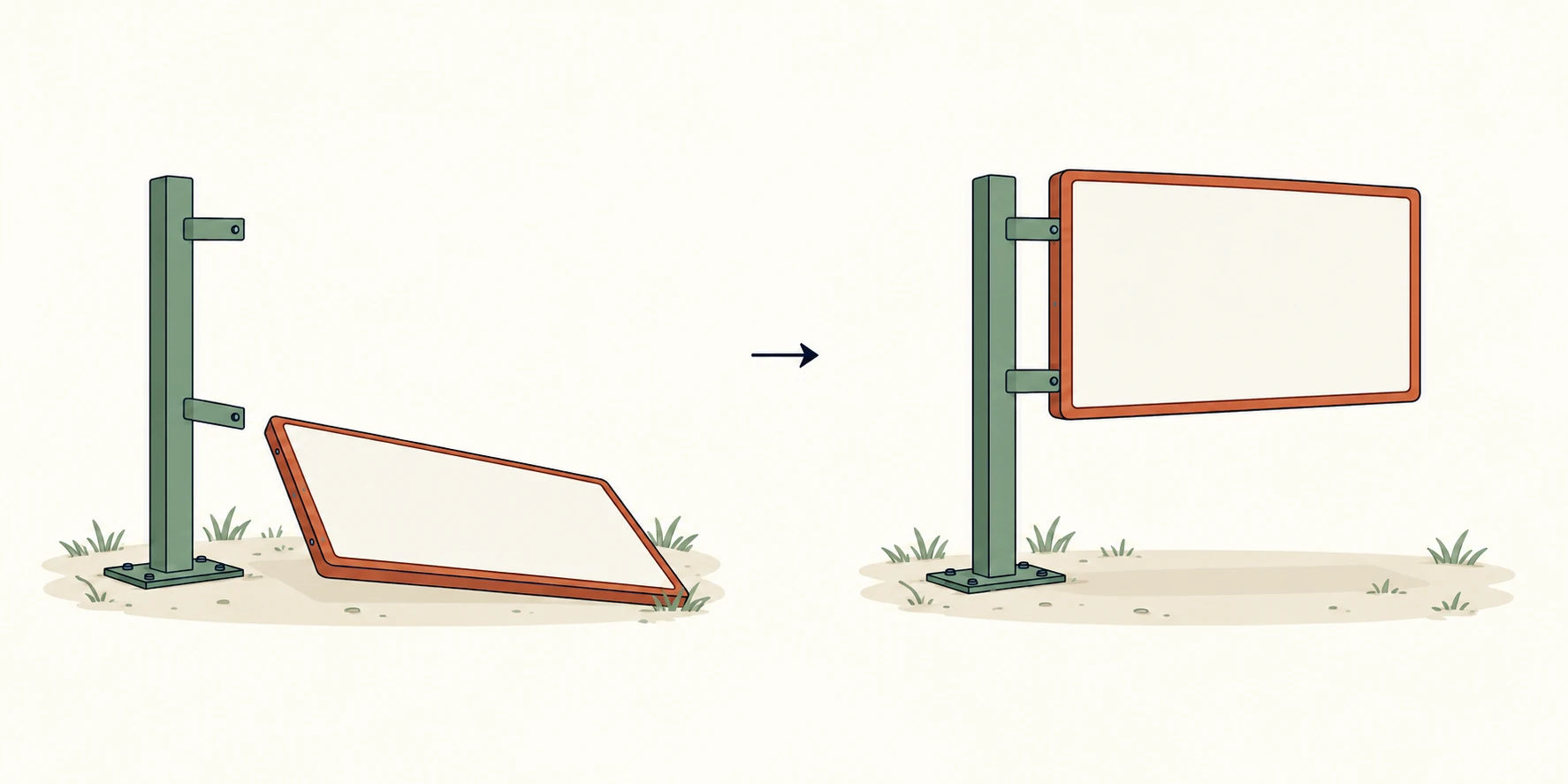
Two people write short notes about the same small incident at a neighbourhood hall. One person sees the fall; the other arrives afterwards. Read what each person actually observes before deciding which details they share.
Note de Nora
18 h 05J’ai vu le panneau tomber devant la salle.
18 h 08Le gardien a relevé le panneau.
Heure non notéeJ’ai vu le gardien recevoir un appel. Je n’ai pas noté l’heure de cet appel.
Note de Sami
18 h 07Je suis arrivé. Le panneau était déjà par terre.
18 h 08J’ai vu le gardien relever le panneau.
Shared evidence can come from witnesses who arrive at different times
Both notes place the raising of the sign at 18 h 08. Nora can describe its fall because she was there at 18 h 05. Sami’s statement at 18 h 07 describes the resulting situation: the sign was already on the ground. He does not claim to have witnessed the fall.
À dix-huit heures sept, le panneau était déjà par terre.
At seven minutes past six, the sign was already on the ground.
A separate row does not create a timestamp
Nora labels the phone call Heure non notée. Its position in the table does not establish that it happened after the raising, because she explicitly says she did not record the time. You can report that she saw the call, but cannot place it precisely among the timed events from these notes alone.
For a careful summary, combine the known sequence and the gap: Le panneau est tombé à 18 h 05, puis le gardien l’a relevé à 18 h 08. Nora a aussi vu le gardien recevoir un appel, mais son heure n’est pas notée. The summary preserves both what is known and what remains unspecified.