Write a 90–110-word French anecdote about finding a stranger’s glasses case. Build the setting, interruption, search and resolution with clear tense contexts.
Set the scene with the imparfait, introduce the request, then tell the search and result with completed actions. For this task, a glasses case is found behind a timetable panel. Use a few sequence connectors so the reader can follow how the search leads to the discovery.
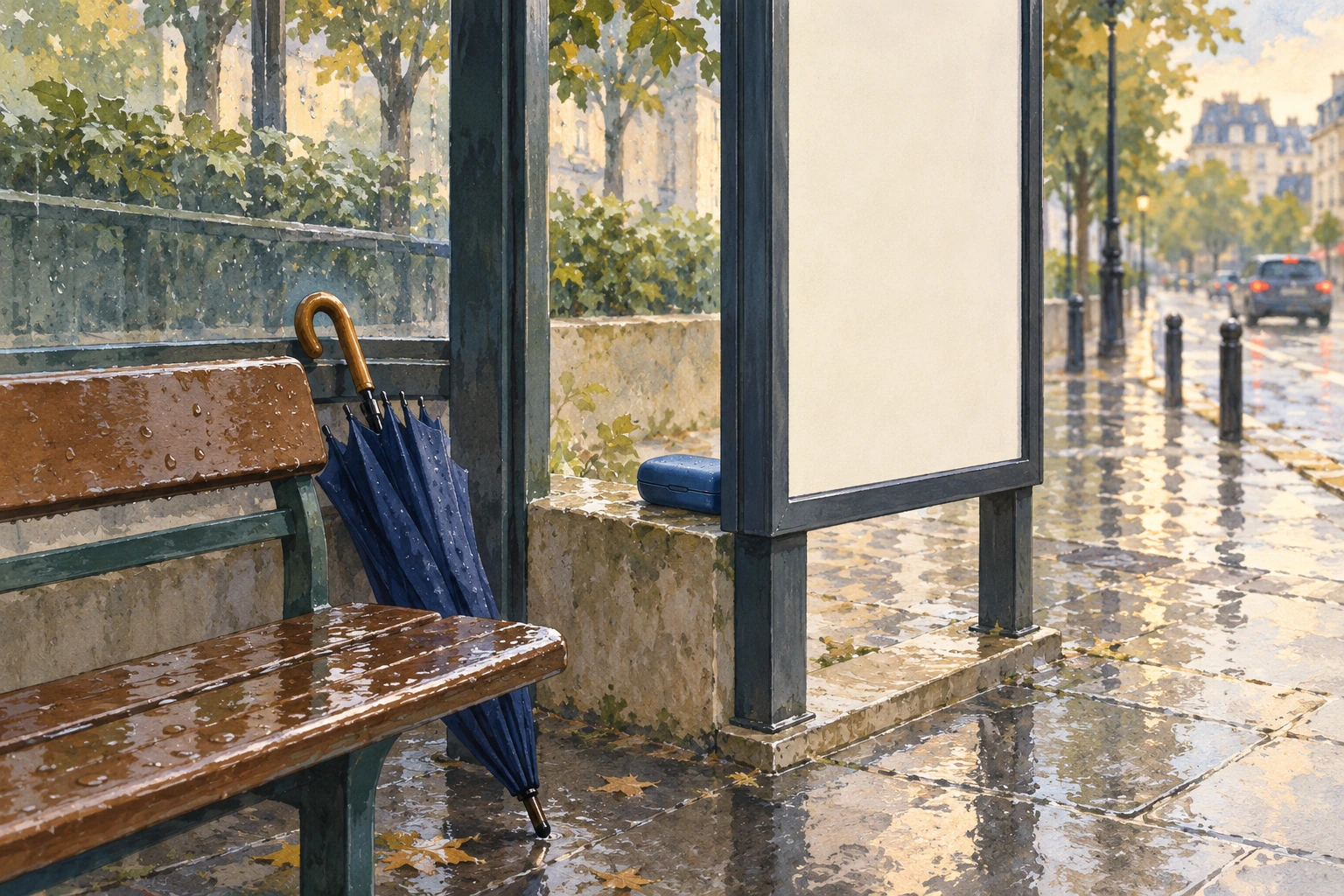
The discovery behind the timetable panel gives the anecdote its resolution. Illustration: Atelier
You are Samir. At a bus stop, a woman asks whether you have seen her glasses case. Write a short anecdote for a friend. The point is to show the sequence clearly, including where the object is found, rather than adding a long introduction about helping people in general.
A2 · Short anecdote · 90–110 wordsNot an official exam paper
Raconte en 90 à 110 mots comment tu as aidé une femme à retrouver son étui à lunettes à un arrêt de bus. Décris le moment et le lieu, puis la demande, la recherche et la découverte derrière le panneau des horaires. Termine par sa réaction et l’arrivée du bus. Utilise au moins quatre imparfaits, quatre passés composés et trois connecteurs.
(90 mots minimum)
In 90–110 words, tell how you helped a woman recover her glasses case at a bus stop. Set the scene, describe the request, search and discovery behind the timetable panel, then end with her reaction and the bus arriving. Use at least four imparfait forms, four passé composé forms and three sequence connectors.
Your answer
Nothing you write is saved or sent. Copy it before you leave.
Read a model answer
Il était dix-sept heures et j’attendais mon bus devant la piscine. Je rentrais chez moi après mon cours. Il pleuvait et le banc était mouillé. Une femme cherchait quelque chose dans son sac. Soudain, elle m’a demandé si je voyais un étui à lunettes. D’abord, nous avons regardé sous le banc. Ensuite, j’ai remarqué une petite boîte bleue derrière le panneau des horaires. Je l’ai montrée à la femme. Elle l’a ouverte : ses lunettes étaient dedans. Finalement, elle m’a remercié et nous avons continué à attendre. Mon bus est arrivé deux minutes plus tard.
Review your draft
Four kinds of background fit in a few lines
Il était gives the time, j’attendais gives the ongoing activity, il pleuvait supplies the weather and le banc était mouillé adds a physical detail. Cherchait describes what the woman was already doing. These details establish the situation into which her request arrives.
Choose actions that explain the result
Regarder sous le banc, remarquer la boîte and montrer la boîte are useful steps because they lead directly to the recovery. D’abord and ensuite order the search; finalement introduces its resolution. The ending returns to the original bus wait, now with the missing object found.
Elle l’a ouverte : ses lunettes étaient dedans.
She opened it: her glasses were inside.
L’ refers to la boîte in the preceding sentence. Ouverte has the feminine e because that direct object appears before the compound verb. You can use Elle a ouvert la boîte instead if you prefer to keep the object after the verb in your own version.
Keep the revised version focused on the same chain: waiting, request, search, discovery, thanks, bus. Changing a colour or object is easy; keeping the cause and order clear is the main narrative skill.