Buying organic in France: the AB logo, the shops and what it costs
What bio means on a French pack, the two logos that prove it, the labels that look green but are not organic, the specialist chains, and where organic is worth the difference.
Look for the green European leaf: it is the only compulsory proof that a packaged food is organic. The French AB logo beside it means the same and is optional. Words such as naturel, fermier or raisonné promise nothing about organic farming.
Yellow the idea to rememberBlue French to learnRed watch out
The two logos that count
On the pack
- l’Eurofeuille the EU organic leafcompulsory
Stars forming a leaf on a green ground. Compulsory on every packaged organic food made in the EU. Under it: the code of the certifying body and Agriculture UE or non UE.
- AB, agriculture biologique the French organic markoptional
Green and white. Since 2010 it has meant exactly the same rules as the leaf. Optional, and still the one shoppers recognise.
At least 95 % of the farmed ingredients must be organic for either logo to appear.
Labels that are not organic
Green-looking words, and what they do mean
- EnvironmentalHVE
Haute valeur environnementale: a farm-level certificate on biodiversity and inputs. Pesticides are allowed.
not bio - Residueszéro résidu de pesticides
A private label: none detected in the food. Says nothing of how it was grown.
not bio - QualityLabel Rouge
Better taste, tested. Often free-range. Not organic unless it also carries the leaf.
not bio - NutritionBleu-Blanc-Cœur
Animals fed for more omega-3.
not bio - Stricter than the lawDemeter, Nature & Progrès, Bio Cohérence
Private marks that go beyond the EU rules. These are organic and more.
bio plus - A wordnaturel, de la ferme, artisanal
No legal definition for most foods.
means little
Where to buy it
| Where | What to expect | Site |
|---|---|---|
| Supermarkets | An organic aisle and own brands, the cheapest route. Carrefour Bio, Bio Village at Leclerc, Monoprix Bio. | Carrefour, E.Leclerc, Monoprix |
| Biocoop | A co-operative network, the largest specialist. Strict on season and origin, strong on loose goods. | biocoop.fr |
| Naturalia | City-centre shops, mostly in and around Paris. Owned by the Monoprix group. | naturalia.fr |
| La Vie Claire | One of the oldest chains, with its own brand. | lavieclaire.com |
| Bio c’ Bon, So.bio | Smaller chains, now part of Carrefour. | bio-c-bon.eu |
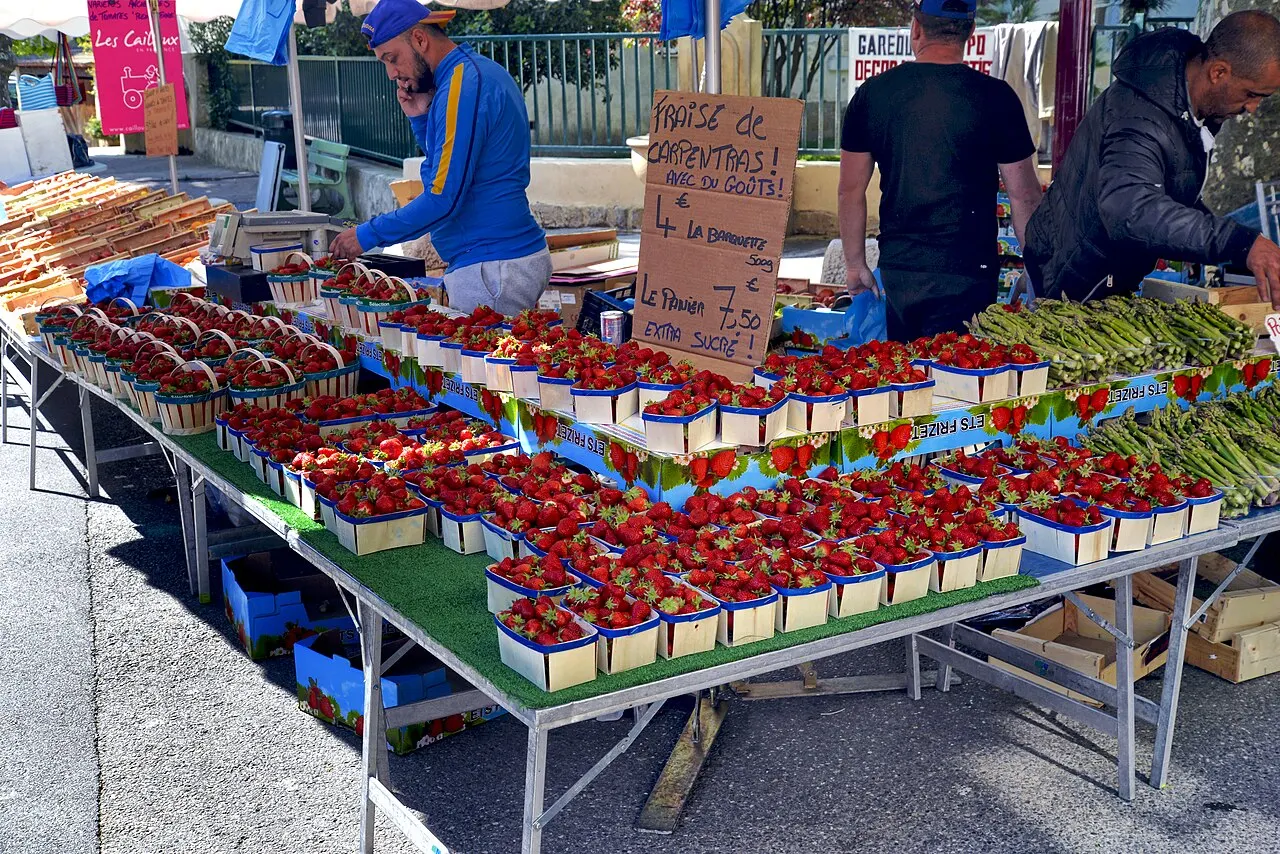
| Markets | A marché bio once a week in most towns; organic growers on ordinary markets too. | your town hall’s site |
| AMAP | A weekly box paid in advance to one farm for a season. | reseau-amap.org |
Where it is worth the difference
Organic costs more: consumer surveys regularly put the gap for fruit and vegetables at half as much again, sometimes double, and it is narrower on own-brand staples such as pasta, flour, milk and eggs. Three ways the French narrow it: buy loose, en vrac; buy what is in season; buy the supermarket’s organic own brand for dry goods.
A common way to choose
- œufs, lait, farine, pâtes eggs, milk, flour, pastaeasy
The price gap is small.
- pommes, fraises, raisin, salade apples, strawberries, grapes, saladoften chosen
Fruit and leaves eaten with their skin are where people most often switch.
- bananes, avocats, agrumes bananas, avocados, citrusless often
Thick peel. Many shoppers stay conventional here, except for zest.
- viande meatdearest
The largest gap. Many households buy less, and better.
For zest, buy citrons non traités après récolte: unwaxed after picking, organic or not.
Buying loose
At the vrac wall
- 1Take a paper bag or bring your own jar
If it is your jar, have it weighed empty first: la tare.
- 2Fill it from the dispenser
Pull the handle gently: lentils come fast.
- 3Write or print the product number
A code on each bin. Some shops have a scale that prints the label.
- 4Pay at the till
The cashier weighs it and takes off the jar.
| French | English |
|---|---|
| bio, issu de l’agriculture biologique | organic |
| en vrac | loose, unpackaged |
| de saison | in season |
| local, en circuit court | local, sold directly or nearly |
| non traité | untreated |
| un producteur | a grower |
| un panier | a weekly box |
| sans emballage | without packaging |
Checked 20 November 2026. The rules of the green leaf (compulsory on pre-packaged organic food made and sold in the EU, at least 95 % organic ingredients, the inspection body’s code and the origin of the raw materials printed beside it) were read on the European Commission’s page. The price gap with ordinary food is an order of size from consumer surveys, not a figure measured this month, and shop names and ownership change.