Gap-fill
French A2 gap-fill: quantities and en at a refill shop
Practise en, de and measured quantities in a French refill-shop story. Twelve gaps follow jars, rice and lentils from the counter to the kitchen.
- A2
- 12 gaps
- Translation included
- Learn this in the A2 notebook →
In short
After a weight or amount, use de: un kilo de riz. When the food has already been named, en replaces that food and the amount stays: j’en prends un kilo. Fill twelve gaps using the quantity or pronoun cues.
| Pattern | French example | Meaning |
|---|---|---|
| Measured amount | deux cents grammes de pâtes | two hundred grams of pasta |
| Food already named | Des pâtes ? J’en prends deux cents grammes. | Pasta? I’ll take two hundred grams. |
| An amount remaining | Il en reste un peu. | There is a little left. |
| Enough | J’en ai assez. | I have enough of it. |
Bring these to the refill counter
Find:
Deux bocaux, juste assez
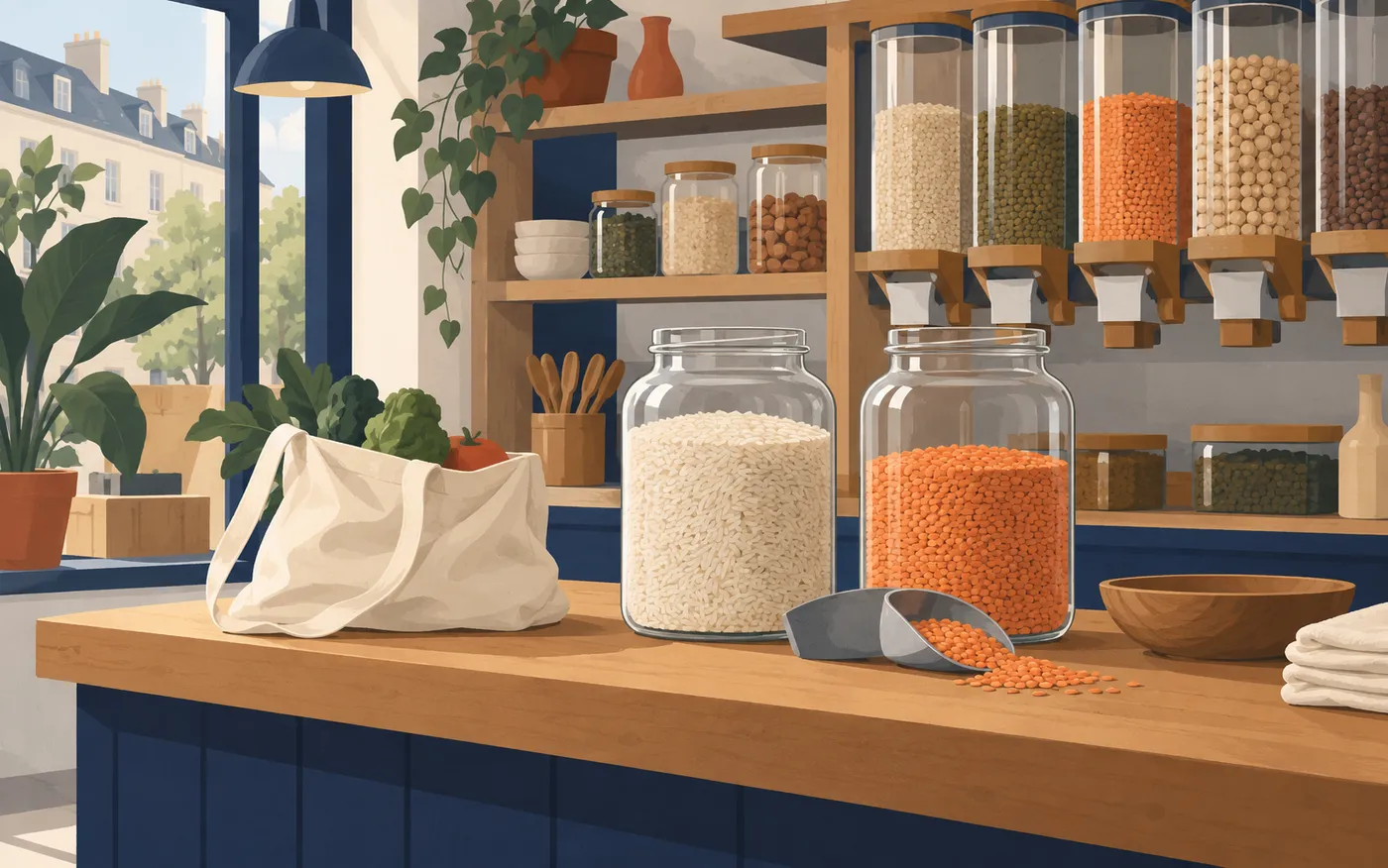
Ce matin, Zoé va à l’épicerie en vrac avec deux bocaux réutilisables. Elle veut acheter un kilo (after a weight) riz et cinq cents grammes (after a weight) lentilles. Elle pose ses bocaux sur le comptoir. Le vendeur les pèse avant de les remplir.
« Vous prenez du riz ? » demande-t-il. « Oui, j’(pronoun replacing du riz) prends un kilo. » Il remplit le grand bocal. Pour les lentilles, le petit bocal est trop petit. Zoé change donc sa commande : « Je vais (pronoun replacing des lentilles) prendre seulement trois cents grammes. » Le vendeur remplit le deuxième bocal.
Zoé regarde aussi le café. Elle (pronoun replacing du café) a encore chez elle. Elle n’(pronoun replacing du café) achète donc pas aujourd’hui. Elle ferme les deux bocaux et vérifie les couvercles. Puis elle rentre à pied avec son sac.
À la maison, elle prépare le déjeuner avec deux cents grammes (after a weight) riz. Après le repas, il (pronoun replacing du riz) reste huit cents grammes dans le grand bocal. Pour demain, elle veut préparer une soupe avec cent grammes (after a weight) lentilles. Elle (pronoun replacing des lentilles) aura encore deux cents grammes après cette soupe. Elle a assez (after assez) nourriture pour les deux prochains repas. Elle n’a pas besoin (after besoin) retourner au magasin.
Read it in English
This morning, Zoé goes to the refill shop with two reusable jars. She wants to buy a kilo of rice and five hundred grams of lentils. She puts her jars on the counter. The shopkeeper weighs them before filling them.
“Are you having rice?” he asks. “Yes, I’ll take a kilo.” He fills the large jar. For the lentils, the small jar is too small. So Zoé changes her order: “I’m only going to take three hundred grams.” The shopkeeper fills the second jar.
Zoé also looks at the coffee. She still has some at home. So she does not buy any today. She closes both jars and checks the lids. Then she walks home with her bag.
At home, she makes lunch with two hundred grams of rice. After the meal, eight hundred grams remain in the large jar. For tomorrow, she wants to make soup with a hundred grams of lentils. She will still have two hundred grams after making this soup. She has enough food for the next two meals. She does not need to go back to the shop.