Gap-fill
French B1 gap-fill: whose meal is in the shared freezer?
Fill 12 ownership gaps as flatmates identify unlabelled meals. Practise le mien, la tienne, les nôtres and à qui with picture cards and a translation.
- B1
- 12 gaps
- Translation included
- Learn this in the B1 notebook →
In short
A possessive pronoun replaces the whole noun phrase: mon plat becomes le mien. Its gender and number follow the thing owned; the owner determines whether you choose mien, tien, sien, nôtre, vôtre or leur.
| Meaning | French pattern | Example |
|---|---|---|
| My soup: feminine singular | la mienne | Cette soupe est la mienne. |
| Your dishes: masculine plural, one friend | les tiens | Ces plats sont les tiens. |
| Our boxes: feminine plural | les nôtres | Ces boîtes sont les nôtres. |
| An owner named directly | à + person | Ce dessert est à Salomé. |
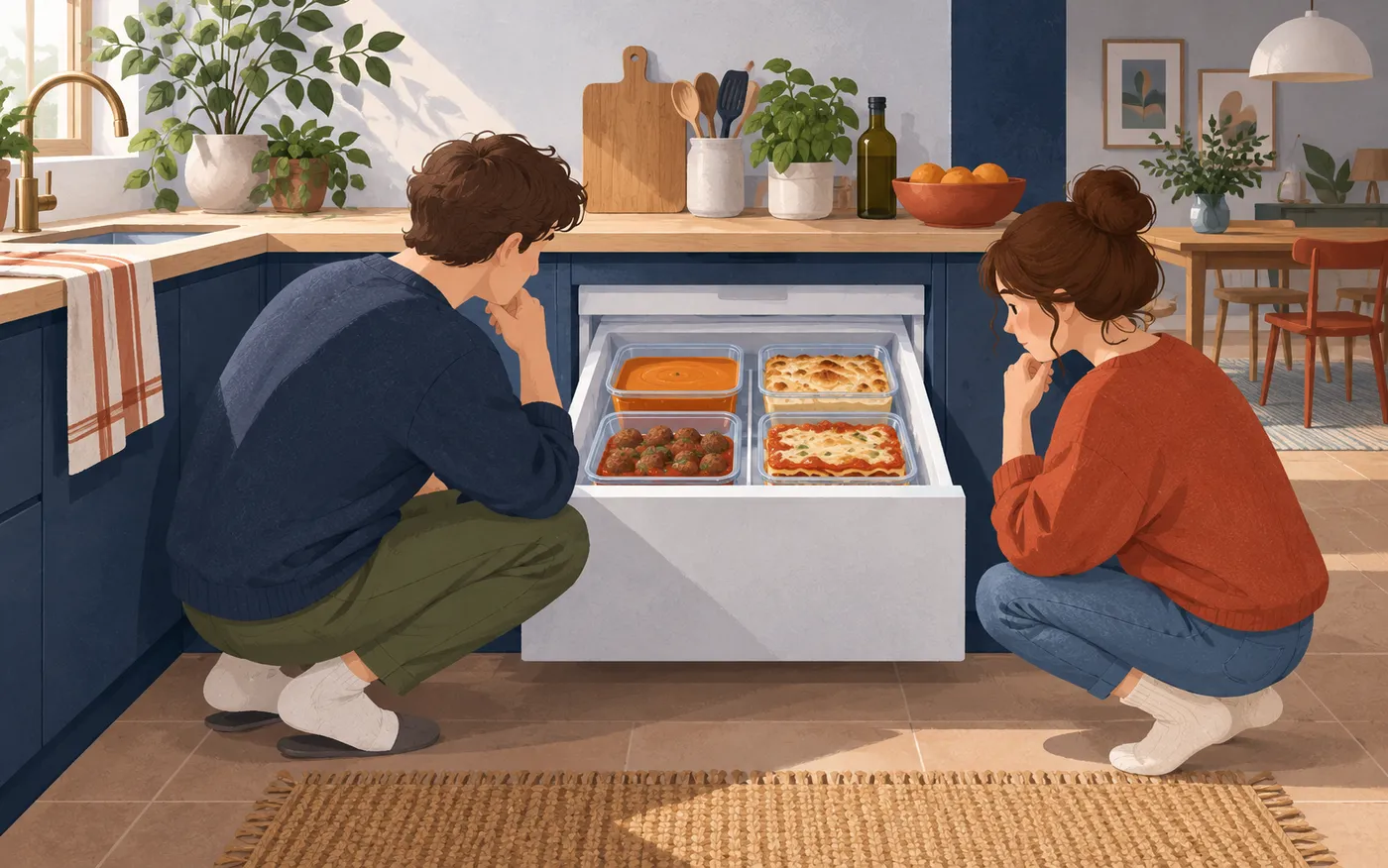
Four things in the freezer
Find:
Salomé, Mehdi and Zoé share a freezer. Use each cue to identify the owner, and keep the article with the possessive pronoun. Names in the cues give you the speaker’s viewpoint.
Le congélateur sans étiquettes
Samedi, Salomé ouvre le congélateur de la colocation. Toutes les boîtes se ressemblent et aucune ne porte de nom. Elle montre une soupe orange. « (whose; two words) est cette soupe ? » Mehdi répond : « C’est (mine; Mehdi means the soup). J’y ai mis des carottes. » Salomé reconnaît ensuite son gratin : « Et ce gratin, c’est (mine; Salomé means the gratin). »
Zoé arrive avec deux boîtes vides. Salomé lui demande : « Ces boîtes sont (yours; Salomé addresses Zoé) ? » Zoé confirme, puis désigne des boulettes. « Mehdi et moi, nous les avons préparées ensemble. Ce sont (ours; Zoé means the meatballs). » Salomé répond : « D’accord, je laisse (yours; Salomé addresses Mehdi and Zoé, meaning the meatballs) ici. »
Un pot de sorbet reste au fond. Mehdi explique : « Il est (Salomé’s; use à and her name). Elle l’a acheté hier. » Zoé le rapproche du gratin. « Le sorbet et le gratin sont donc (hers; Zoé means Salomé’s sorbet and gratin) », résume-t-elle. À côté, deux portions de lasagnes appartiennent aux voisins du dessus. « Ce sont (theirs; Salomé means the neighbours’ portions) », précise Salomé.
Mehdi prend une des boîtes vides de Zoé. « Je peux utiliser (yours; Mehdi means one box belonging to Zoé) pour mon riz ? » Elle accepte. Ils décident enfin d’étiqueter les repas. « Nous avons acheté ces étiquettes tous les trois : elles sont (ours; use à plus a pronoun), dit Zoé. Chacun écrira son nom sur (their own; means each person’s labels). »
Read it in English
On Saturday, Salomé opens the flatmates’ freezer. All the containers look alike and none has a name on it. She points to an orange soup. “Whose soup is this?” Mehdi replies, “It’s mine. I put carrots in it.” Salomé then recognises her gratin: “And this gratin is mine.”
Zoé arrives with two empty containers. Salomé asks her, “Are these containers yours?” Zoé confirms, then points to some meatballs. “Mehdi and I prepared them together. They’re ours.” Salomé replies, “OK, I’ll leave yours here.”
A tub of sorbet remains at the back. Mehdi explains, “It belongs to Salomé. She bought it yesterday.” Zoé moves it nearer the gratin. “So the sorbet and the gratin are hers,” she sums up. Next to them, two portions of lasagne belong to the upstairs neighbours. “They’re theirs,” Salomé explains.
Mehdi takes one of Zoé’s empty containers. “Can I use yours for my rice?” She agrees. They finally decide to label the meals. “The three of us bought these labels: they belong to us,” Zoé says. “Everyone will write their name on their own labels.”