Timeline
Marie Curie: a life in Paris in nine dates
From Warsaw to the Sorbonne, two Nobel Prizes and the Panthéon: Marie Curie's life as a French timeline, with the passé simple and passé composé side by side.
- B1
- 9 moments
- Put-in-order game
- Learn this in the B1 notebook →
In short
Marie Skłodowska Curie (1867–1934) left Poland for Paris in 1891, studied at the Sorbonne, discovered polonium and radium with Pierre Curie, and won two Nobel Prizes (physics 1903, chemistry 1911). She was the first woman buried in the Panthéon for her own merits.
Yellow the idea to rememberBlue French to learn
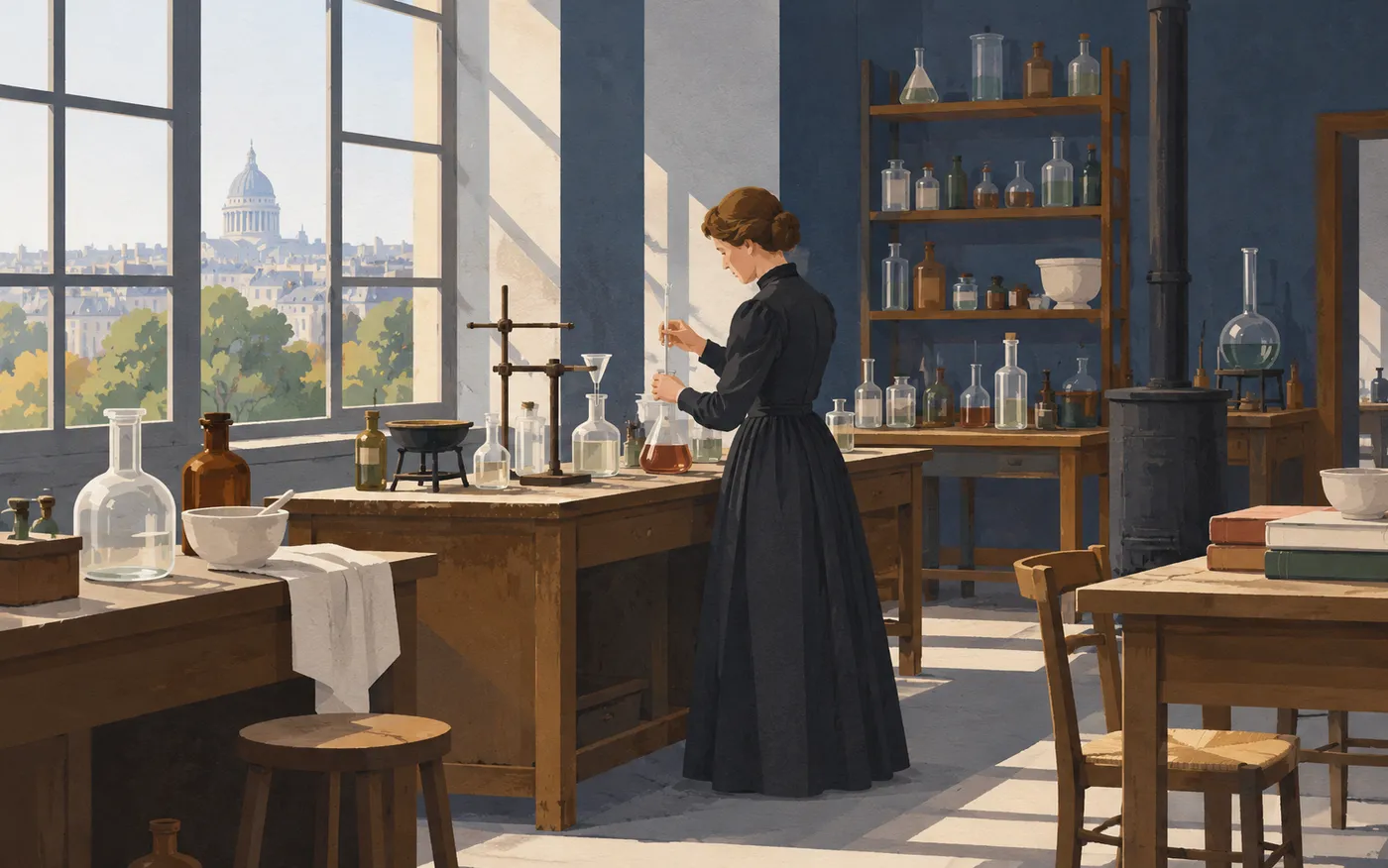
- 1867Naissance à Varsovie.Born in Warsaw.
- 1891Elle part étudier à la Sorbonne, à Paris.She leaves to study at the Sorbonne in Paris.
- 1895Elle épouse Pierre Curie.She marries Pierre Curie.
- 1898Ils découvrent le polonium et le radium.They discover polonium and radium.
- 1903Prix Nobel de physique, partagé avec Pierre et Henri Becquerel.Nobel Prize in Physics, shared with Pierre and Henri Becquerel.
- 1906Pierre meurt ; Marie reprend sa chaire à la Sorbonne.Pierre dies; Marie takes over his chair at the Sorbonne.
- 1911Prix Nobel de chimie.Nobel Prize in Chemistry.
- 1914–1918Elle crée des unités de radiologie mobiles, les « petites Curies ».She creates mobile X-ray units, the "little Curies".
- 1995Ses cendres sont transférées au Panthéon.Her ashes are moved to the Panthéon.
Key words
| French | English |
|---|---|
| la chaire | professorship |
| découvrir | to discover |
| le prix Nobel | Nobel Prize |
| la radiologie | radiology |
| les cendres | ashes |
| le Panthéon | mausoleum of great figures |
Biographies in French often use the présent de narration (historic present), as in this timeline: Elle part étudier à Paris. Books and encyclopedias may use the passé simple instead: elle partit, elle découvrit, ils reçurent. You need to recognise the passé simple for reading, but you rarely need to produce it.
| Passé simple | Passé composé | English |
|---|---|---|
| elle partit | elle est partie | she left |
| ils découvrirent | ils ont découvert | they discovered |
| elle reçut | elle a reçu | she received |
| il mourut | il est mort | he died |