Gap-fill
Fit, vit and dit: a passé simple gap-fill story
Read and complete a short story with fit, vit, dit, firent, virent and dirent. Includes full verb tables and contrasts with fut, vint and present dit.
- B2
- 9 gaps
- Translation included
- Learn this in the B2 notebook →
In short
In a past narrative, fit is faire (“did” or “made”), vit is voir (“saw”) and dit is dire (“said”). Their third-person plurals are firent, virent and dirent. Complete the story after checking the table.
Yellow the idea to rememberBlue French to learnRed watch out
| Subject | faire | voir | dire |
|---|---|---|---|
| je | fis | vis | dis |
| tu | fis | vis | dis |
| il / elle / on | fit | vit | dit |
| nous | fîmes | vîmes | dîmes |
| vous | fîtes | vîtes | dîtes |
| ils / elles | firent | virent | dirent |
What are the passé simple forms of faire, voir and dire?
| Form | Infinitive | Past meaning |
|---|---|---|
| fit | faire | did / made |
| fut | être | was |
| vit | voir | saw |
| vint | venir | came |
Il vit can also be the present of vivre: il vit à Lyon means “he lives in Lyon”. The passé simple of vivre is il vécut. In the story below, the surrounding past events and what the characters see make vit a form of voir.
Il entra, fit un signe et dit bonjour.
He came in, made a sign and said hello.
Here dit belongs to the past sequence.
Il dit bonjour chaque matin.
He says hello every morning.
Here the same spelling dit has a present habitual reading.
The inversion in dit-il identifies the speaker; the surrounding narration supplies the time frame. Check the vous spellings too: vous dites is present, while vous dîtes is passé simple. The circumflex is part of the past form.
Four clues in the room
Find:
Complete the nine gaps in the passé simple
Write the verb form from the table. Keep the subject in view: one person takes fit, vit or dit; the two sisters take the matching plural.
Le carnet de leur mère
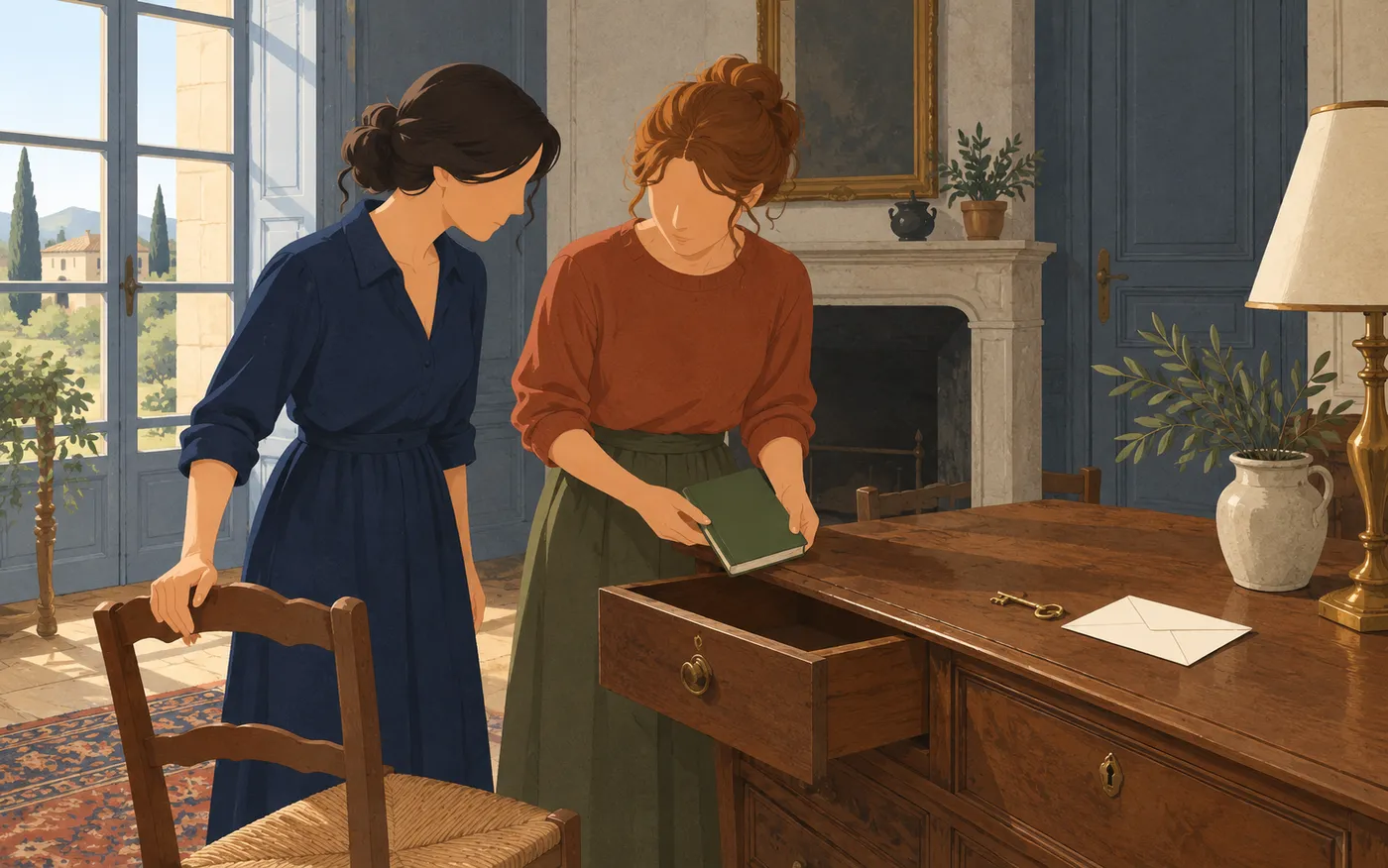
Lucie entra dans le bureau. La pièce était calme, et sa sœur attendait près de la table. Lucie (faire) un signe à sa sœur, puis elle (voir) une clé sous une enveloppe. « Regarde ce que j’ai trouvé », (dire)-elle.
Les deux sœurs (faire) le tour de la pièce. Lucie ouvrit un tiroir avec la clé. Elles y (voir) un petit carnet vert. Sur la première page, leur mère avait écrit leurs prénoms. « C’est son carnet de voyage », (dire)-elles presque en même temps.
Lucie ouvrit le carnet. Elle (voir) un dessin de leur ancienne maison. Sa sœur (faire) un pas vers elle et posa la main sur la page. « Je me souviens de ce jardin », (dire)-elle. Elles restèrent un moment sans parler, puis décidèrent de lire le carnet ensemble.
Read it in English
Lucie entered the study. The room was quiet, and her sister was waiting near the table. Lucie signalled to her sister, then saw a key under an envelope. “Look what I’ve found,” she said.
The two sisters walked around the room. Lucie opened a drawer with the key. There they saw a small green notebook. On the first page, their mother had written their first names. “It’s her travel notebook,” they said almost at the same time.
Lucie opened the notebook. She saw a drawing of their old house. Her sister took a step towards her and put her hand on the page. “I remember that garden,” she said. They remained silent for a moment, then decided to read the notebook together.