Cheat sheet

Prepare journey details in French: dates, stations and the last leg

Build a clear French journey note with departure and arrival dates, a final address and one useful question. Includes an overnight journey check.

In short

Write the departure, the service’s arrival and your final destination on separate lines. Keep a date beside each time, especially overnight. Finish with the question you need answered: Comment aller de la gare au centre ?

Yellow the idea to rememberBlue French to learn

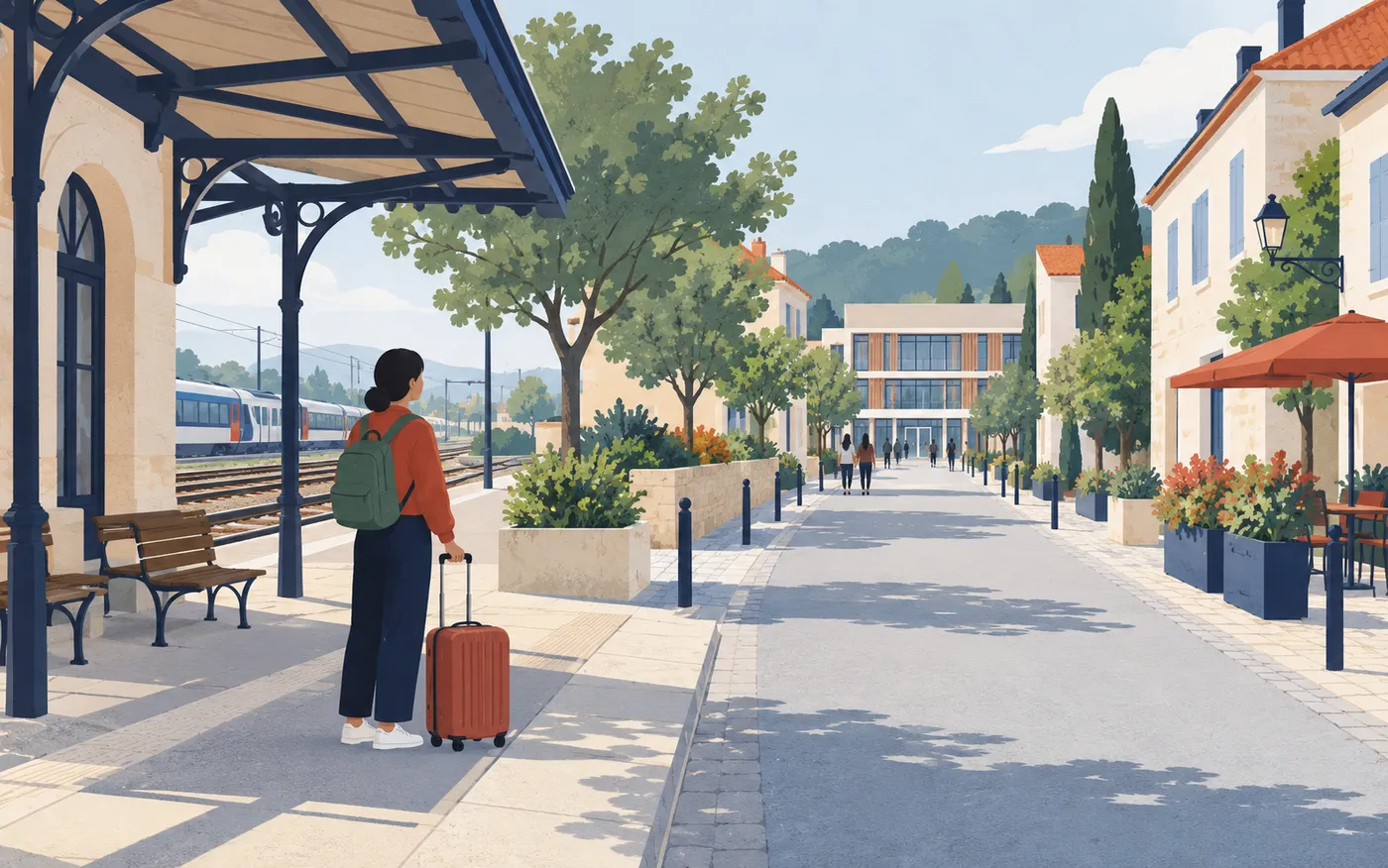
A traveller leaves a railway station and considers the onward walk.
The journey continues from la gare to the final destination. Illustration: Atelier

Ma fiche de voyage

1 · Departure · where and when

Keep the town, date and departure time on one line.

Je pars de Nantes le dix juin à neuf heures.I leave Nantes on 10 June at nine o’clock.

2 · Arrival · name the transport stop

A station or airport is one stage of the journey.

J’arrive à la gare à onze heures.I arrive at the station at eleven o’clock.

3 · Final destination · add the address

Give the place you need to reach and the time you need to be there.

Je dois être au 6, rue des Lilas, à midi.I need to be at 6 Rue des Lilas at noon.

A journey note you can point to

Trip to a training course
LabelYour informationEnglish
DépartClairville, le 12 mai à 12 h 10Clairville, 12 May at 12:10
Arrivée du trainGare de Montfleur, le 12 mai à 13 h 40Montfleur station, 12 May at 13:40
Destination finaleCentre de formation, 8 rue du ParcTraining centre, 8 Rue du Parc
Heure du rendez-vousLe 12 mai à 14 heures12 May at 14:00
À vérifierLe trajet entre la gare et le centreThe journey from the station to the centre

Four things to identify on the journey

À l’accueil de la gare
  1. Vous

    Bonjour. Mon train arrive à Montfleur à treize heures quarante. Je dois être au centre de formation à quatorze heures.

    Hello. My train arrives in Montfleur at 13:40. I need to be at the training centre at 14:00.

  2. Employée

    Vous avez l’adresse ?

    Do you have the address?

  3. Vous

    Oui, c’est au huit, rue du Parc. Comment y aller depuis la gare ?

    Yes, it’s at eight Rue du Parc. How do I get there from the station?

  4. Employée

    Je vais regarder le plan avec vous.

    I’ll look at the map with you.

The note gives a twenty-minute gap between the train’s arrival and the appointment. The question asks how to cover the final leg. Arrivée du train and heure du rendez-vous make the two times easy to find.

How do you give journey dates in French?

A separate overnight example
EventDate and timeSay it aloud
DépartLe 12 mai à 23 h 40Le douze mai à vingt-trois heures quarante.
ArrivéeLe 13 mai à 1 h 10Le treize mai à une heure dix.

Le départ est prévu le douze mai au soir, et l’arrivée le treize mai, après minuit.

The departure is scheduled for the evening of 12 May, and the arrival for 13 May, after midnight.

Prévu means scheduled or planned. Pair it with the event: le départ prévu, l’arrivée prévue. In the overnight example, the arrival date changes even though the journey is short.

Check your own note

Before asking for travel help

  • I have kept each departure and arrival beside its date.
  • I have written the station name and the final address separately.
  • I have labelled the appointment time.
  • I have written one question about the missing leg.
Question 1No account needed
For the training-course trip, when must the traveller be at the centre?

Choose one answer.

Answer and explanation

At 14:00.. The appointment is at 14:00. The 13:40 time is the train’s arrival at the station.

Question 2No account needed
In the separate overnight example, what is the arrival date?

Choose one answer.

Answer and explanation

13 May.. The train leaves late on 12 May and arrives after midnight on 13 May.

Question 3No account needed
Which line marks information that still needs checking?

Choose one answer.

Answer and explanation

À vérifier : le trajet entre la gare et le centre.. À vérifier labels the remaining question: the route from the station to the centre.