Gap-fill
Quelqu’un or quelque chose? A French moving-day gap-fill
Choose someone or something in a moving-day story. Practise singular verbs, qui and que, then check what you understood with three questions.
- A2
- 6 gaps
- Translation included
- Learn this in the A2 notebook →
In short
Quelqu’un means “someone”; quelque chose means “something”. Both take a singular verb: Quelqu’un arrive. Quelque chose manque. You can use them in questions too: Tu attends quelqu’un ? asks whether you are waiting for someone.
Yellow the idea to rememberBlue French to learn
quelqu’unsomeone
Focus: A person whose name you have not given.
Je cherche quelqu’un qui peut m’aider.
I’m looking for someone who can help me.
C’est quelqu’un que tu connais.
It’s someone you know.
quelque chosesomething
Focus: An object, detail, event or idea you have not named.
Je cherche quelque chose qui fonctionne.
I’m looking for something that works.
Quelque chose a changé.
Something has changed.
The choice between qui and que answers a different question. In quelqu’un qui peut m’aider, the person is the subject of peut. In quelqu’un que tu connais, tu is the subject and the person is the object of connais. A thing can also be a subject: quelque chose qui fonctionne.
The moving-day objects
Find:
Complete the story: person or thing?
Fill each gap with quelqu’un or quelque chose. Read the whole sentence: a person can knock or offer help; an unnamed object can be left in a box. The English translation stays available below the story.
Le premier soir dans l’appartement
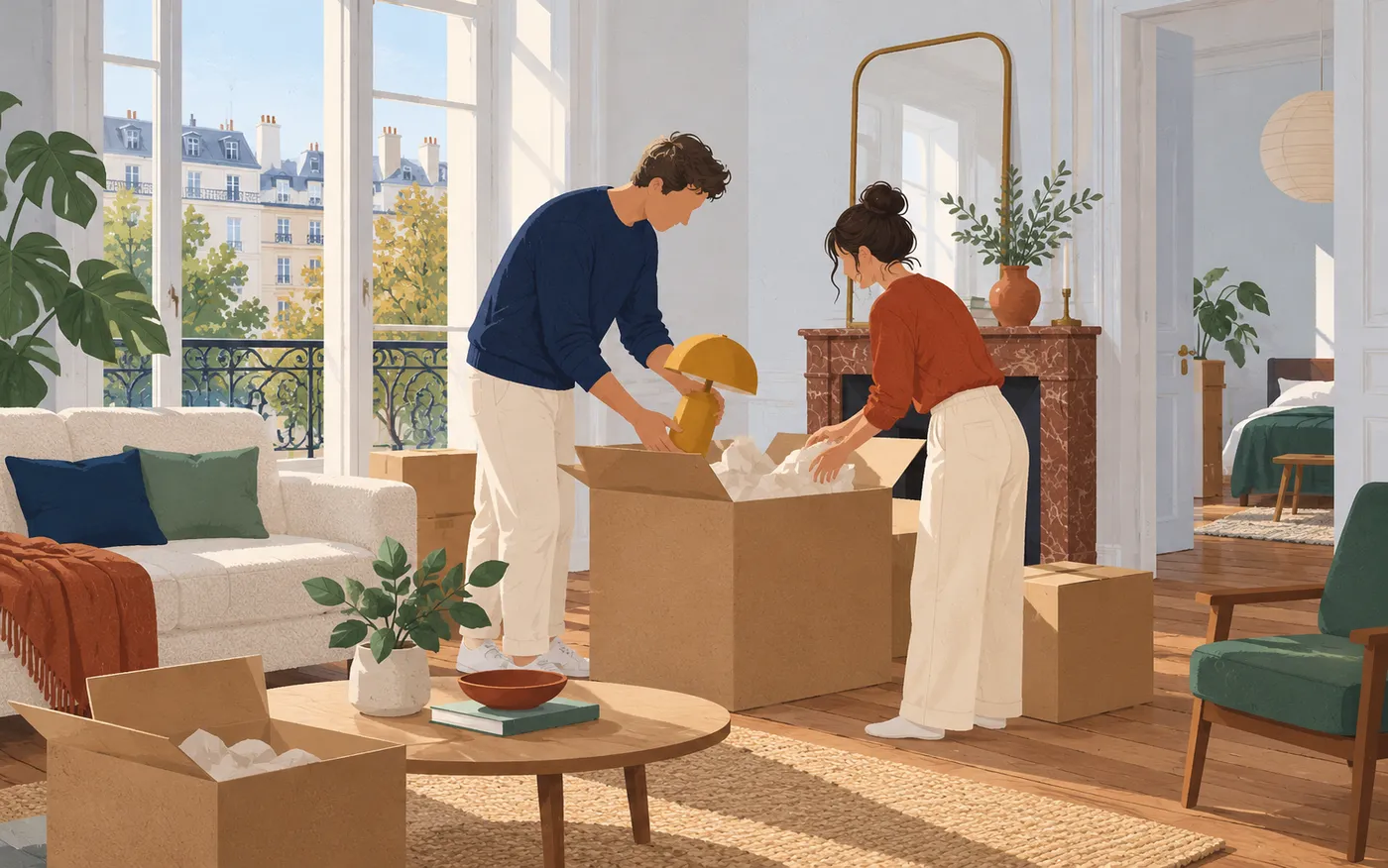
Lina ouvre le dernier carton. Il reste (something) au fond : une petite lampe jaune. Elle la branche, mais rien ne se passe. « Je connais (someone) qui peut la réparer », dit Hugo.
On frappe à la porte. « Tu attends (someone) ? » demande Lina. « Oui, ma sœur vient nous aider. » Elle entre avec une chaise. « J’ai trouvé (something) pour ton bureau ! »
Un peu plus tard, Lina cherche ses clés. « (Someone) a vu mes clés ? » Hugo montre le carton. « Il y a (something) sous la lampe. Regarde ! » Lina retrouve enfin ses clés.
Read it in English
Lina opens the last box. Something is left at the bottom: a little yellow lamp. She plugs it in, but nothing happens. “I know someone who can repair it,” says Hugo.
There is a knock at the door. “Are you expecting someone?” asks Lina. “Yes, my sister is coming to help us.” She comes in with a chair. “I’ve found something for your desk!”
A little later, Lina looks for her keys. “Has anyone seen my keys?” Hugo points to the box. “There’s something under the lamp. Look!” Lina finally finds her keys.