Conjugation table
Venir conjugation: common French tenses, venir de and related verbs
Conjugate venir in seven common tenses, use venir de for the recent past, and compare revenir and devenir with examples and a four-question quiz.
- A2
- 7 tenses
- Auxiliary: être
- Learn this in the A2 notebook →
In short
Venir means “to come”: je viens, nous venons, ils viennent. Its past participle is venu and its compound tenses use être. Add de + infinitive to say what has just happened: Je viens de rentrer.
Yellow the idea to rememberBlue French to learn
- Infinitive
- venir
- Past participle
- venu
- Present participle
- venant
- Auxiliary
- être
Présentcoming now; regular visits
| je | viens |
| tu | viens |
| il / elle / on | vient |
| nous | venons |
| vous | venez |
| ils / elles | viennent |
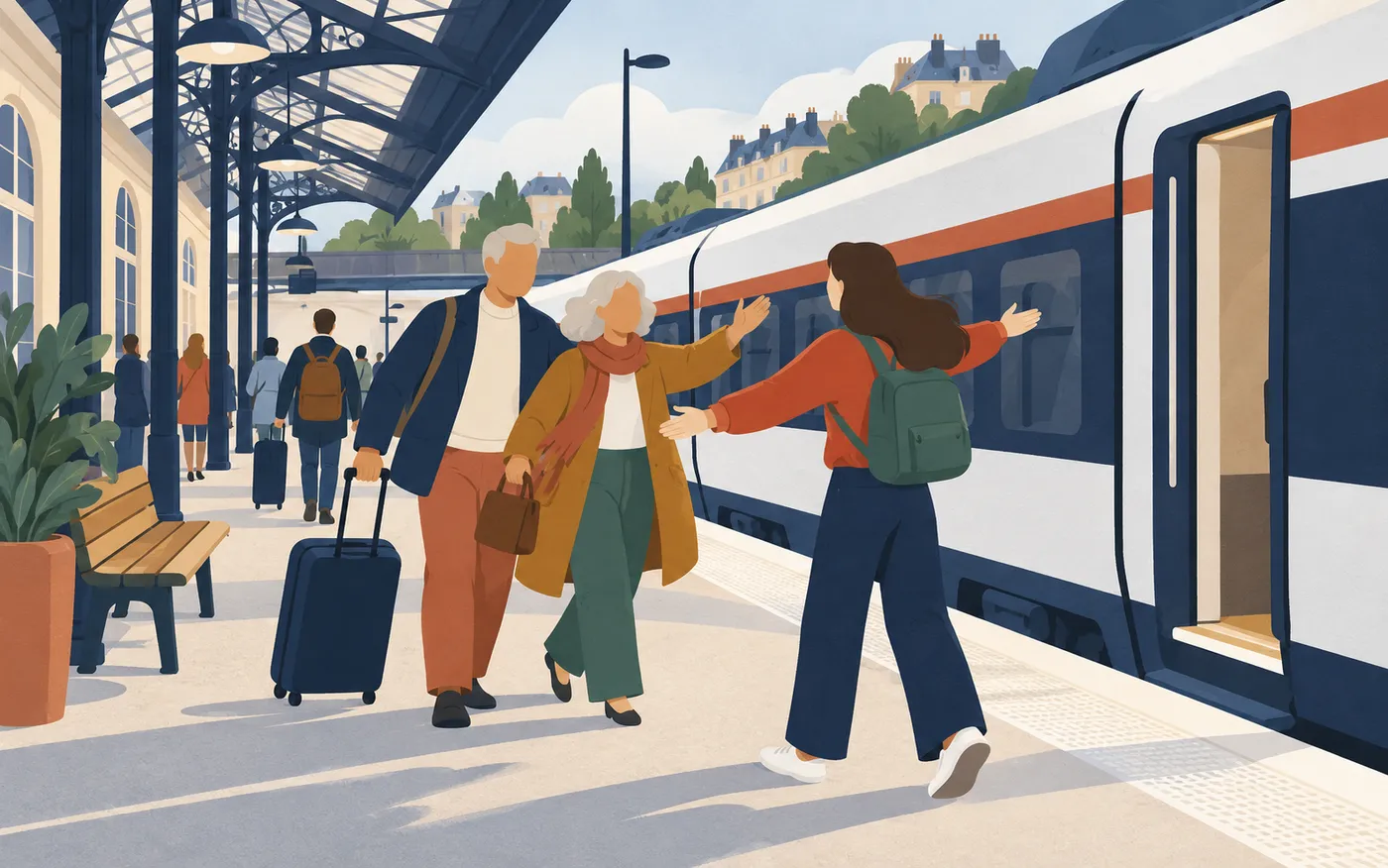
Mes parents viennent en train.
My parents are coming by train.
Passé composéa completed visit or arrival
| je | suis venu(e) |
| tu | es venu(e) |
| il / elle / on | est venu(e) |
| nous | sommes venu(e)s |
| vous | êtes venu(e)(s) |
| ils / elles | sont venu(e)s |
Léa est venue chez nous samedi.
Léa came to our place on Saturday.
Imparfaitpast habits; background
| je | venais |
| tu | venais |
| il / elle / on | venait |
| nous | venions |
| vous | veniez |
| ils / elles | venaient |
Nous venions ici chaque été.
We used to come here every summer.
Futur simplea future visit or arrival
| je | viendrai |
| tu | viendras |
| il / elle / on | viendra |
| nous | viendrons |
| vous | viendrez |
| ils / elles | viendront |
Je viendrai te chercher à la gare.
I will come and pick you up at the station.
Conditionnel présentan imagined visit
| je | viendrais |
| tu | viendrais |
| il / elle / on | viendrait |
| nous | viendrions |
| vous | viendriez |
| ils / elles | viendraient |
Si j’avais le temps, je viendrais avec toi.
If I had time, I would come with you.
Subjonctif présentafter expressions such as vouloir que
| que je | vienne |
| que tu | viennes |
| qu’il / qu’elle / qu’on | vienne |
| que nous | venions |
| que vous | veniez |
| qu’ils / qu’elles | viennent |
Je voudrais que tu viennes dîner.
I would like you to come for dinner.
Impératifan invitation or instruction
| (tu) | viens |
| (nous) | venons |
| (vous) | venez |
Venez avec nous !
Come with us!
Does venir agree in the passé composé?
The brackets in the table show agreement choices. Add -e for a feminine subject and -s for a plural subject. With singular polite vous, use a singular participle. With on, agreement follows the people meant: On est venues for a group of women.
| Subject | Example | Meaning |
|---|---|---|
| Paul | Paul est venu. | Paul came. |
| Léa | Léa est venue. | Léa came. |
| Paul et Léo | Ils sont venus. | They came. |
| Léa et Inès | Elles sont venues. | They came. |
What does venir de mean?
venir de + placeto come from somewhere
Focus: where the journey starts
venir de + noun
Je viens de la gare.
I’m coming from the station.
Elle vient du marché.
She’s coming from the market.
venir de + infinitiveto have just done something
Focus: a recent action
venir de + infinitive
Je viens de réserver un billet.
I’ve just booked a ticket.
Nous venons d’arriver.
We’ve just arrived.
Quand tu as appelé, je venais de rentrer.
When you called, I had just got home.
Use the imparfait of venir for an action just completed at a past moment. Before a vowel, de becomes d’.
How do revenir and devenir conjugate?
| Verb | Present | Future | Completed action |
|---|---|---|---|
| revenir | je reviens / nous revenons | je reviendrai | elle est revenue |
| devenir | je deviens / ils deviennent | je deviendrai | il est devenu |
Ma sœur est devenue professeure. Elle reviendra en juin.
My sister has become a teacher. She will come back in June.
What mistakes do learners make with venir?
- Ils venent demain.Ils viennent demain.
The present plural needs -iennent with ils and elles.
- J’ai venu hier.Je suis venu hier.
Venir takes être. A woman writes Je suis venue hier.
- Nous venons de arrivons.Nous venons d’arriver.
After venir de, keep the next verb in the infinitive and elide de before a vowel.