Gap-fill
French articles gap fill: a crêpe recipe with 12 gaps
Complete a French crêpe recipe with du, de la, des, de and le. Practise quantities, ingredients and known items, with hints and an English translation.
- A2
- 12 gaps
- Translation included
- Learn this in the A2 notebook →
In short
Use du or de la for an unspecified amount, des for an unspecified plural, and de after a quantity. Use le for the particular masculine ingredient already identified. This recipe gives you twelve gaps to practise all five choices.
Yellow the idea to rememberBlue French to learn
| Meaning | Pattern | Example |
|---|---|---|
| an unspecified amount | du / de la | du riz / de la soupe |
| an unspecified plural | des | des pommes |
| a measured amount | quantity + de | un kilo de riz |
| no amount at all | ne… pas de | Je n’ajoute pas de sel. |
| an identified ingredient | le | Le riz est déjà cuit. |
Fill each gap with du, de la, des, de or le. The hints tell you whether to express an unspecified amount or refer to something already prepared. The milk measured in the first paragraph is the specific milk used in the next steps.
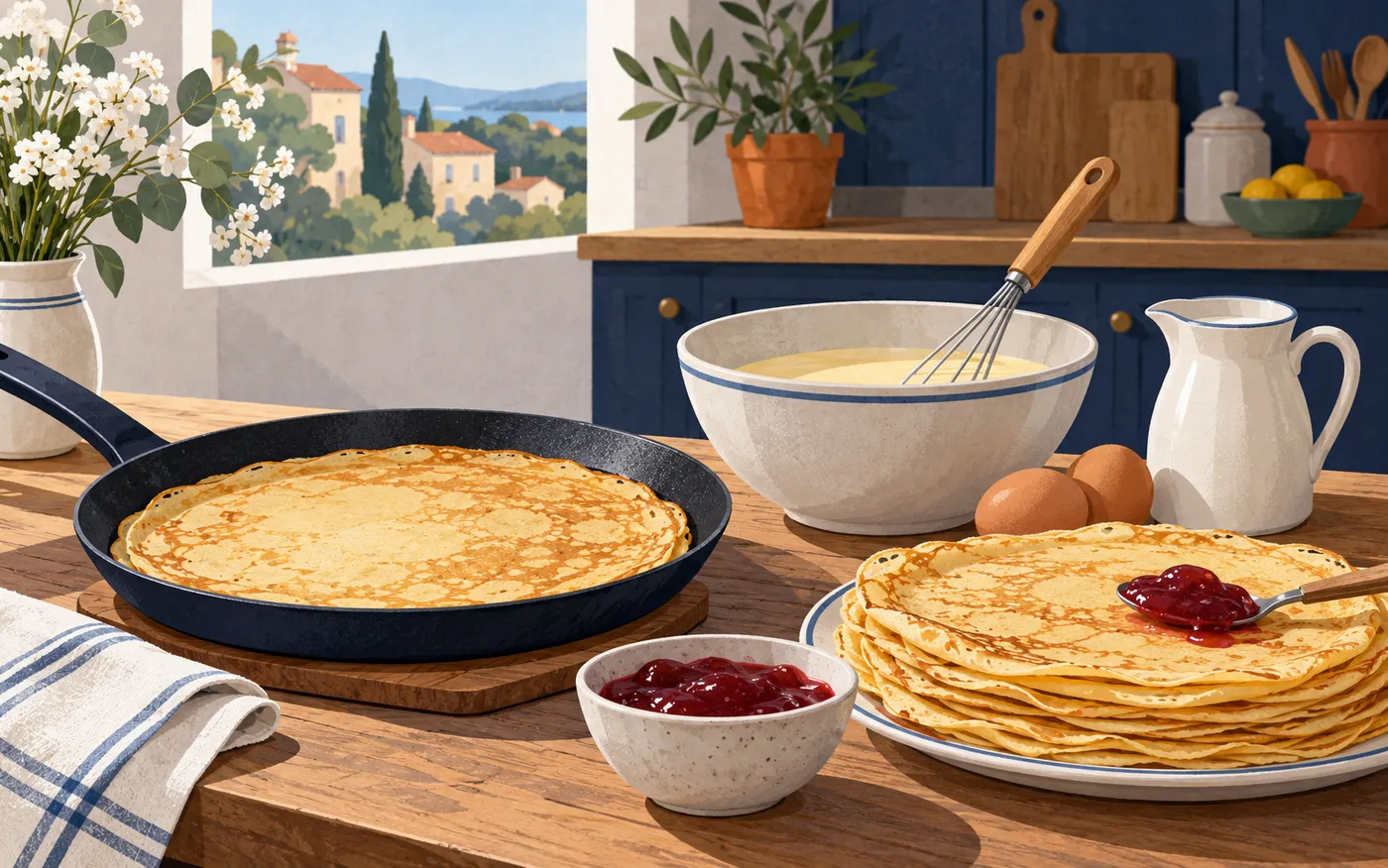
Des crêpes pour quatre personnes
Pour huit crêpes, préparez 250 grammes (après une quantité) farine, un demi-litre (après une quantité) lait et deux œufs. Gardez (lait déjà mesuré) lait près du saladier. Sortez aussi un fouet et une grande poêle.
Versez la farine dans le saladier. Cassez les œufs au centre. Ajoutez une pincée (une pincée…) sel, puis versez (lait déjà mesuré) lait petit à petit. Mélangez avec le fouet pour obtenir une pâte lisse. Si elle est trop épaisse, ajoutez (lait en quantité non précisée) lait. Laissez reposer la pâte pendant trente minutes.
Faites chauffer la poêle. Pour la graisser, utilisez (beurre en quantité non précisée) beurre. Versez une petite louche (une louche…) pâte et inclinez la poêle pour bien la répartir. Faites cuire la crêpe, puis retournez-la avec une spatule. Continuez avec le reste de la pâte.
Pour servir, posez (plusieurs crêpes, nombre non précisé) crêpes sur chaque assiette. Proposez (sucre en quantité non précisée) sucre et (confiture en quantité non précisée) confiture. Aujourd’hui, nous n’ajoutons pas (absence après ne… pas) chocolat. Chacun choisit sa garniture. Bon appétit !
Read it in English
For eight crêpes, prepare 250 grams of flour, half a litre of milk and two eggs. Keep the measured milk near the mixing bowl. Get out a whisk and a large frying pan too.
Pour the flour into the bowl. Crack the eggs into the centre. Add a pinch of salt, then pour in the measured milk a little at a time. Mix with the whisk to get a smooth batter. If it is too thick, add some milk. Leave the batter to rest for thirty minutes.
Heat the frying pan. Use some butter to grease it. Pour in a small ladleful of batter and tilt the pan to spread it evenly. Cook the crêpe, then turn it over with a spatula. Continue with the rest of the batter.
To serve, put some crêpes on each plate. Offer some sugar and some jam. Today, we are not adding any chocolate. Everyone chooses their topping. Enjoy your meal!
Read the cooking instructions
| Instruction | Meaning | Infinitive |
|---|---|---|
| Versez | Pour | verser |
| Mélangez | Mix | mélanger |
| Laissez reposer | Leave to rest | laisser reposer |
| Faites chauffer | Heat | faire chauffer |
| Retournez | Turn over | retourner |
A recipe can use the vous imperative to address the reader: Versez, Mélangez, Laissez. The subject pronoun is left out. For a gentle request at the table, change to a question: Tu peux me passer une assiette, s’il te plaît ?