Picture scene
Départ, arrivée, destination: read a French station timetable
Explore a station, read a simple itinerary and practise départ, arrivée and destination, including a train whose final stop is beyond yours.
- A2
- 8 things to find
- Tap to explore
- Find-it game
- Learn this in the A2 notebook →
In short
Le départ is the departure, l’arrivée is the arrival and la destination is where you are heading. A time after départ tells you when to leave; a city after destination tells you where the train is going.
Yellow the idea to rememberBlue French to learn

At the station: explore, then find each detail
Find:
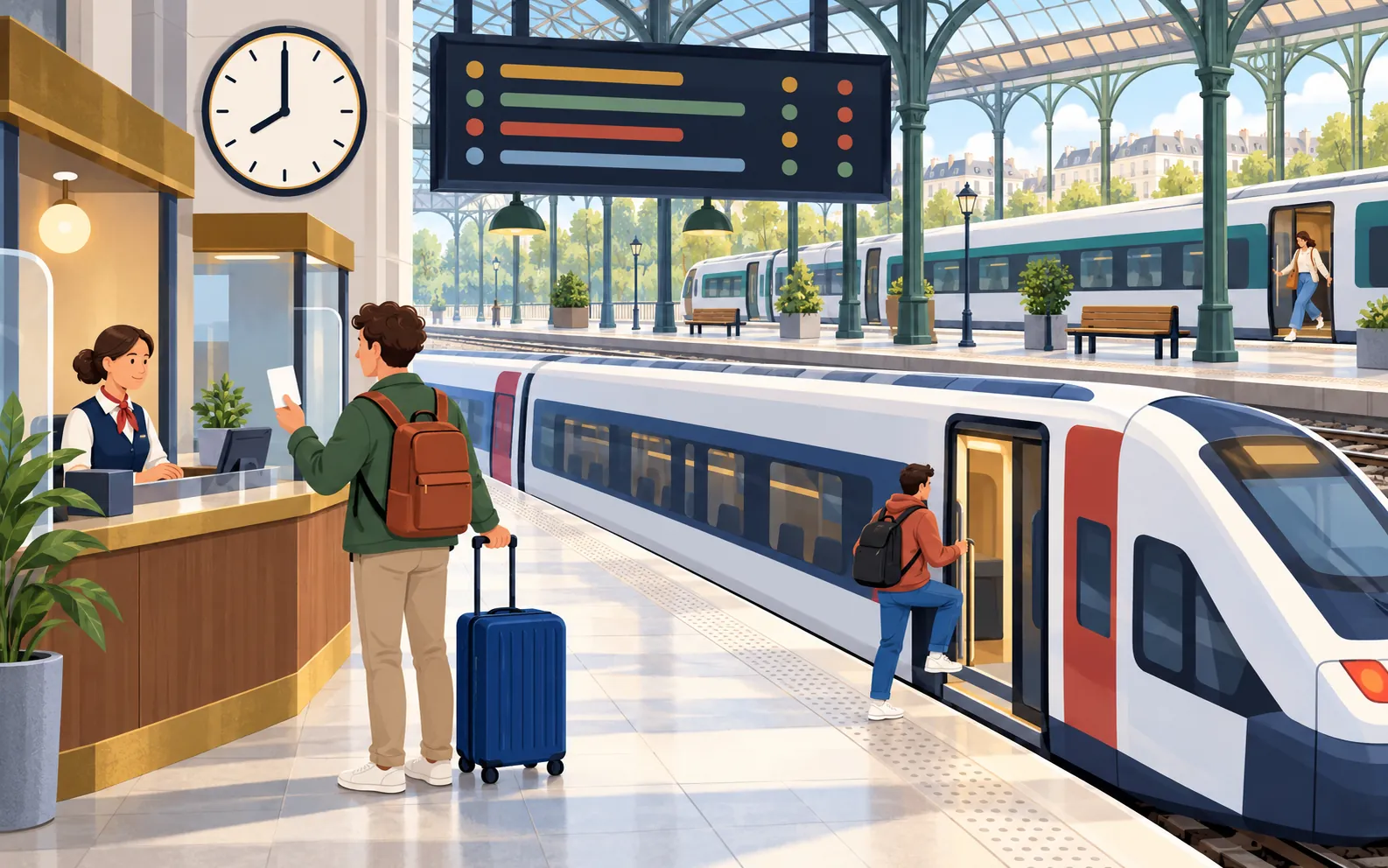
What do départ, arrivée and destination mean on a timetable?
| Label | Detail | Meaning |
|---|---|---|
| Gare de départ | Paris | Starting city |
| Départ | 08 h 10 | Departure time |
| Destination | Lille | City you are travelling to |
| Arrivée | 10 h 30 | Arrival time |
Nous partons de Paris à huit heures dix et nous arrivons à Lille à dix heures trente.
We leave Paris at ten past eight and arrive in Lille at half past ten.
The two times are on the same day. The journey takes two hours and twenty minutes. Notice the genders: un départ matinal (an early departure), une arrivée tardive (a late arrival), une destination lointaine (a distant destination).
The train’s final destination can be beyond your stop
- Voyageuse
Je vais à Amiens. Le tableau indique Lille.
I’m going to Amiens. The board says Lille.
- Agent
C’est la destination finale. Ce train s’arrête aussi à Amiens.
That’s the final destination. This train also stops in Amiens.
- Voyageuse
Merci. Je descends donc à Amiens.
Thank you. So I get off in Amiens.
à destination de Lille means “bound for Lille”. En provenance de Paris means “coming from Paris”. For your own journey, keep your stop alongside the train’s final destination: Je prends le train pour Lille, mais je descends à Amiens.