Gap-fill
French A2 past-tense gap-fill: a cooking lesson ends early
Complete twelve passé composé forms as a cooking student makes a mistake and starts again. Practise reflexive verbs, auxiliaries and agreement.
- A2
- 12 gaps
- Translation included
- Learn this in the A2 notebook →
In short
In the passé composé, reflexive verbs use être: elle s’est préparée. Many other actions use avoir: elle a préparé une soupe. Complete all twelve gaps with the whole past form, including the reflexive pronoun where needed; the learner is a woman.
- Elle a se levé.Elle s’est levée.
Keep se before the auxiliary; it becomes s’ before est. Here the participle agrees with elle.
- Elle a préparée une soupe.Elle a préparé une soupe.
With avoir, the feminine subject alone adds no -e to the participle.
On the worktop
Find:
Le gâteau salé
Samedi, Élise avait son premier cours de cuisine. Avant de partir, elle (se préparer · passé composé) tranquillement. Elle (mettre · passé composé) un tablier dans son sac. Puis elle (se dépêcher · passé composé) pour prendre le bus.
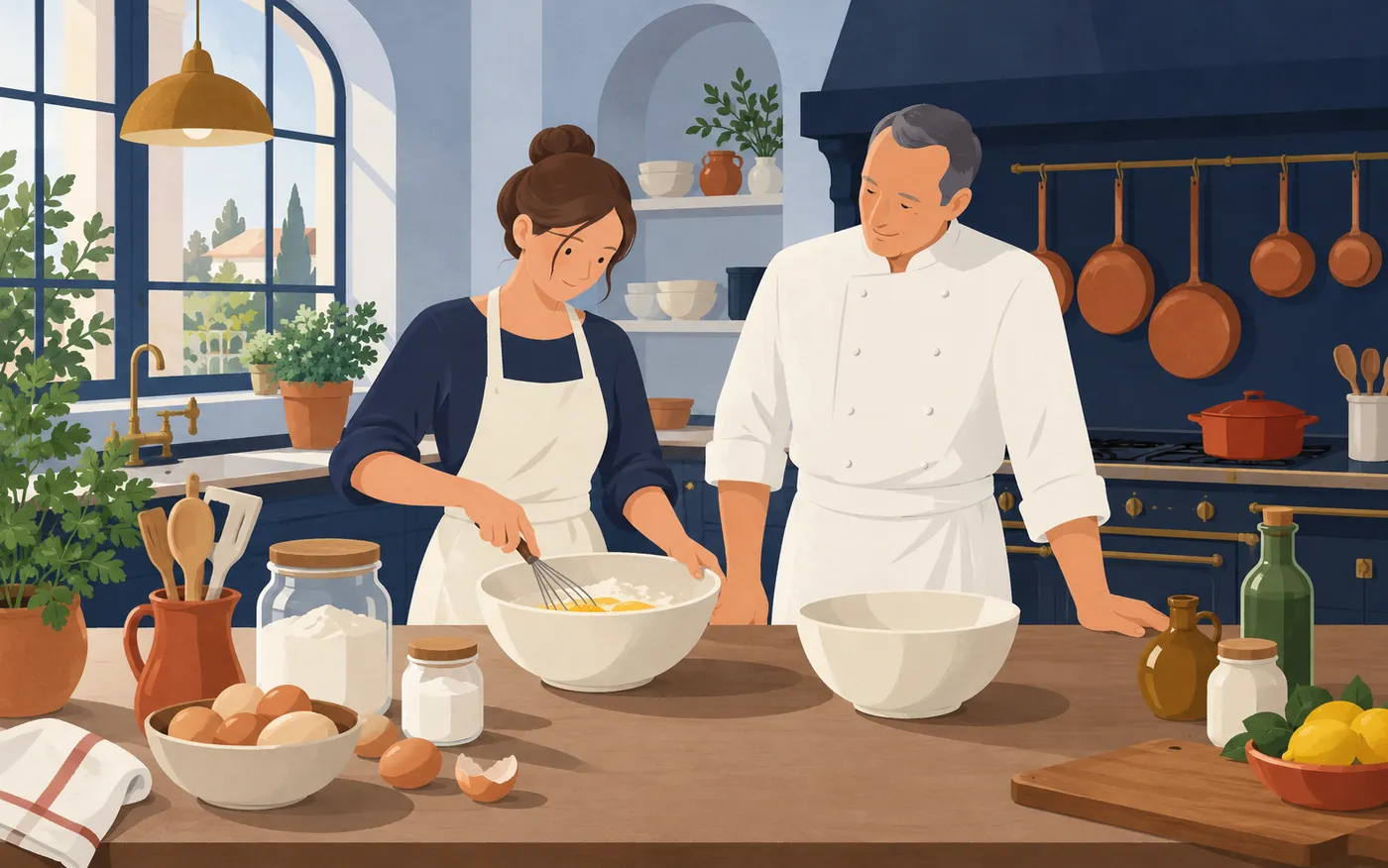
À l’école de cuisine, elle (s’installer · passé composé) près de la fenêtre. Le professeur a présenté la recette. Élise (lire · passé composé) les instructions, puis elle (prendre · passé composé) un grand saladier. Elle (verser · passé composé) de la farine et des œufs dedans.
Ensuite, elle a ajouté trois cuillères de sel. Le professeur a regardé son bol. Élise (se tromper · passé composé) : la recette demandait du sucre ! Elle (s’arrêter · passé composé) pour écouter les conseils. Puis elle (recommencer · passé composé) la préparation dans un autre saladier.
Cette fois, tout allait bien. Mais une coupure de courant a empêché la cuisson : le four ne marchait plus. Le cours (se terminer · passé composé) plus tôt que prévu. Élise (rentrer · passé composé) avec sa préparation dans une boîte fermée pour la faire cuire chez elle.
Read it in English
On Saturday, Élise had her first cooking class. Before leaving, she got ready at a leisurely pace. She put an apron in her bag. Then she hurried to catch the bus.
At the cookery school, she settled in near the window. The teacher introduced the recipe. Élise read the instructions, then took a large mixing bowl. She poured some flour and eggs into it.
Then she added three spoonfuls of salt. The teacher looked at her bowl. Élise had made a mistake: the recipe called for sugar! She stopped to listen to the advice. Then she started the mixture again in another bowl.
This time, everything was going well. But a power cut prevented the baking: the oven no longer worked. The class ended earlier than planned. Élise went home with her mixture in a closed container to bake it at home.