Dialogue
Il y a or y a? Follow a conversation about a new flat
Recognise casual y a as il y a in a conversation about a flat. Practise questions, negatives and “two days ago”, with a picture scene to explore.
- A2
- 12 lines
- Practice mode
- Learn this in the A2 notebook →
In short
Conversational y a /ja/ is a shorter pronunciation of il y a /il ja/. It still means “there is” or “there are”: Y a un balcon ? asks whether there is a balcony. Use il y a in standard writing.
Yellow the idea to rememberBlue French to learnRed watch out

| Casual speech written out | Standard writing | Meaning |
|---|---|---|
| Y a un balcon ? | Il y a un balcon ? | Is there a balcony? |
| Y a pas de jardin. | Il n’y a pas de jardin. | There is no garden. |
| Y a encore deux cartons. | Il y a encore deux cartons. | There are still two boxes. |
| Y a deux jours. | Il y a deux jours. | Two days ago. |
The short opening stays the same for one thing and several things: y a un canapé, y a deux cartons. In a negative, keep listening for pas: y a pas de jardin. In standard writing, restore both il and n’: il n’y a pas de jardin.
- Nora
Alors, ton nouvel appart, il est comment ?
English
So, what’s your new flat like?
- You
Il est petit, mais il est lumineux.
Say the flat is small but bright.
English
It’s small, but it’s bright.
- Nora
Y a un balcon ?
English
Is there a balcony?
- You
Oui, il y a un petit balcon.
Answer yes and say there is a small balcony.
English
Yes, there’s a small balcony.
- Nora
Et dans le salon, y a quoi ?
English
And what’s in the living room?
- You
Il y a un canapé vert et une table basse.
Name the green sofa and the coffee table.
English
There’s a green sofa and a coffee table.
- Nora
Y a un jardin aussi ?
English
Is there a garden too?
- You
Non, il n’y a pas de jardin.
Say there is no garden.
English
No, there isn’t a garden.
- Nora
Tu as déjà toutes tes affaires ?
English
Have you already got all your things?
- You
Presque. Y a encore deux cartons chez ma sœur.
Use the casual opening to say two boxes are still at your sister’s.
English
Almost. There are still two boxes at my sister’s.
- Nora
Tu as emménagé quand ?
English
When did you move in?
- You
Il y a deux jours.
Say you moved in two days ago.
English
Two days ago.
Explore the flat: find the six things mentioned
Find:
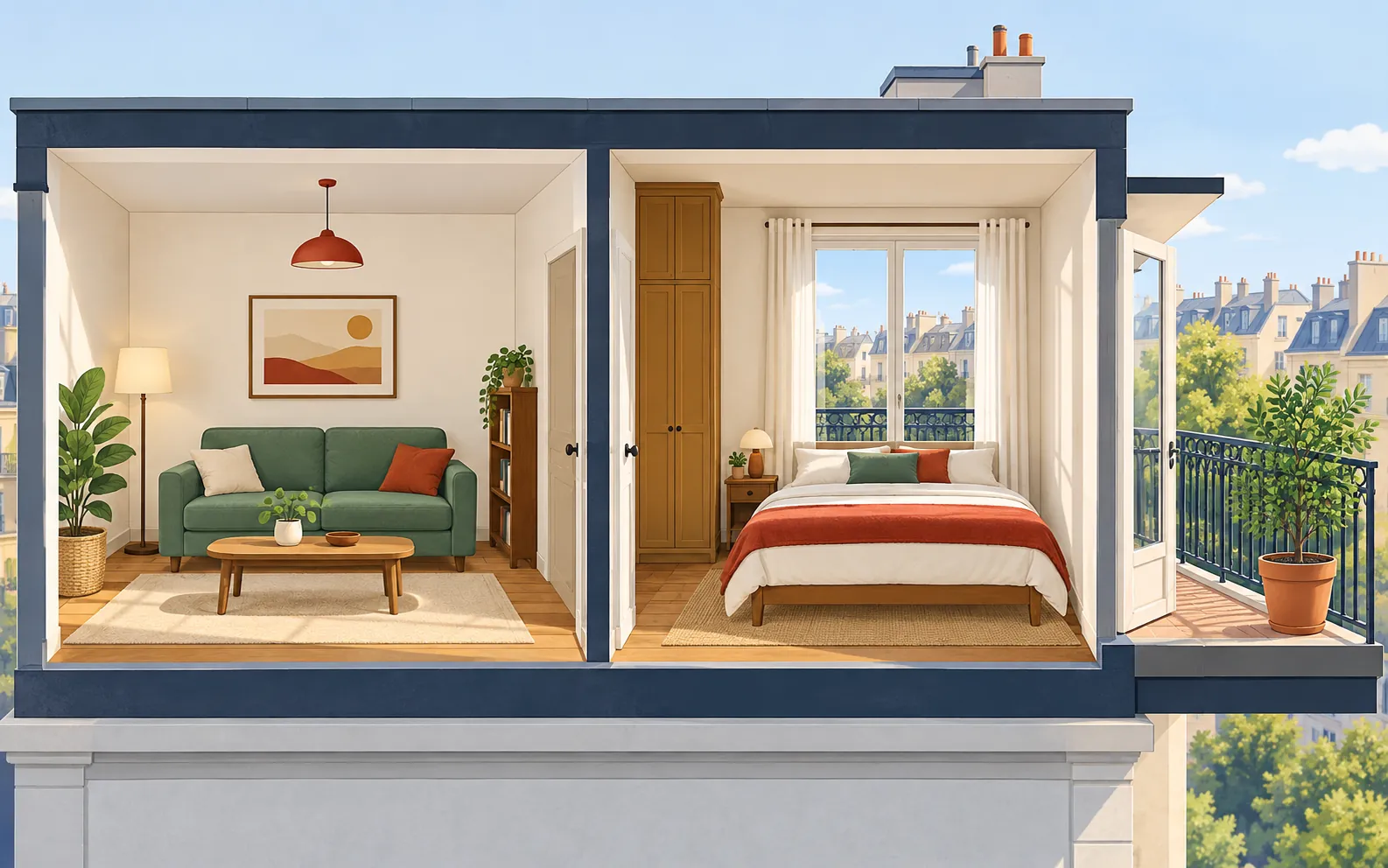
Does il y a mean “there is” or “ago”?
Il y a deux cartons chez ma sœur.There are two boxes at my sister’s.
Focus: Names things that are present.
Y a encore deux cartons chez ma sœur.
There are still two boxes at my sister’s.
J’ai emménagé il y a deux jours.I moved in two days ago.
Focus: Places an event in the past.
Y a deux jours, j’étais encore chez ma sœur.
Two days ago, I was still at my sister’s.
Encore means “still” in the box sentence: the boxes are waiting to be moved. Il y a deux jours gives elapsed time. The same shortened opening can introduce either meaning; the rest of the sentence makes the choice clear.