
Graded story

Track time in a French literary passage: events, background and flashback

Read a meeting scene with four past tenses. Map the previous day, overlapping background and the return to the main sequence, then test the timeline.

In short

Choose the current scene as your anchor. Place earlier completed actions before it, keep overlapping background beside it, and follow explicit time phrases when the scene moves on. Sentence order and event order can differ.

Yellow the idea to rememberBlue French to learn

A visitor entering a rainy office as a director holds a blank letter.
Anchor the narrative in la visite de Léa. Illustration: Atelier

A meeting, an earlier letter and a departure

La visite de Léa

Léa entra dans le bureau à dix heures. Le directeur l’attendait près de la fenêtre. Il tenait une lettre qu’il avait reçue la veille1. Léa la reconnut aussitôt : elle l’avait écrite deux jours plus tôt, après une longue conversation avec sa sœur.

La pluie frappait les vitres. Dès que Léa eut refermé2 la porte, le directeur lui proposa une chaise. Elle s’assit et posa son sac à ses pieds. Pendant quelques secondes, personne ne parla. Puis le directeur demanda pourquoi elle souhaitait partir.

Léa répondit qu’elle avait trouvé un travail dans une autre ville. Elle attendait cette question depuis le début de la visite et avait préparé sa réponse. Le directeur hocha la tête, puis lui rendit sa lettre. Quelques minutes plus tard3, elle quittait le bureau. Dans le couloir, elle s’arrêta enfin pour respirer.

Read it in English

Léa entered the office at ten. The director was waiting for her near the window. He was holding a letter he had received the previous day. Léa recognised it at once: she had written it two days earlier, after a long conversation with her sister.

Rain was beating against the windows. As soon as Léa had closed the door behind her, the director offered her a chair. She sat down and put her bag at her feet. For a few seconds, nobody spoke. Then the director asked why she wanted to leave.

Léa replied that she had found a job in another town. She had been expecting this question since the start of the visit and had prepared her answer. The director nodded, then gave her letter back. A few minutes later, she was leaving the office. In the corridor, she finally stopped to breathe.
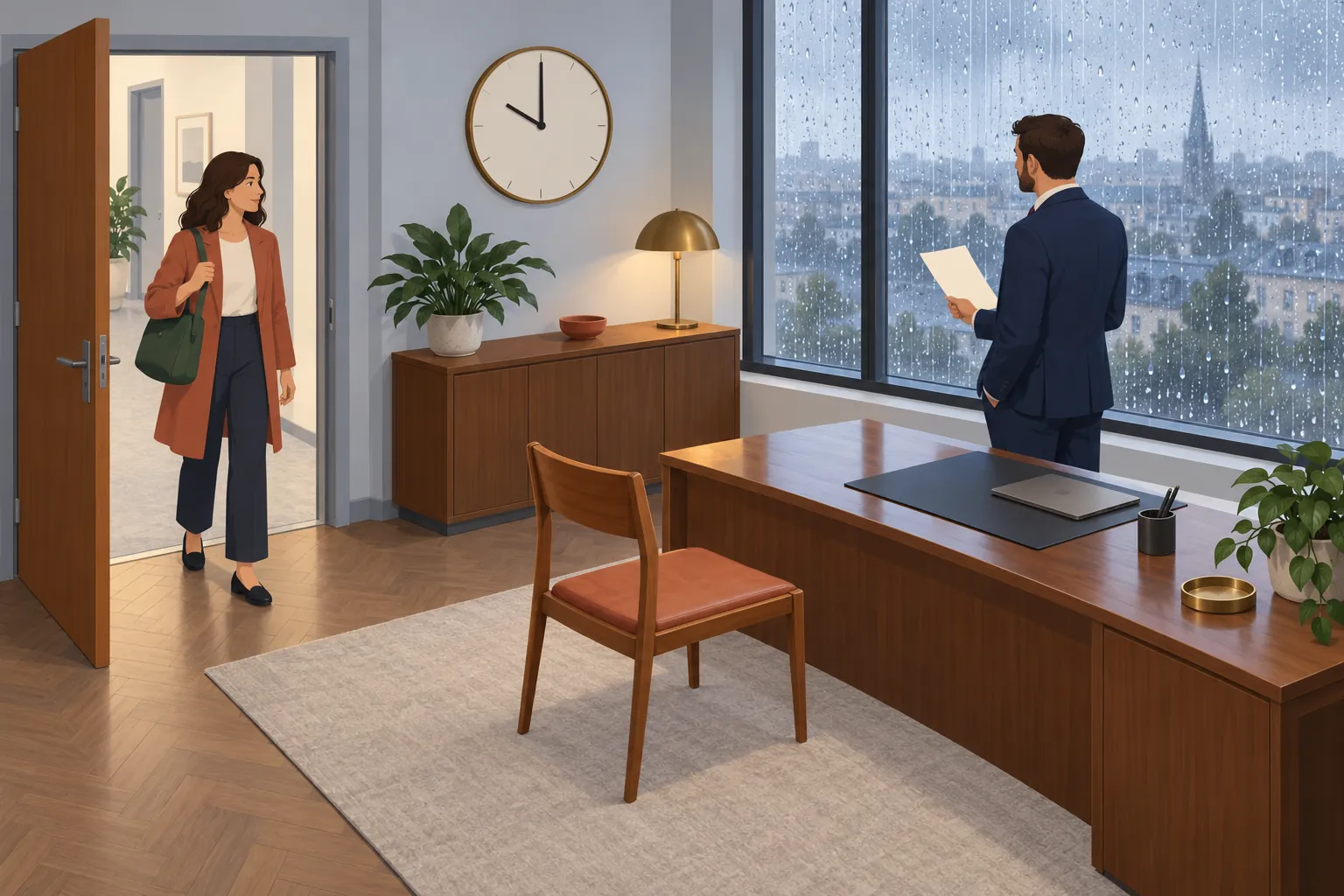
Place the people and objects in the meeting scene

An office during a rainy morning, viewed from slightly above. One female visitor has just come through an open door. A male director stands beside a large rain-

How do you follow time in a French literary text?

A partial timeline: enough to follow the scene
LayerEvidencePlace on the timeline
Two days earlierelle l’avait écriteWriting the letter precedes the visit.
The previous dayqu’il avait reçueReceipt precedes the visit.
The meeting at tenentra / l’attendaitThe entrance occurs during the director’s waiting.
Inside the meetingeut refermé / proposaClosing the door precedes the chair offer.
After the exchangequelques minutes plus tard, elle quittaitThe departure comes later, despite its imparfait form.

The waiting begins before the entrance, but its exact starting time is unstated. The rain surrounds the meeting; its start and finish are also unstated. Elle avait trouvé un travail places the job discovery before her reply, without giving its exact relation to the letter. Leave those boundaries open.

Question 1No account needed
Which event is earliest among these three?

Choose one answer.

Answer and explanation

Léa writes the letter.. The letter was written two days before the visit and received the day before it.

Question 2No account needed
Does l’attendait place the waiting after the entrance?

Choose one answer.

Answer and explanation

No, the waiting is already in progress.. The imparfait presents the director’s waiting as ongoing when Léa enters.

Question 3No account needed
Which event precedes the chair offer?

Choose one answer.

Answer and explanation

Léa closes the door.. Dès que … eut refermé places the completed closing before proposa.

Question 4No account needed
What does elle quittait describe here?

Choose one answer.

Answer and explanation

Her departure a few minutes after the exchange.. The explicit later-time phrase gives this narrative imparfait its place in the forward sequence.

Question 5No account needed
When exactly did Léa find the new job?

Choose one answer.

Answer and explanation

The passage does not give an exact date.. The plus-que-parfait gives earlier completion relative to the report, but supplies no date.

Use this map on another passage

A self-review aid, not a grade. Ticks are not saved.